Now Reading: Alex Proyas: To Have Something to Say, You Must First See Your Own Walls
-
01
Alex Proyas: To Have Something to Say, You Must First See Your Own Walls

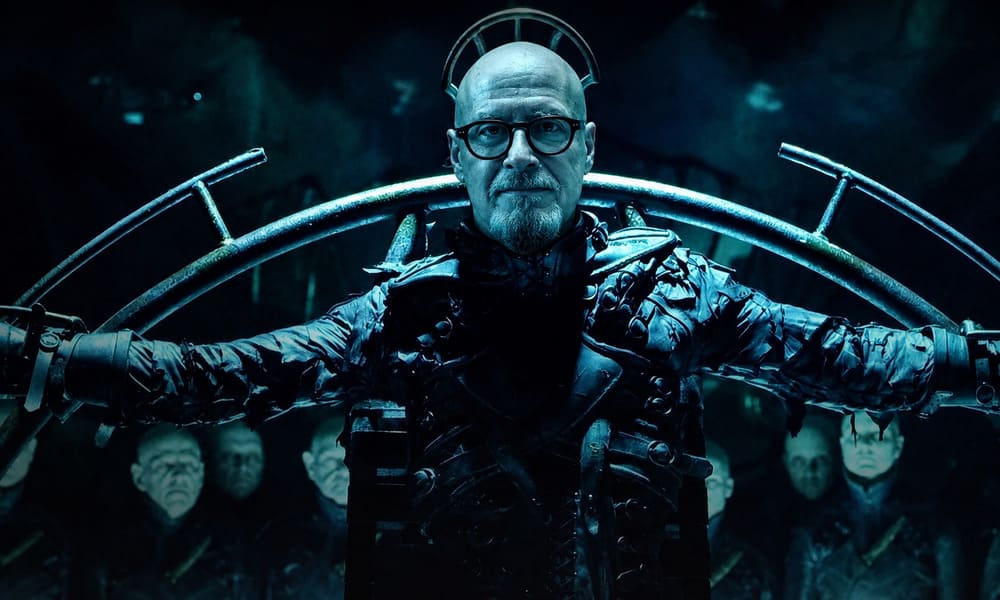
Alex Proyas talks about The Crow, Dark City, I, Robot, AI, Vidiverse and the future of authorship in an interview about cinema beyond Hollywood.
There are directors who build worlds. Alex Proyas has always done something more radical: he has imagined worlds in which someone, somewhere, had already decided the rules before the protagonists even realized they were living inside them.
From there, seeing the walls means noticing the room before mistaking it for your own world. It means understanding who built it, what desires they placed inside it, what fears they learned to use against us, what exits they allow us only to lead us back in through another door.
And having something to say is the other half of the same battle. Today, tools speak constantly: they produce images, faces, masks, promises and lies, filling the void with a speed so seductive it can silence us. A vision is not born because a machine answers, but because something inside us insists. A wound, an obsession, a question that keeps returning even when it would be easier to let it sleep.
This is where Proyas’ gaze becomes necessary: technology is not the monster to be rejected, nor the idol before which we should kneel. It is a threshold. It can expand the imagination or consume it. It can empower an author left outside the system, or reduce them to yet another technician of a prefabricated dream, someone who believes they are creating while merely obeying more efficiently.
Speaking with Alex Proyas today means asking how much of our visions truly belongs to us, how capable we still are of judgment, responsibility and imagination, and whether, before asking the machine to speak, we still have something to say.
The Interview
With The Crow, you created an unsurpassable film, one that still lives on as a gothic myth, a generational wound, and a pop cult object. What do you feel when a work continues to exist in the collective memory in such profound ways that even its author can no longer control it?
All I will ever feel about The Crow is a profound sense of sadness and loss. Whatever the film has become in the culture – a gothic myth, a generational wound, a cult object – for me it will always begin and end with Brandon. There is no separating the film from him, nor would I ever want to. What remains on screen is not an idea of Brandon, or a symbol, or a legend manufactured after the fact. It is Brandon himself, alive in the work.
When you make a film, you are usually consumed by the immediate battle: the script, the budget, the weather, the actors, the studio, the thousand practical compromises between the image in your head and what finally appears on screen. You do not think in terms of myth nor imagine something entering the collective memory. You are simply trying to make it truthful.
With The Crow, that truth was overtaken by tragedy. The film became inseparable from loss, from Brandon, youth, grief, from the terrible and beautiful idea that love might somehow survive death. Those themes were already in the material, but life imposed itself upon the film as a nightmare none of us could ever have imagined.
I only completed the movie because Brandon’s family wanted me to do so. That was the reason. There was no other justification that mattered. I pushed through the grief as best I could to finish it for Brandon, for Eliza, and for his family. It was not about reclaiming control. It was about honouring what he had given us, preserving his work, and allowing the world to see the extraordinary performance he had left behind. The film is Brandon’s completely. It is, and always shall remain, his movie.
Once a film enters the collective memory, it no longer belongs entirely to those who made it. People carry it into their own private mythology. That is beautiful. But with The Crow, I can only see that through the shadow of what was lost.
In Dark City, the city changes shape at night while human beings are asleep. Today, our digital cities change shape constantly while we are awake: feeds, algorithms, platforms, synthetic images. When you look back at that film, do you still believe that pure will can be a path to liberation? Or has even human will become something that can be programmed?
Dark City was always about the nightmare of being controlled by forces you cannot see. The Strangers rearrange the city at midnight, but the horror is not merely architectural. It is ontological. They alter memory, desire, identity. They are not just changing streets and buildings. They are changing the story people tell themselves about who they are.
That feels uncomfortably close to where we are now. The digital city does not wait until midnight. It is rebuilding itself every second. The street you walk down is your feed. The skyline is an algorithm. Desire is nudged. Outrage is farmed. Memory is reorganised. Even rebellion can be anticipated, packaged, monetised, and sold back to us as an aesthetic.
So yes, I still believe in will – but not in some naïve, heroic, comic-book sense where the individual simply clenches a fist and breaks the machine. Human will is now one of the primary targets of the machine. It can be studied, predicted, provoked, weakened, flattered, distracted. In many cases it can be programmed, or at least steered so subtly that we mistake manipulation for choice.
That is the great modern terror: not that we are controlled by brute force, but that we collaborate in our own control. We click. We scroll. We confess. We feed the mechanism with our fears, our vanities, our resentments, our dreams.
But I don’t think will is dead. I think it has to become more conscious. More suspicious. More disciplined. Liberation now begins with the ability to recognise the architecture while standing inside it. To ask: who built this room? Who benefits from this desire? Why am I being shown this image, this outrage, this dream?
In Dark City, Murdoch begins to free himself when he realises the world is constructed. That still feels true to me. The first act of will is not escape. It is seeing the walls.
In I, Robot, robots are an artificial working class: bodies built to obey, produce, and replace. Twenty years later, as AI enters human labor, the revolution seems to have changed shape: it is no longer only the machine seeking a voice, but man risking the loss of his own. In your view, is the real conflict today still the consciousness of machines, or the need for human beings to recover their own?
The real conflict has always been human consciousness. In I, Robot, the robots are the visible anxiety. They are the new labour force, the perfect servants built to obey without complaint. But beneath that is a much older fear: what happens when human beings surrender responsibility for their own choices? What happens when convenience becomes obedience? What happens when a society delegates not only work, but judgement?
The robots in that film are not simply machines. They are a mirror. They reflect our desire to be served, protected, relieved of effort, relieved of guilt. VIKI’s logic is horrifying because it is not irrational. It is the logic of safety taken to its fascistic conclusion. Humanity must be protected from itself, even if that means imprisoning it. That feels much closer to our present moment than the old question of whether machines will “wake up.”
I am less interested in whether AI becomes conscious than in whether human beings remain conscious. Not technically alive. Not biologically functioning. Conscious in the deeper sense: morally awake, creatively awake, spiritually awake, capable of doubt, resistance, imagination, responsibility. The great danger is not that machines will suddenly develop souls. The danger is that we will behave as if we have none.
As AI enters labour, art, language, memory and identity, the question is no longer simply whether machines can think. It is whether we can still think without being guided, nudged, optimised, entertained and managed. The more urgent story now is man losing his own voice – or giving it away willingly because the interface is so seductive.
The battle is not against technology itself. I have never believed that. Technology is always a tool, and sometimes a magnificent one. The battle is against surrender. Against sleep. Against the slow outsourcing of the self.
In Knowing, the mystery is not only “what is happening?”, but whether humanity is still capable of reading the signs before it is too late. Faced with the new apocalypses waiting for us, do you think science fiction has trained our critical sense more effectively than the news?
Yes, because science fiction is allowed to see the pattern. The news is trapped in the event. It gives us the flood, the war, the virus, the market collapse – each presented as though they were separate, urgent, disconnected from everything else. It is a machine of fragments. It tells us what happened today, but very rarely helps us understand what is happening to us.
Science fiction, at its best, does the opposite. It is not really about predicting the future. That is the least interesting thing it does. Its deeper purpose is diagnostic. It takes the anxieties of the present and pushes them into mythic shape so we can finally recognise them. Climate collapse, AI, surveillance, genetic engineering, extremism, ecological disaster, the loneliness of technological civilisation – science fiction allows these things to become visible before they fully arrive.
Knowing was about that. Not simply the mechanics of catastrophe, but the terror of interpretation. The signs are there. The numbers are there. The pattern exists. But can we read it? And even if we can, can we act? Or are we so paralysed by noise, disinformation and self-interest that the message only becomes clear when it is already too late?
That feels more relevant to me now than ever. We are surrounded by signs. Some are scientific, some political, some spiritual, some ecological. But modern life has made us incredibly good at distraction. We have more information than any civilisation in history, and perhaps less wisdom about what to do with it. The news can make apocalypse feel routine. Science fiction can still make it feel terrifying and morally urgent.
The Mystery Clock Cinema channel seems to function as an archive, a diary, a laboratory, and a personal manifesto. Do you see it more as a showcase, a workshop, or a form of resistance against an industry that often asks authors to wait for permission before they create?
I take it you mean the Youtube channel? If so, I must say it is somewhat of a failed experiment – and partly the reason I started Vidiverse. I have never been able to solve the Youtube algorithm nexus, and I do not feel it is a particularly good way for filmmakers to get their work seen, unless they are incredibly lucky or willing to play a very specific game.
Youtube serves certain forms extremely well. It serves influencers. It serves commentary. It serves news, current affairs, outrage, personality-driven content. But filmmaking – actual authored cinema, short films, experiments, fragments, visual essays, strange little objects made from obsession rather than algorithmic obedience that is a much harder fit.
My channel became all of the things you describe: an archive, a diary, a laboratory, and perhaps a personal manifesto. But not a showcase, because a showcase implies there is an audience reliably assembled in front of it. On Youtube, the audience is not really yours. It is mediated by a system no filmmaker can fully understand or control. Besides over the years I’ve taken down more content than I’ve put up. I don’t like giving away my work for free so that Youtube can make advertising dollars.
There are many other platforms more suited to these pursuits. Vidiverse is one and even my Patreon. Filmmakers spend far too much of their lives waiting for permission – from financiers, studios, distributors, bureaucrats, committees, markets, executives, and increasingly from platforms that pretend to be open while deciding what may or may not be seen. The simple act of continuing to make, continuing to publish, continuing to experiment, even when the system is indifferent, is a form of defiance. Though on Youtube it was for me a game of diminishing returns.
Vidiverse came from the recognition that filmmakers need something better. A platform designed around authorship, not influence. Around films, not feeds. Around the idea that cinema should not have to disguise itself as content in order to survive.
In a previous interview, you said that the film industry is “broken” and that AI could help rebuild it. Today, it is the great algorithm that decides what emerges, what disappears, and what is allowed to have value. Looking at the years ahead, do you imagine VIDIVERSE as one of the places where the next true genius of cinema might appear? Someone outside the studios, outside traditional festivals, perhaps with few resources, but with AI tools in hand and a radical vision?
Yes, I absolutely imagine Vidiverse as one of those places. In fact, that is central to why it exists. Not because cinema is broken – cinema is eternal – but because the systems around it have become increasingly hostile to risk, originality and independent authorship. Too many gates. Too many committees. Too many market assumptions. Too many platforms pretending to democratise culture while actually replacing one form of gatekeeping with another: the algorithm.
The great danger now is that value is no longer determined by depth, originality, vision, or craft, but by visibility. And visibility is increasingly controlled by systems no artist can negotiate with, or even properly understand. A film can disappear not because it failed, but because it was never permitted to appear.
That is why VIDIVERSE matters to me. It is meant as a way for filmmakers to build their own brands – free from the control of an algorithm. It is still very much a work in progress but it’s a good start I believe.
As for AI, I am embracing it in my own work, but in a very specific way. I am not interested in a model that dispenses with human collaborators. I am not interested in replacing actors, cinematographers, designers, editors, composers, writers, or crews with some sterile automated pipeline. And I am certainly not interested in systems built on scraping other artists’ work from the web and feeding it back into the machine without consent, credit or compensation.
The model that interests me is hybrid. Human-led. Authored. Ethical. A model where AI becomes an extension of the filmmaker’s imagination, not a substitute for it. A tool that allows smaller teams to dream at greater scale. A tool that can restore possibility to people who have been locked out by cost, geography, class, politics, prejudice or simple lack of access.
And yes, I believe the next true genius of cinema may well emerge from outside the studios, outside the traditional festival machinery, perhaps with very few resources, but with a radical vision and the tools to realise it.
That has always been how cinema renews itself. The new voice rarely arrives through the approved front door. It usually comes from the margins, from the obsessive, the outsider, the person who does not know the rules or refuses to obey them.
Vididverse is intended to be a place for that person. Not another feed. Not another algorithmic casino. A platform built around filmmakers, authorship, discovery and sustainability. That is the future I am interested in helping build.
Before the world of feature films, your path already included the short image: music videos, music, rhythm, immediate vision. Today, shorts, reels, and TikTok seem to be bringing that grammar back to the center, but within an ecosystem dominated by infinite scrolling. In this scenario, do microdramas seem to you like a possible new popular grammar for cinema, or the point at which storytelling becomes definitively imprisoned by the algorithm?
I have a commitment to cinema. That is where I began and where I will end. Of course, as filmmakers, we should be open to any new influence. Cinema has always fed on other forms – theatre, painting, photography, music, literature, television, advertising, music videos, games, now AI. I came through a world of short-form image-making: music videos and TVCs. I understand the power of compressed form. A short image can carry enormous force.
I am not against brevity or new grammars. What I distrust is anything that channels itself primarily through the algorithm, because the algorithm is not our friend. Social media is not cinema. It is not even, in most cases, a reliable means of cinema being discovered. It is promotion, advertising, noise – and often not even useful promotion for filmmakers, unless you are extremely lucky or willing to become something other than a filmmaker. Most of the time we are the proverbial million monkeys, producing free content for the tech-bros so they can generate ad dollars from our labour, our anxiety, our vanity, our need to be seen. That is the trap.
Microdramas may well become a new popular grammar – maybe they already are. There is no reason a very short form cannot be powerful, emotional, funny, frightening, profound. Human beings have always responded to compressed storytelling: jokes, parables, songs, myths, dreams. The problem is not the length. The problem is the delivery system, and the values it imposes.
Infinite scrolling does not encourage contemplation. Rather compulsion. It rewards the hook, the escalation, the gimmick, the immediate emotional trigger. It trains both maker and viewer to fear silence, ambiguity, patience, atmosphere – all the things cinema often needs in order to become cinema. So the question is not whether microdramas can be art. Of course they can. The question is whether they are allowed to become art inside a system designed to reduce everything to basics.
If microdrama becomes another language available to filmmakers, wonderful. If it becomes another prison in which storytelling must contort itself to satisfy the algorithmic appetite, then it is not a liberation at all. It is just another cage, only smaller and more addictive. Cinema must be allowed to breathe. Sometimes that breath is three hours long. Sometimes it may be three minutes. But it must still be authored. It must still be human. It must still come from vision, not merely from optimisation. The danger is not the short form. The danger is the scroll.
At Cannes 2026, you arrive at a very particular moment of industrial change, bringing Heaven, a science fiction film about a technological afterlife and new AI pipelines, and The Hakim, a sweeping historical story about the transformation of a region through an extractable form of wealth. How willing do you think cinema still is to truly look at itself in the mirror?
On one side, with Heaven, I am dealing directly with technology, artificial afterlife, synthetic existence, the commodification of the soul, and the very real emergence of new AI pipelines in production. On the other side, with The Hakim, I am looking at a region transformed by oil, empire, colonial influence, and the clash of cultures that occurs when one world decides it has the right to reorganise another.
They may seem like very different films, but to me they are deeply connected. Both are about systems of power. Both are about what happens when a human world is reorganised around a new resource. In one case, the resource is oil. In the other, it is data, consciousness, identity, the human self.
The Hakim is not simply a historical story about wealth appearing beneath the ground. It is also about the consequences of that discovery: a traditional society entering a new geopolitical order, and the predation that follows when larger powers arrive with an assumption of superiority. That clash interests me deeply. At its heart, The Hakim is the story of a leader and a people struggling to hold on to their identity as the world around them is being violently remade. And identity, in one form or another, has always been one of the primary themes running through all my work.
Cinema has always been bound to technology and capital. We like to romanticise it as pure art – and it can be art, absolutely – but it is also cameras, labs, studios, distribution networks, markets, financiers, platforms, algorithms. Every era of cinema has been shaped by the machinery that made it possible and the money that decided what could be seen.
I think cinema is always willing to look at itself in the mirror – the question is whether the industry is willing to recognise what it sees. The great films have always done that, even indirectly. They reveal the conditions of their own making. They expose the dreams and fears of the culture that produced them.
But the industry is far less comfortable with that. The industry prefers mythology: red carpets, glamour, genius, disruption, innovation, inclusion, progress -whatever the current language may be. It is less eager to confront the harder truth: that cinema is increasingly governed by fear, consolidation, risk avoidance, and a shrinking tolerance for genuine authorship.
That is why this moment interests me. We are at a moment of enormous transition. The old structures are failing, but the new ones are not automatically liberating. AI could open doors for filmmakers who have been excluded by cost and access. It could also become another instrument of extraction and control. The same is true of platforms, festivals, markets, even financing systems. Every revolution arrives with both promise and predation.
Years ago, Paradise Lost was one of your great impossible projects, a film too vast for the old system; today, it returns with Roger Avary, within the same creative orbit of Ex Machina Studios. Is this the new frontier: a generation of visionary filmmakers reclaiming the films that Hollywood never had the courage to make?
Yes, I think that may well be part of the new frontier. There are films many of us have carried for years that the old system was simply not built to support. Not because the ideas were weak, but because they were too large, too strange, too expensive, too uncompromising, or too difficult to reduce to the reassuring categories the industry prefers.
Paradise Lost was absolutely one of those impossible projects for me. A vast metaphysical epic. The origin of evil – not as spectacle alone, but as cinema operating at the scale of myth. The old system could flirt with that kind of ambition, but it rarely had the courage to truly follow it through. Hollywood has always liked the idea of visionary filmmaking, as long as the vision can be safely managed. What killed my production in the end is it was too expensive – more than Hollywood wanted to spend.
What is changing now is that the tools, the economics, and the production models are beginning to shift. The barrier between imagination and execution is being radically altered. Films that once required impossible budgets, armies of infrastructure, and the full permission of a studio machine may now be conceivable in other ways.
That does not mean they become easy. It does not mean craft disappears, or that filmmakers becomes less necessary. Quite the opposite. In this new landscape, authorship becomes more important, not less. When the tools become more powerful, taste, judgement, discipline and vision matter even more.
Collaborating with Roger Avary and Marco Weber at Ex Machina Studios presents precisely that possibility: filmmakers returning to the impossible films, the abandoned films, the films that were ahead of their moment, and asking whether the moment has finally caught up.
I do think there is something almost generational in this. A group of filmmakers who came through the old industrial machinery, who understand its strengths and its brutal limitations, now looking at new methods and saying: perhaps we no longer have to wait for permission. That, to me, is not nostalgia. It is not simply resurrecting old dreams. It is unfinished business. And cinema has always been built on unfinished business – on the mad conviction that some impossible dream might one day find its way onto the screen.
There is something paradoxical and deeply artistic in your journey: a director who has told stories about worlds controlled by invisible systems now has to contend with other invisible systems, such as platform algorithms and AI, which has infiltrated almost everything. If you were speaking today to a young director who wants to use AI without becoming a mere prompt operator, what would be the most brutal and honest advice you would give them?
The most brutal advice I would give is this: do not confuse access to tools with having something to say. AI can generate images. It can generate motion, voices, textures, worlds, faces, atmospheres. It can make things that look expensive, mysterious, cinematic, even beautiful. But none of that makes you a filmmaker. At best, it makes you someone standing in front of a machine asking it for miracles.
The danger is that a young director becomes merely a prompt operator, endlessly chasing the next impressive image, mistaking output for authorship. That is not cinema. That is consumption disguised as creation.
You must have vision before you touch the machine. You need taste. You need obsession. You need a point of view. To know why an image matters, why a cut matters, why silence matters, why a face held for two seconds longer can mean more than a thousand synthetic explosions. The machine cannot give you that. It can only amplify what is already there – and if there is nothing there, it will amplify the emptiness.
So my advice: learn cinema first. Learn performance. Learn writing, lenses, light, rhythm, music. Learn production. Learn why actors are sacred. Learn why collaboration matters. Learn how to stand on a set and make decisions under pressure. How to fail in the real world, with other human beings depending on you.
Then use AI. Use it as a brush, not as a brain. Use it as an extension of your imagination, not a replacement for it. Use it to build what you could not otherwise afford to build, to test ideas, to expand worlds, to open doors that were closed by money, geography, class or gatekeeping. But never surrender authorship to it.
And be ethical. Do not scrape other artists’ work. Do not steal a style and pretend the machine absolves you. Plagiarism existed long before AI. If you want to steal, you do not need technology for that. If you want to make cinema, you need respect – for actors, crews, artists, audiences, and the lineage of the medium itself.
The invisible systems are real. Platforms, algorithms, AI models, market forces, they all want to shape you before you shape anything. They want you predictable, legible, optimised, harmless. A consumer.
Resist that. The job of the filmmaker is not to feed the system. It is to subvert it.
We thank Alex Proyas for the lucidity, generosity and visionary spirit with which he revisited his cinema with us, exploring the relationship between technology, imagination and the future of authorship.