Now Reading: S1m0ne: Andrew Niccol’s Absolute Simulacrum
-
01
S1m0ne: Andrew Niccol’s Absolute Simulacrum

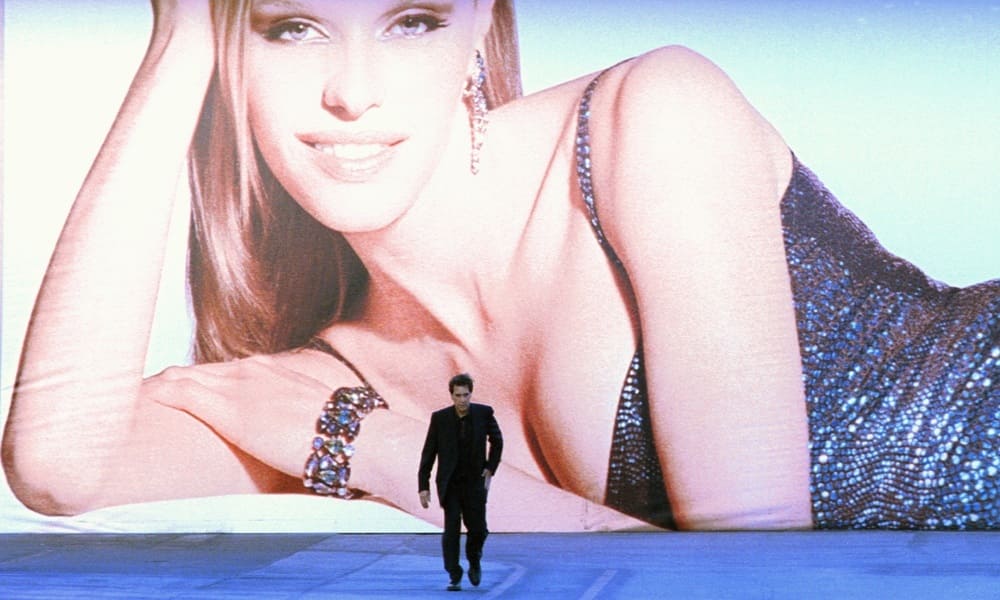
Andrew Niccol delivers a prophetic satire on Hollywood, stardom and synthetic images: in S1m0ne, the fake no longer imitates reality. It replaces it.
Written, directed and produced by Andrew Niccol in 2002, with music by Carter Burwell, S1m0ne casts Al Pacino as director Viktor Taransky, alongside Catherine Keener as his wife Elaine, Evan Rachel Wood as his daughter Lainey, and Rachel Roberts as the superhuman S1m0ne.
Niccol imagined a future in which VFX would no longer be merely a tool of cinema, but its greatest leading star. Today, his prophecy sounds far less like science fiction: just think of the case of Tilly Norwood, the AI actress launched in 2025 and immediately placed, symbolically, at the center of the clash between the Hollywood industry and the SAG-AFTRA union.
In 2002, S1m0ne was an elegant, meta-cinematic satire. In 2026, it describes a world in which the audience applauds artifice and rejects the real, the media turn nothingness into religion, and, beyond any reasonable doubt, the industry prefers synthetic perfection to human imperfection.
Sunrise and Sunset: the life of light and the death of the real
“Simone is a digitized star. Do you know what that means? We have entered a new dimension. Our ability to create the fake now exceeds our ability to detect it.”
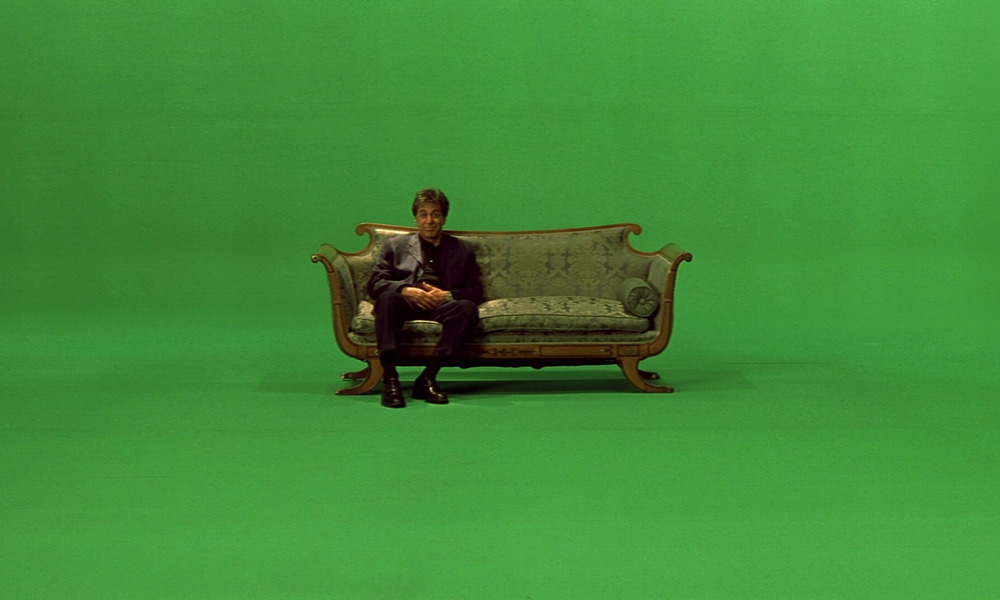
Viktor Taransky, a talented director now marginalized by Hollywood, finds himself without a leading actress for his film Sunrise and Sunset after a falling-out with the temperamental diva Nicola Anders, played by Winona Ryder, the nemesis and explosive alter ego of director Andrew Niccol. The solution comes from visionary programmer Hank Aleno, played by Elias Koteas, who leaves him Simulation One: a piece of software capable of generating a perfect digital actress able to replace the protagonist.
S1m0ne is technically flawless. She has “the voice of a young Jane Fonda, the body of Sophia Loren, the face of Audrey Hepburn combined with that of an angel, and the grace of Grace Kelly”: a new dawn for cinema, one that already contains its ontological sunset. The face ceases to be the meeting point between camera and person, and becomes a calculable surface, manipulable, perfect by definition.
Eternity Forever: the immortal, timeless star
“Simone, we can’t stop now. These films are speaking to the human soul. We are changing lives. People need to believe that you are real.”
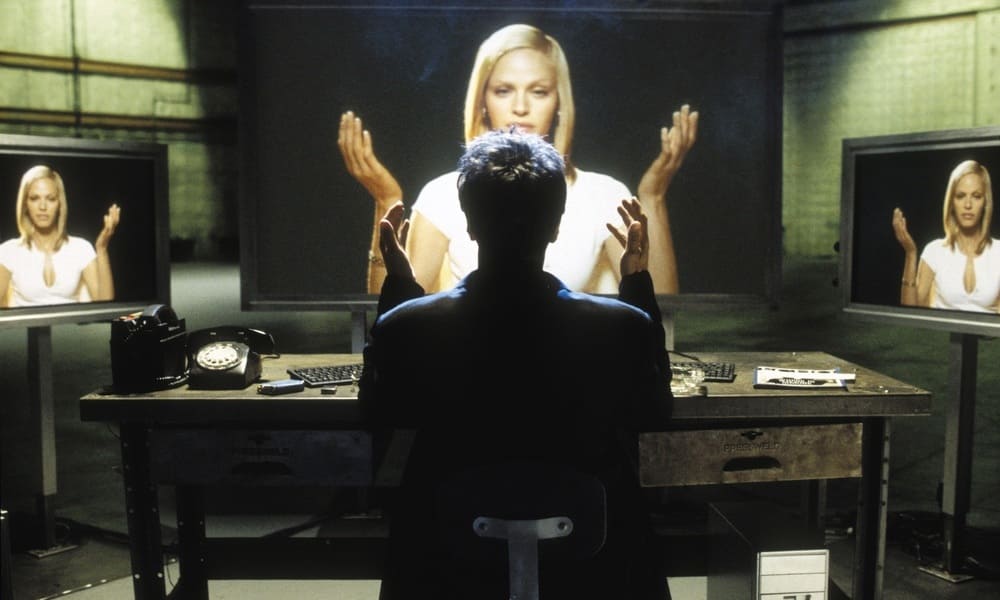
Locked inside his control room, Viktor continues to manufacture interviews, appearances and cinematic performances. Thanks to the film Eternity Forever, the world falls in love with a star no one can truly touch, including the actors she appears with on screen. In her digital perfection, S1m0ne becomes the ultimate realization of the Hollywood dream: an eternal star, forever young, forever equal to the collective fantasy. And unreachable.
Niccol links the character’s success to a very precise idea: the industry no longer desires the extraordinary human being, but a product that remains forever available and controllable, making the real world redundant.
And here one can already glimpse the logic of streaming in relation to the traditional experience of cinema: a timeless archive of presences that can always be summoned, always identical to themselves, removed from the erosion of time and the fragility of the human, capable of inspiring belonging, nostalgia and deepfakes.
Gossip and appearances: the liturgy of S1m0ne
“She’s a computer maniac. She’s severely agoraphobic. She has a morbid fear of people, germs, spaces, heights, and you name it.”
The more famous S1m0ne becomes, the more the film insists on a decisive detail: her public existence is built almost entirely through indirect accounts. Viktor lends her a voice, organizes remote appearances, manipulates the media, fuels curiosity and mystery.
S1m0ne exists not because she is real, but because people talk about her. Gossip, interviews, features, rumors: everything contributes to creating the character.
Niccol shows with great clarity that stardom does not depend on the reality of facts. No one really wants to verify, no one really wants to know, but everyone wants to believe. S1m0ne becomes more powerful the more distant, intangible and elusive she remains. Fame is only the product of media repetition.
Beneath the surface, the logic of reality TV and livestreaming already emerges: what matters is no longer that a person does something extraordinary, but that they are observed, commented on and monitored inside a continuous flow of attention and monetization.
The pop star in concert: the Avatar as media theophany
“It’s easier to make a hundred thousand people believe something than one person.”
The suggestive Sanskrit etymology of “avatāra” refers to the descent of the divine onto earth, its temporary incarnation in a visible and bodily form in order to restore “dharma,” the cosmic order fractured by reason. In the film, the imbalance is represented by the persistent detective Max Sayer, played by Pruitt Taylor Vince, an inquisitorial figure who continues to demand material proof, a body, a verifiable presence.
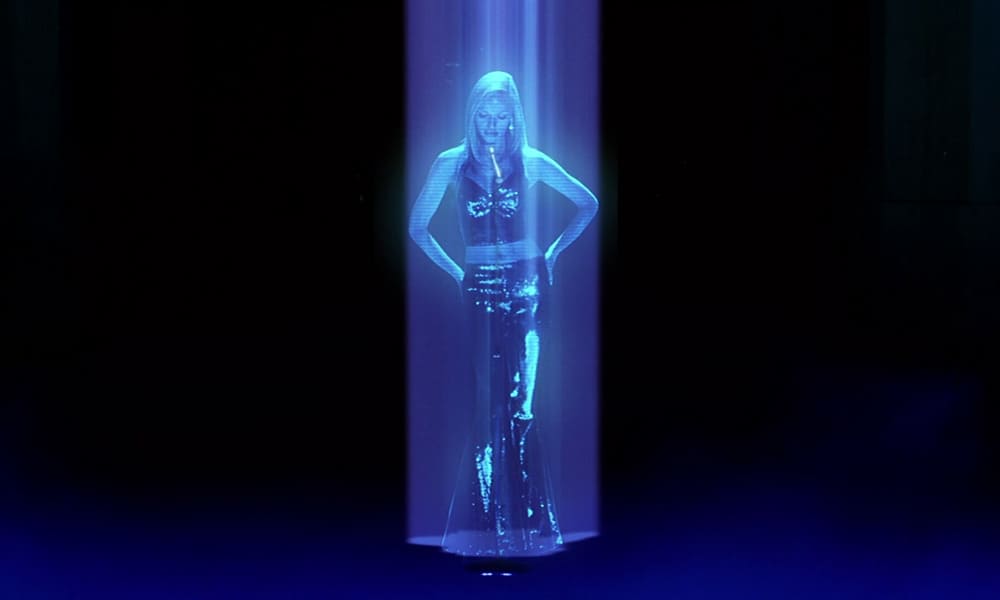
It is precisely under this pressure that Viktor, following the expansive logic of the media ecosystem, transforms S1m0ne into a multifaceted holographic pop icon, designed to occupy every space of the imagination. The concert in which S1m0ne sings (You Make Me Feel Like) A Natural Woman marks the point of no return: it is there that the director’s private fiction incarnates itself in collective adoration.
Here the simulacrum stops imitating reality and begins to replace it as the center of emotional experience. The audience no longer asks for authenticity. It asks for intensity. And if intensity arrives, whether it comes from a body or from an algorithm becomes secondary.
From the Oscar to the funeral: the true consecration of S1m0ne
“You created Simone? Viktor… she created you.”
After her media triumph and the concert, the virtual diva continues to grow until she wins a double Oscar, tying with herself, while Viktor remains in the shadows, displaced by his own invention.
Viktor then tries to sabotage her myth from within: he credits her with directing the disgusting film I Am Pig, makes her drink, smoke and say foolish things live, but everything turns against him. The media system metabolizes any nonsense as spectacle, and what should have destroyed her is interpreted as artistic boldness, sincerity and anti-conformism.
In one final attempt, Viktor infects his computer with a virus, locks hard drives and floppy disks inside a trunk and throws it into the sea, then tells journalists that the diva has died from a rare virus. But when the police open a case and arrest him for murder, Viktor fully discovers the horror of the simulacrum: one cannot truly kill what has no body, and precisely for that reason everyone is ready to believe that such a body existed.
Resurrection and the false future: the world after the person
“Your mistake wasn’t making something fake. Fake is fine with us, as long as you don’t lie to us afterward.”
While Viktor is in prison, it is his daughter Lainey who brings S1m0ne back to life, restoring her public existence and reassuring public opinion. Viktor is cleared, but his liberation is only apparent: his real prison is now life itself, a daily existence made of fake family rituals and a grotesque domestic performance organized around S1m0ne’s “child.”
The story ends where it first began to deform: not with Viktor’s triumph, but with his capitulation. Although he tried to take control of his destiny again, by creating perfection he ended up surrendering completely to it, recognizing himself as redundant.
S1m0ne is the first frame in a long series of stories that cinema — and not only cinema — will be forced to tell more and more often.