Now Reading: Avatar and the Digital Neocolonialism of Hollywood
-
01
Avatar and the Digital Neocolonialism of Hollywood

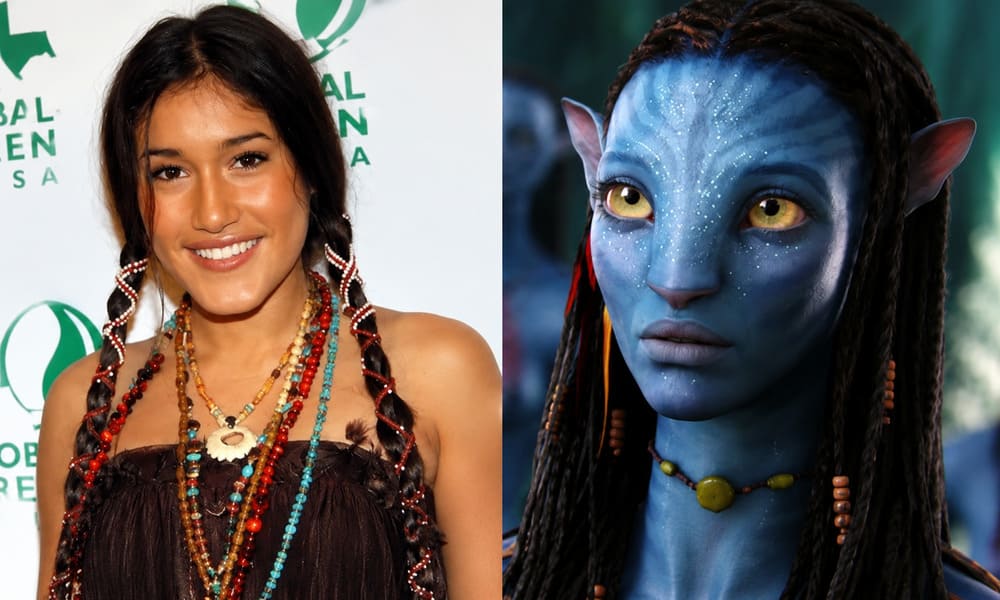
Q’orianka Kilcher accuses James Cameron and Disney of using her face for Neytiri in Avatar: for Hollywood, the Indigenous face has become an asset.
Q’orianka Kilcher, the actress who played Pocahontas in The New World by Terrence Malick, has sued James Cameron, Disney and other parties connected to the production of Avatar. The accusation is simple and cinematically perfect: the face of Neytiri, the Na’vi warrior princess played by Zoe Saldaña, was allegedly built from a photograph of the young Kilcher, without consent, without credit, without compensation. The lawsuit was filed on May 5, 2026, in the federal court of the Central District of California.
The most explosive part is that Cameron allegedly publicly admitted the origin of that visual reference. In a 2024 interview with Konbini, cited in the complaint, the director reportedly explained that the source for the first sketch of Neytiri was a photograph published in the Los Angeles Times to promote The New World: a young Q’orianka Kilcher, “the lower part of her face,” a “very interesting” face. The complaint itself includes comparative images, but this remains the point: this is not simply a resemblance noticed by the Internet twenty years later. It is an alleged production trace, a genealogy of the face.
The Q’orianka Kilcher lawsuit and James Cameron’s narcissistic claim
Kilcher claims that Cameron and the entire Avatar production chain “extracted, replicated and commercially used” her likeness starting from a photograph taken in connection with her performance as Pocahontas. Her face then allegedly entered the design process for Neytiri: sketches, maquettes, sculptures, digital models, all the way to the final creature seen in the 2009 film and later transformed into one of the most recognizable icons of the franchise.
The lawsuit includes claims of misappropriation of likeness, invasion of privacy, interference with potential economic gains and violations related to digital representation. Kilcher is seeking damages, a jury trial, a public statement recognizing her contribution and payment of profits attributable to the unauthorized use of her image. Disney and a legal representative for Cameron, according to the Los Angeles Times, had not immediately responded to a request for comment.
Kilcher allegedly met Cameron in 2010 at an environmental event; according to the complaint, the director gave her a signed print of the original Neytiri sketch with a dedication acknowledging that her beauty had been an early inspiration for the character. The actress, however, says she did not understand at the time the full extent of the use of her face, and that she truly connected the dots only years later, when the video of Cameron’s interview began circulating on social media.
The headline writes itself: “Cameron stole Pocahontas’s face.”
But cinema has always fed on visual references: photographs, faces, bodies, gestures, people met by chance, actresses seen on a poster, features recombined inside fictional characters. The question of likeness is where inspiration ends and where the commercial appropriation of a recognizable person begins — and today it sits at the center of several debates about extraction by generative artificial intelligence.
The Kilcher case tries to plant the marker right there: not on vague suggestion, but on the alleged transformation of a real face into an industrial asset. And the fact that the face belonged to an Indigenous girl, used to build the symbolic character of an alien people oppressed by a colonial army, makes the case perfectly suited to become political.
Then there is the AI issue, which must be handled carefully.
Avatar was born long before the current explosion of generative AI. Its technological core is made of performance capture, CGI, sculptures, maquettes, character design and visual-effects pipelines. Yet the problem we now call “AI” is already all there: a human face is taken, analyzed, transformed, made scalable, reproducible, monetizable. It is the same cultural grammar as digital replicas: the body is no longer only presence; it becomes training material, a surface to be sampled, an archive from which value can be extracted.
It is no coincidence that in California in 2024 Governor Gavin Newsom signed specific laws designed to protect actors and performers from the unauthorized use of their voice or image through digital replicas, requiring greater contractual clarity and consent in cases where technology may replace human performance.
Avatar and the colonialism of Pandora return to Earth
The paradox is fierce because Avatar built its myth precisely on the denunciation of imperialism. Pandora is the sacred planet invaded by humans, nature violated by industry, the native people besieged by a military and economic machine interested in resources. Cameron has always claimed the film’s political transparency: it was not a subtle metaphor; the Na’vi were conceived as Indigenous peoples crushed by technologically superior powers.
That is why this lawsuit, regardless of how it ends in court, already carries enormous symbolic value.
If Kilcher’s argument were accepted, Avatar would not only be the film that tells the story of colonial extraction. It would also be a film born, at least in part, from a small preliminary extraction: not the unobtanium beneath Hometree, but a likeness; not a mine on Pandora, but a 2005 promotional image; not an alien people, but a young Indigenous actress.
The complaint brings out precisely this deeply democratic contradiction: a saga that presents itself as sympathetic to Indigenous struggles allegedly exploited, according to Kilcher, a real Indigenous girl in silence. The Los Angeles Times reports that the lawsuit describes Kilcher as an Indigenous actress-activist of Quechua-Huachipaeri descent and accuses the film of having built a highly profitable franchise on an unacknowledged image.
Hollywood has always had a voracious relationship with otherness: it takes faces, accents, rituals, landscapes, costumes, historical traumas; it converts them into imagery and then resells them as global spectacle. With AI, or with any technology of digital replication, this voracity becomes more refined, more technical, cleaner, harder to see.
Old imperialism took land, gold, oil, bodies. New imperialism takes data, facial features, voices, movements, photographic archives. It no longer needs to invade a territory; everything has already been digitized.
The point is not to demonize James Cameron and American Democrats
The point is that the Kilcher case forces contemporary cinema to look at its own laboratory, because the future of cultural and technological colonization had already begun long before we called it AI. Avatar tells of a civilization entering someone else’s world, measuring it, mapping it, digitizing it, occupying it and then claiming to understand it better than its inhabitants.
Q’orianka Kilcher’s lawsuit reverses the shot: what if that gesture had also happened behind the camera? What if the blue dream of Pandora had carried, from the very beginning, the very earthly color of appropriation? What if spectacular empathy toward imaginary natives became the most elegant way to neutralize the protest of real natives?
The answer will eventually come from a court.
But cinema, in the meantime, has already received its question: when a face becomes a character, when a person becomes a reference, when an Indigenous identity becomes a sellable aesthetic, who gets paid? Who gets named? Who remains outside the frame? And if Cameron had not “gifted” Kilcher the product of her own photograph, would we even be asking these questions?
Because the real technological monster in these stories may not be AI. It may be the old habit of calling “inspiration” what, in the hands of industry, becomes property.