Now Reading: Live facial recognition: London scans faces in the street
-
01
Live facial recognition: London scans faces in the street

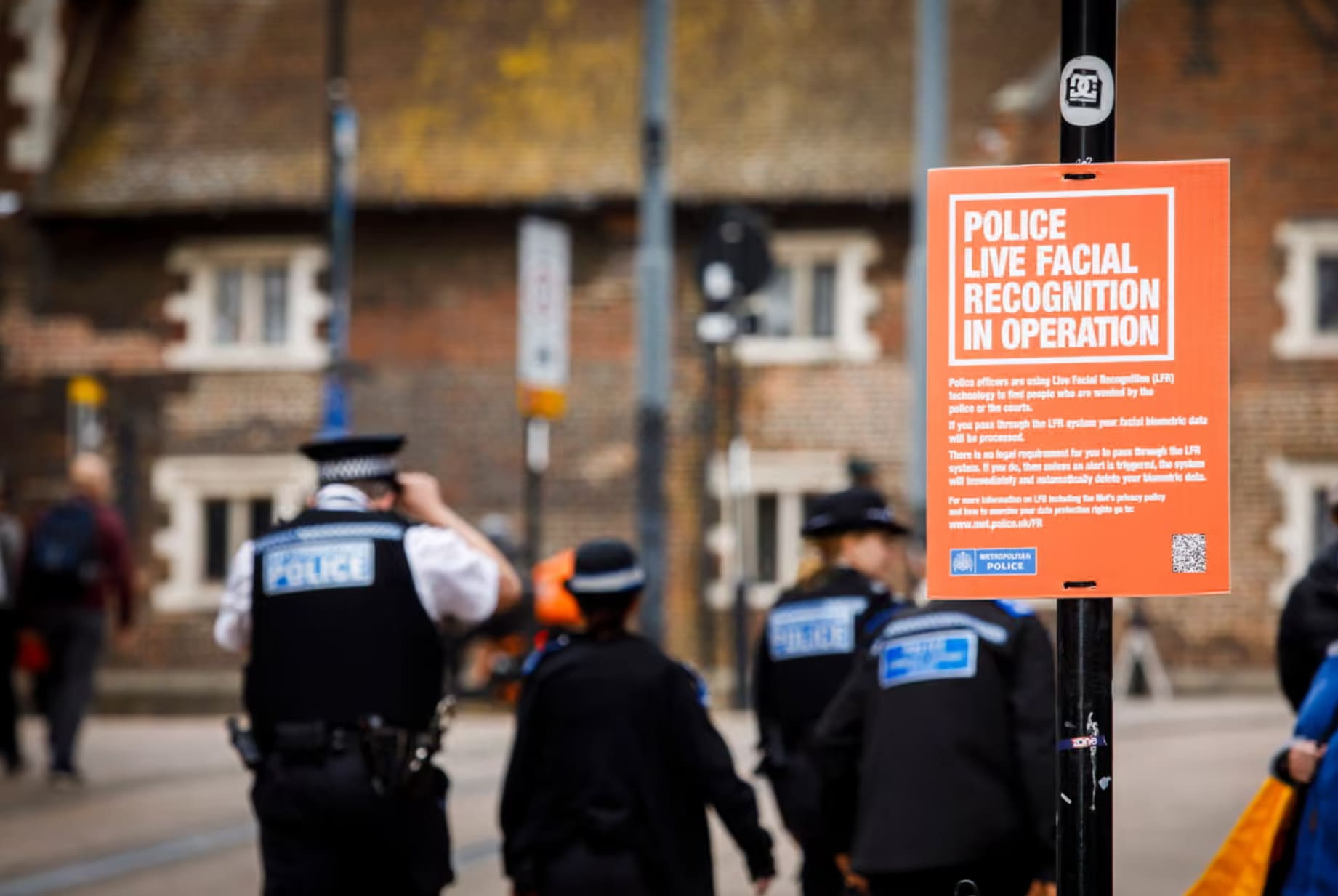
London’s Met Police tests live facial recognition: up to 5,000 faces scanned per hour, rapid arrests and growing doubts over privacy and surveillance.
In Croydon, south London, police switched on the cameras at 10 in the morning. Not just any cameras: live facial recognition, mounted on vans, lamp posts and street furniture. Every passer-by went into the system: face captured, image sent in real time to an operations room in Sydenham, automatic comparison with a wanted list, alert on the officer’s device. All in a few seconds.
According to the Guardian, the system used by the Metropolitan Police, supplied by Japan’s NEC, can scan up to 5,000 faces per hour. On an ordinary weekday morning it produced 19 alerts and 9 arrests, for offences ranging from rape to shoplifting to breaches of court orders. The fifth arrest reportedly came after just 45 minutes.
The scene is simple. A man walks past, the system flags him, the officer’s phone vibrates, and up come the live photo, the mugshot, the name, the suspected offence, and any possible risks linked to weapons or drugs. Then the officers arrive. If the man runs, they tackle him. If he protests, they restrain him. If people around him stare, too bad: the city has become an open-air control room.
Croydon, the laboratory of the mandatory face
The Metropolitan Police defends the operation with heavy numbers. In its official statement on the Croydon pilot, it reports more than 100 arrests in the first three months, with an average of one arrest every 34 minutes when the system was active. One third of those arrested were wanted for offences linked to violence against women and girls, including strangulation and sexual assaults. The Met also says that in Fairfield ward, Croydon, crime fell by 12% during the trial period.
The official examples are built to shut the argument down: a woman on the run for more than 20 years, a registered sex offender with an unregistered phone and access to social media in breach of a restraining order, a 27-year-old man wanted on suspicion of kidnapping. Put like that, raising doubts almost sounds indecent. Who wants to defend privacy in front of rapists, kidnappers and fugitives?
This is exactly where the matter becomes interesting. Because live facial recognition works politically when the case is ugly, the suspect is bad and the result is immediate. But the system does not scan only the wanted person. It scans everyone: people going to work, people buying bread, people passing by by accident, people who did not read the sign, people who did read it and still have no real alternative.
The Met says each deployment uses a tailored watchlist, prepared no more than 24 hours in advance and deleted immediately afterwards. It says the cameras are switched on only when officers are present. It says alerts are checked by human beings. It also says that since 2024 the technology has contributed to more than 2,100 arrests, with more than 1,400 people subsequently charged or cautioned, and more than 100 sex offenders arrested.
Twelve false alerts out of three million faces: the number that reassures and disturbs
The figure most often used to reassure the public is this: in 2025, more than 3 million faces reportedly passed in front of the cameras, with just 12 false alerts and no arrests caused by those false alerts. According to the Met, tests by the National Physical Laboratory also found the system to be accurate and balanced across ethnicity and gender at the operational thresholds used by police.
Fine. Twelve false alerts out of three million is few. But those three million are still three million. The point is not only the technical error. It is the administrative habit: turning a walk down the street into a preventive biometric check. The city no longer asks for your ID. First it looks at your face, then it decides whether to let you keep walking.
Here the issue directly intersects with technological power as an infrastructure of control. We are not dealing with a silent camera. We are dealing with a system that connects face, database, police, algorithm, patrol and physical intervention. It joins software and baton, recognition and pursuit, statistics and detention.
No wonder British biometric data watchdogs have sounded the alarm. In another investigation, the Guardian reports that the Met has already scanned more than 1.7 million faces in London in 2026, an 87% increase compared with the same period in 2025. William Webster, the biometrics commissioner for England and Wales, said legislation is struggling to keep up with reality. His Scottish counterpart, Brian Plastow, described the regulatory framework as “patchwork” and said that police forces are, in effect, marking their own homework.
Public safety cannot become an urban login
On 21 April 2026, the Met also secured a court victory: the High Court found its live facial recognition policy lawful. Commissioner Mark Rowley celebrated by calling the technology effective, public, signposted, supervised by trained officers and supported by around 80% of Londoners, according to police figures.
But a technology can be legal and still be enormous. It can be useful and still be dangerous. It can arrest people who are genuinely wanted and, in the same gesture, normalise biometric control of public space.
It is the same trajectory running through many forms of digital security: first comes the emergency, then comes the tool, then comes the routine. In the end, the citizen discovers that the exceptional measure has become street furniture, like the lamp post on which the camera is mounted.