Now Reading: Paramount-Warner: Workers Get the Bill for the Merger
-
01
Paramount-Warner: Workers Get the Bill for the Merger

The WGA still says the Paramount-Warner merger will hurt writers, but it has withdrawn its lawsuit. The settlement guarantees films and investment, not the number of workers needed.
The Writers Guild of America still believes the Paramount-Warner merger will harm writers, but it has withdrawn the lawsuit with which it was trying to stop it: after the agreement reached by twelve U.S. states, continuing the case alone would have cost millions of dollars.
It is a piece of news that explains the day after the merger better than any corporate press release, because it shows how expensive opposing industrial concentration can become even for a major union.
The conditions of the antitrust agreement determine how many films the new group will have to distribute and how much it will have to invest in the United States; meanwhile Paramount is aiming to obtain up to $6 billion in savings from the operation and, according to internal sources, employees are preparing for multiple waves of layoffs in the coming months.
The cuts have not yet been quantified, but the anxiety already has a calendar.
More films, but with what structure?
The new group will have to bring at least 30 films a year to theaters for the first two years and 32 for the following three, while the two companies are on course to release a combined 28 in 2026. The gap between the current volume and the first target is therefore two titles; much harder to measure is how the people, budgets and decisions behind those titles will change.
The agreement requires at least $1.5 billion in additional spending on U.S. production over five years and includes requirements for wide releases, independent films and high-budget titles, but leaves the group room to allocate spending among individual projects.
One extra film on the calendar says nothing about how many weeks a crew will work, nor whether a screenwriter will still have more than one studio to which the same idea can be pitched.
Emblematic in these days is the case of The Third Hand: according to Goodfellas’ Vincent Maraval, AI made it possible to shoot a battle sequence in two days instead of ten. For the production, that is eight days saved; for the crew, it is eight days of shooting for which their work was no longer required.
Theaters obtain protections, the group keeps its assets
For Cinema United, the exhibitors’ association, the agreement incorporates several demands from theaters: a minimum number of releases, a period of theatrical exclusivity, access to catalogs and limits on certain cost increases imposed on operators. These are concrete guarantees for those who have to schedule films and negotiate with their distributor, although the association itself acknowledges that the agreement does not eliminate all the risks of the merger.
Paramount can in fact proceed without initially divesting studios, networks or other assets. The text of the agreement provides for divestitures as a remedy for specific future violations: if the group failed to meet the annual film quota and did not cure the shortfall within six months, it would have to sell Miramax.
The WGA discovers the price of opposition
The WGA statement is unusually explicit: the union still considers the operation harmful, but explains that continuing a complex antitrust case without the states would have required millions of dollars. In the settlement with Paramount it obtained $17.5 million for its health fund, reimbursement of legal expenses and a five-year ban on laying off CBS News Broadcast writers, a precise protection that does not, however, extend to all writers in the group.
Before the settlement, Paramount had also asked the court to require a $1.88 billion bond from the states and the WGA, arguing that it needed protection from the economic losses of a further delay if it ultimately won the case. It was a request contested by the opposing parties, not a payment ordered by the judge; it remains, however, an eloquent detail about the financial weight the battle had assumed before the court could even decide whether the merger was lawful.
A fund for those who will lose their jobs
The agreement with the states creates a $47.5 million fund over five years for training and professional development of workers affected by the merger, while also requiring compliance with existing collective bargaining agreements. These are concrete commitments, also supported by organizations such as the DGA and IATSE; the fund, however, is designed to manage the consequences of people leaving work, while the target of six billion dollars in savings remains part of the economics of the transaction.
And just as funds are being allocated for the training of people who risk losing their jobs, directors and crew members who have run short of work are being paid to teach AI models how to write, prepare shot lists and organize projects. For some workers, “reskilling” will end up meaning explaining to a machine how to perform part of the job they lost.
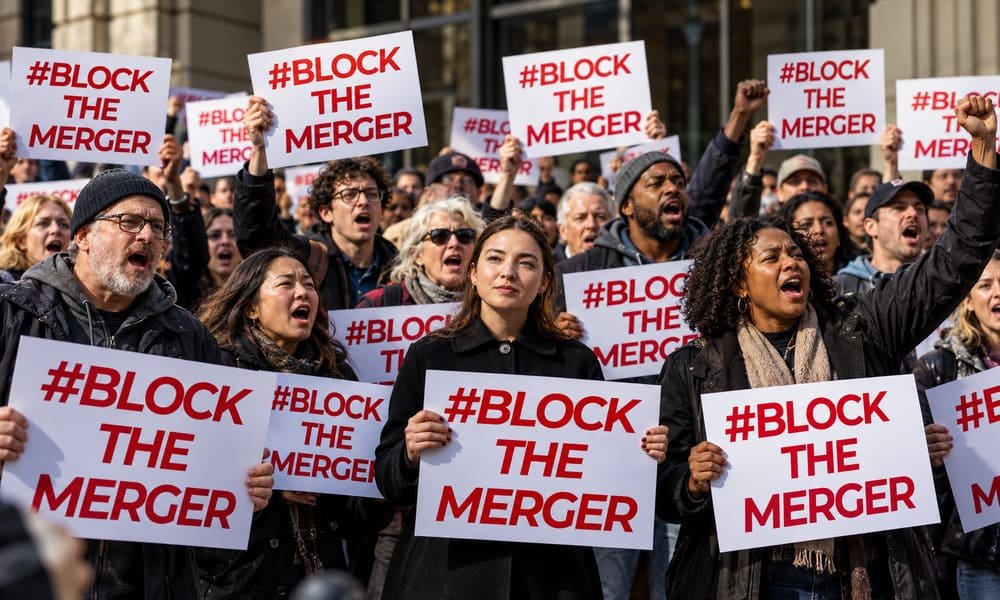
On September 22, workers and activists protested outside the Paramount gates against protections they considered insufficient, citing an estimate commissioned by Los Angeles County according to which about 4,500 direct film and television jobs could be at risk over three years.
Paramount and Warner have guaranteed how many films will reach theaters; no one has guaranteed how many people will still be needed to make them, or to give them a value different from the one on a balance sheet.