Now Reading: Independence Day and the Apocalypse as a Global Holiday
-
01
Independence Day and the Apocalypse as a Global Holiday
Independence Day and the Apocalypse as a Global Holiday

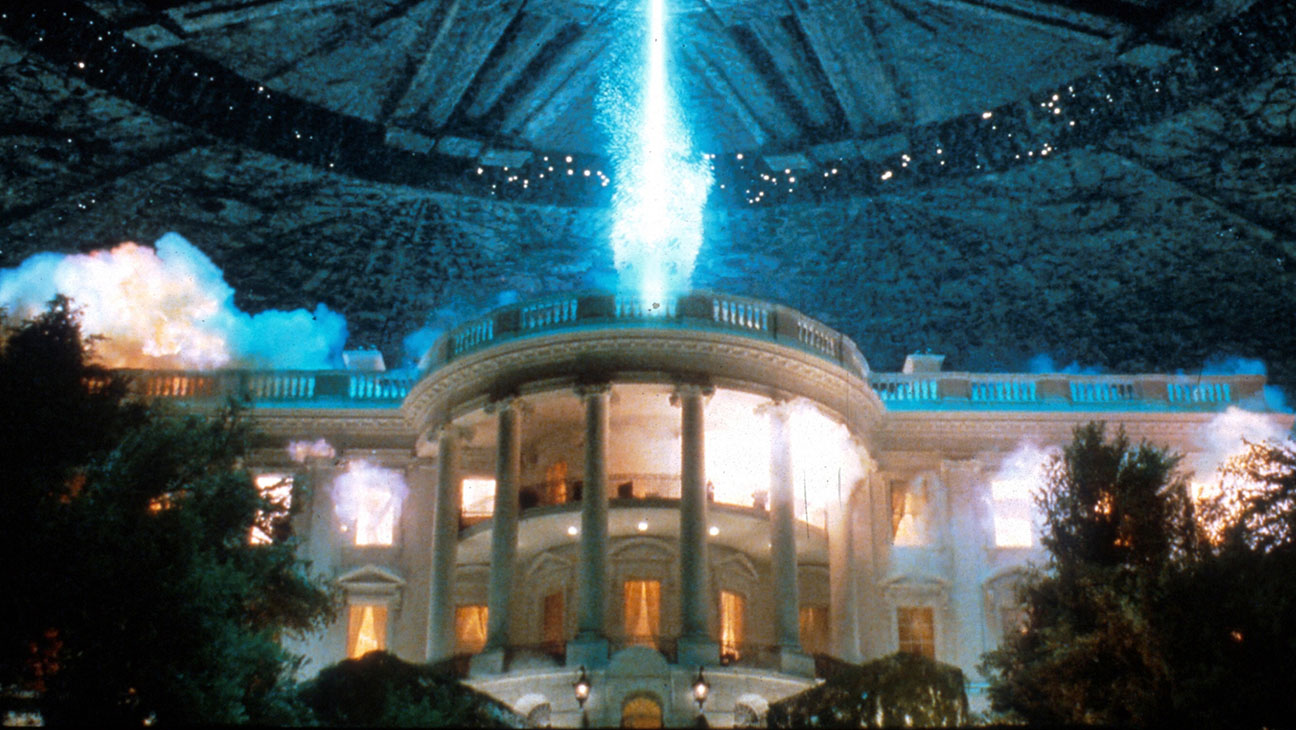
Released in 1996, Independence Day is the film that turned alien invasion into a military parade, a civil mass, and a pyrotechnic spectacle of American hegemony
Directed by Roland Emmerich, written by Dean Devlin and Emmerich himself, produced by Devlin and distributed by 20th Century Fox, Independence Day combines science fiction, action and disaster movie conventions with an ensemble cast led by Will Smith, Bill Pullman, Jeff Goldblum, Mary McDonnell, Judd Hirsch, Margaret Colin, Randy Quaid, Robert Loggia, James Rebhorn and Vivica A. Fox.
Gigantic spaceships arrive on Earth, destroy the world’s major cities and force an unlikely group of politicians, soldiers, scientists, civilians and assorted failures to organize a counteroffensive. Beneath the noise of the explosions, Independence Day constructs one of the most effective political fantasies of 1990s American cinema: the world is saved when it accepts U.S. leadership, democracy takes refuge in the charisma of the leader, conspiracy paranoia is rehabilitated, and catastrophe becomes an opportunity for rebirth.
Independence Day is a film about the all-American need for an absolute enemy: only when faced with a non-negotiable Other can imperialism continue to call itself Independence.
Cosmic Extractive Capitalism: The Aliens as a “Rogue State”
The aliens in Independence Day are not a civilization to be understood, translated or encountered. They are not the metaphysical enigma of 2001: A Space Odyssey, nor the linguistic otherness of Arrival. They are a predatory, vertical, mute, totalitarian power. They arrive, occupy the sky, annihilate cities, consume resources and then, presumably, move on to the next planet to strip bare. In this sense, they are the perfect enemy of the 1990s: a kind of absolute rogue state, with no ambassadors, no foreign press, no treaties, and no reason capable of complicating the moral picture.
Their political function is extremely convenient: they eliminate every doubt. Before them there is no diplomacy, no appeasement, no realpolitik, no Western guilt. There is only survival. The film thus constructs a war that is finally “clean,” at least in the perception of those fighting it: on one side, humanity; on the other, a cosmic machine of extermination. These aliens do not seem like mankind’s enemy so much as the monstrous caricature of capitalism freed from every hypocrisy: no civilizing mission, no market, no progress, only seizure, consumption, destruction.
A colonialism without ceremonies, an imperialism without inaugural speeches, an economy of plunder without a corporate brochure: the aliens are technical superiority transformed into a license to devour. Through this ideological trick, America alienates its own predatory side, expels it outside itself and contemplates it as a monster from space, receiving the viewer’s terror of the inhuman as deference, while distracting them from the logic of conquest, consumption and devastation that already inhabits the ordinary political and economic history of its civilization.
Area 51: The Conspiracy Paranoia That Saves the State
Independence Day takes one of the great myths of the American imagination — Area 51, Roswell, hidden alien bodies, secret spacecraft, a lying government — and proves it right. The aliens were there, the government knew, the evidence was concealed, the apparatus lied. The point is that the film does not use this revelation to demolish the State; on the contrary, it uses it to save it.
The institutional lie is not truly condemned, but absorbed into the logic of emergency. Of course, some officials had “hidden the truth even from the president,” but when the end of the world arrives, those lies are transformed into strategic capital: recovered technology, knowledge of the invader, the possibility of counterattack.
In short, the film absolves paranoia while also absolving the State. It confirms to the viewer that they were right to suspect, but wrong to despair: behind the secret there was not only manipulation, but also a reserve of power ready to be reactivated at the decisive moment. Distrust is reconverted into trust, lies become prudence, and the apparatus is rehabilitated by the alien invasion. Yes, the government lied, but fortunately it had something to hide.
Perhaps this is why, in recent years, “disclosure” around UAPs has moved the UFO imagination from the basement of conspiracy thinking to congressional hearings, Pentagon offices, NASA protocols and federal archives: not because it has solved the mystery, but because it has finally institutionalized it. In this passage, the American State obtains its most obscene reassurance: even those who suspect it continue to recognize it as the only subject powerful enough to guard the secret.
The Democracy That Dreams of the Sacred King, and Populist Family Therapy
President Thomas J. Whitmore is one of the film’s great political phantoms. Formally, he is a democratic, elected, institutional leader. Narratively, however, he functions as something else entirely: he is a father of the nation, a wartime commander, a civil priest, almost a sacred king disguised as a progressive president. His famous speech before the final attack is not merely patriotic rhetoric: it is the act through which ordinary politics dissolves and is reborn as civil religion.
From that moment on, the Fourth of July no longer belongs to the United States: it becomes the independence day of the human race.
The world is not conquered by the United States: it is coordinated. We will save everyone, and in doing so we will speak for everyone — a benevolent hegemony, in other words, command in the form of service, imperial centrality presented as moral duty. Whitmore becomes credible because he puts his body on the line, gets into the fighter jet, fights, takes risks. Democracy, in the extreme moment, does not dream of a parliamentary committee, an inquiry commission or a televised debate: it dreams of a leader who speaks well and decides quickly.
But catastrophe does not only serve to save the planet; it also restores order to the private sphere. David Levinson recovers a form of bond with his ex-wife, the president is returned to family grief, Steven Hiller consolidates his possible family, and even Russell Casse, discredited father, drunkard and object of ridicule, earns through his final sacrifice the dignity that everyday life had denied him.
Individual sacrifice is the moral currency with which the film pays for collective salvation. The army is not enough, science is not enough, leadership is not enough. When the sign arrives from the sky, cities are punished, families are scattered and the leader pronounces the secular mass that recomposes the community; someone must consume himself completely.
Patriotic Explosions, the New Fireworks
Celebrating too early is deadly: in Independence Day, the Fourth of July must pass through war before it can truly explode in its “big fireworks finale.”
The light descending from the spaceships is terror disguised as Spielbergian wonder; the burning cities are the price of innocence; the first military attacks are the spectacle of impotence; even the atomic bomb, that old twentieth-century fetish of absolute power, is reduced to a useless flash against the alien shield.
The fireworks of the national holiday are replaced by the explosions of the planetary counteroffensive: independence is no longer celebrated, it is remade live, before the absolute enemy. But the film establishes a precise condition: spectacle is legitimate only when violence has found its justification.
In this sense, Independence Day is a film that knows perfectly well that modern patriotism also passes through the pleasure of destruction: it is precisely the iconographic sacrifice of the White House, the oppression of conflict and the impotence of ordinary man that make the president’s speech more explosive than a bomb, and larger than the ruins.
The Computer Virus as Deus Ex Machina
Is it possible that an alien civilization capable of crossing space can be brought to its knees by code uploaded from an earthly laptop? The computer, which in 1980s and 1990s pop culture was often associated with control, the Cold War, automation, hacking and dehumanization, here becomes the strategic badge of resistance.
Independence Day does not reason in terms of technical plausibility, but within a typically 1990s imagination, in which computing is still a form of modern magic, a lateral, obscure, almost initiatory knowledge. The computer is not yet everyone’s natural environment; it is the instrument of the outsider, the neurotic technician, the man who does not command armies but understands systems. It is the pop legacy of WarGames, transported into the euphoric and confused climate of the post-Cold War era: no longer the nightmare of uncontrolled nuclear automation, but the fantasy that precisely that computer knowledge, once associated with control, surveillance and destruction, can become the unexpected weapon of salvation.
The ideal reference remains H. G. Wells’s The War of the Worlds. There, the invaders are defeated by terrestrial microbes: a tiny form of life that superior intelligence had not anticipated. In Independence Day, the virus becomes digital, a sign that in the emerging digital age, the battle has shifted from the real domain to the virtual one.
David Levinson is a brilliant outsider, an environmentalist, non-military, still sufficiently outside power to read it better than those who administer it. He does not break down the door; he finds the password and beats the aliens on the level of access: the digital trickster of an age in which technology is still incomprehensible, and precisely for that reason can be invested with a salvific function.
The United World of Resurgence, the New Global Technological Market
In Independence Day: Resurgence, the humanity of 2016 lives inside a techno-military utopia built on the remains of the invasion thwarted twenty years earlier: lunar bases, hybrid fighters, planetary defenses, global surveillance and response systems. Alien technology, once the absolute threat, has been absorbed, studied and transformed into infrastructure; and yet it remains alien precisely for the generation that thought it had tamed it.
The old heroes are still present, but they appear as tired custodians of an order they can no longer truly control. They won the war, rebuilt the planet, transformed trauma into system; and yet the world born from that victory is less obedient, and technical control no longer coincides with moral control. The sequel thus ends up recounting the anxiety of a generation that believed it could administer modernity after the Cold War and instead finds itself before a technologically unified planet that is politically and symbolically unstable.
By 2016, Hollywood was fully immersed in the logic of the franchise, the sequel, the recognizable brand. Roland Emmerich himself explained that one of the reasons for returning to Independence Day was the fact that its mixture of humor, disaster movie and alien invasion had become familiar in superhero cinema and the contemporary blockbuster.
Where the 1996 film transformed American hegemony into pop myth, the 2016 sequel tries to transform the post-9/11 multipolar world into a franchise. China, the UN, planetary defense, alien technology and a new generation are assembled as signs of political updating, and the result is a film that, while still trying to sell the apocalypse, involuntarily recounts the crisis of old American control.