Now Reading: The Great Return of UFOs Through Cinema, Documentaries, and Politics
-
01
The Great Return of UFOs Through Cinema, Documentaries, and Politics

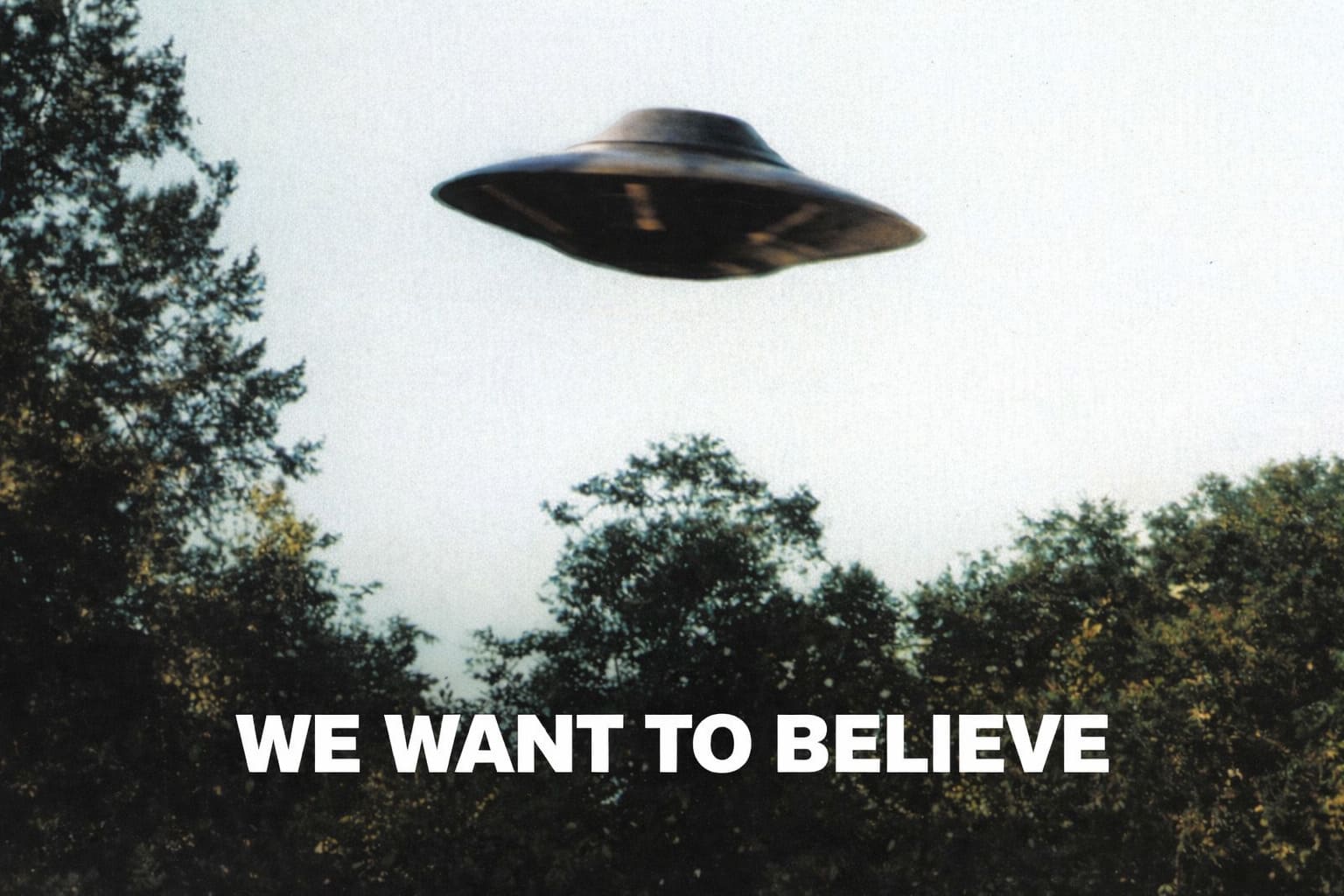
2026. UFOs, Aliens. There's something curious that happens periodically throughout human history: every now and then, we start looking at the sky with suspicion again.
In 2026, the UFO phenomenon, now bureaucratically rebranded as UAPs (Unidentified Aerial Phenomena) to sound more respectable, has made a major comeback. And we’re not just talking about the usual enthusiasts spending their nights with binoculars, waiting for a light in the skies above Nevada or the fields of Wiltshire to do something interesting.
It’s as if the extraterrestrial topic has emerged from the basement of fringe theories and returned to the respectable living room of public debate. We’re talking about documentaries, intelligence agencies, congressional hearings, and governments beginning to say things like: “Okay, maybe some of this deserves to be studied.”
And whenever something like that happens, it means we’ve entered the phase of history where reality becomes indistinguishable from an episode of The X-Files. Inevitably, three groups of people step onto the stage: Hollywood filmmakers, investigative journalists, and politicians who suddenly discover that talking about UFOs generates quite a lot of attention.
Hollywood Has Sensed Something—and Is Looking Back to the Stars
When Hollywood detects a cultural shift, it never ignores it. It turns it into a $200 million movie. So it’s no surprise that in 2026 Steven Spielberg is returning to the UFO subject.
Now, Spielberg isn’t just anyone in the world of aliens.
He’s the man who, in 1977, made the entire world want to climb a mountain in Wyoming and greet a spaceship with five musical notes. More importantly, he’s the man who made us cry with E.T., probably the first alien in cinema history who didn’t want to conquer Earth but simply wanted to phone home.
His new film, Disclosure Day, appears determined to recapture that spirit. No aliens blowing up skyscrapers or vaporizing patriotic Americans, but something far more stimulating for the imagination: what really happens if we discover we’re not alone?
Written by David Koepp and scored by John Williams, Disclosure Day features a cast that includes Emily Blunt, Josh O’Connor, Colman Domingo, Eve Hewson, and Colin Firth.
The film marks the thirtieth (yes, thirtieth) collaboration between Spielberg and Williams, arguably the most iconic film composer of the last fifty years, responsible for the scores of Jaws, Star Wars, Indiana Jones, Jurassic Park, and Harry Potter. Despite being over ninety years old, Williams says: “Retire from music? That would be like stopping breathing.” And honestly, a man who wrote the Star Wars theme can get away with saying almost anything.
Not Just Science Fiction: UFOs as Political Thriller
Spielberg isn’t the only filmmaker bringing UFOs back to the big screen. Director Joseph Kosinski, the man who revived Top Gun with Top Gun: Maverick, is working on a thriller produced by Apple Original Films that promises to approach the subject from a completely different angle.
No romantic science fiction this time, but a Watergate-style political conspiracy thriller. The idea is to tell the story of whistleblowers and secret programs dedicated to recovering unidentified flying objects.
And this is where things become interesting: the point where science fiction begins to blend with reality.
Several former government officials now claim that military programs exist to study vehicles of unknown origin. Some of these testimonies have even reached the United States Congress.
Kosinski has stated that he wants to treat the film not as science fiction but as “science fact.” In other words, telling a story that could, at least theoretically, be true.
And in recent years there have been plenty of unusual testimonies. Former military officials, intelligence analysts, and Navy pilots have reported observing objects displaying characteristics that cannot currently be replicated or explained by contemporary science, including impossible accelerations, turns without inertia, and objects moving seamlessly from air to water as though physics were optional.
Up to this point, one could argue that the UFO resurgence is merely a cultural trend or a form of pseudo-scientific fascination. But in 2026 something happened that dramatically changed the tone of the conversation: U.S. President Donald Trump announced the beginning of a process aimed at gradually declassifying government documents related to UAPs and unidentified aerial phenomena, stating that the issue is “of enormous public interest.”
Congress has held hearings dedicated to the phenomenon, while the Pentagon established a dedicated office to investigate these events: the All-domain Anomaly Resolution Office (AARO).
Now, it’s important to clarify something. So far, there is no official proof that UFOs are extraterrestrial.
According to reports from the Office of the Director of National Intelligence, the overwhelming majority of analyzed cases have been explained as:
- Instrumental anomalies: radar malfunctions, camera distortions, infrared system errors, optical reflections, electronic interference, tracking errors, measurement mistakes, or damaged sensors.
- Identifiable physical objects: satellites, space debris, rocket stages, civilian or military drones, experimental aircraft, classified military vehicles, weather balloons, and even Chinese lanterns.
- Natural phenomena: meteors, fireballs, ball lightning, atmospheric plasma, light refraction, weather-related optical illusions, and bright seasonal planets or stars.
- Human perceptual errors: pilot or witness misinterpretations, parallax effects, mistaken identification of distant objects, and psychological suggestion on both individual and collective levels.
But there remains a tiny, marginal, limited, reduced, contained, minimal, microscopic, almost imperceptible and practically negligible percentage of sightings that still lack a clear explanation.
And for the human brain, that’s an unbearable situation.
UFO Documentaries: The Real Ecosystem of Mystery
If cinema turns mysteries into spectacle, documentaries turn them into obsession.
In recent years, an entire industry of UFO and government-conspiracy series has emerged. Channels like History and even platforms such as Netflix have built extensive programming around secret files, unexplained phenomena, and historical anomalies.
Here are some of the most notable examples:
The UnXplained (2019) – Hosted by William Shatner, the legendary Captain Kirk from Star Trek, exploring scientific mysteries throughout human history.
Unidentified: Inside America’s UFO Investigation (2019) – Following former intelligence officer Luis Elizondo as he presents declassified material from Pentagon UAP investigations.
Fantastic Fungi (2019) – Exploring fungi as an almost extraterrestrial ecosystem, focusing on the underground mycelial network often called the “wood wide web,” which allows trees and plants to communicate.
The Phenomenon (2020) – Directed by James Fox, widely considered one of the most comprehensive modern UFO documentaries, covering seventy years of sightings and featuring politicians, military personnel, and scientists.
History’s Greatest Mysteries (2020) – Narrated by Laurence Fishburne. And who better than Morpheus from The Matrix to guide us down the rabbit hole?
Alien Worlds (2020) – A speculative Netflix docuseries imagining how life might evolve on distant planets using known biological and physical principles.
Top Secret UFO Projects: Declassified (2021) – Focused on declassified government programs connected to UAPs.
UFO (2021) – A Showtime documentary series produced by J.J. Abrams, examining military UAP footage and the new phase of American disclosure.
Moment of Contact (2022) – Another James Fox documentary centered on the famous Varginha incident in Brazil.
Encounters (2023) – Produced by Steven Spielberg, investigating mass-sighting events from different parts of the world.
Secrets Declassified with David Duchovny (2025) – A ten-episode documentary series hosted by the iconic X-Files star David Duchovny, better known as Fox Mulder.
And beyond those: The Proof Is Out There, UFOs: Investigating the Unknown, The President’s Book of Secrets, The Secret of Skinwalker Ranch, Unacknowledged, Mirage Men, Investigation Alien, John Was Trying to Contact Aliens, and the remarkably long-running Ancient Aliens, which, with its 21 seasons and 277 episodes, is practically a case study in itself.
Naturally, as always happens in this field, the line between serious investigation and entertainment is incredibly thin.
But one thing is certain: if these series continue to exist, it’s because people continue to watch them. And if nothing else, that documents something fascinating about our species.
When confronted with the unknown, we simply cannot look away.