Now Reading: Werwulf: Robert Eggers continues his archaeology of Western nightmares
-
01
Werwulf: Robert Eggers continues his archaeology of Western nightmares

Robert Eggers returns to the place contemporary horror cinema finds hardest to reach: the ancient darkness of what mankind cannot control, and has therefore always tried to transform into myth.
After the witch, the lighthouse, the Norse warrior and the vampire, the director returns to a figure seemingly worn out by the pop imagination: the werewolf. Yet he immediately removes it from the most predictable repertoire of contemporary horror: no monster as brand, no transformation as the main attraction, no folklore reduced to aesthetics.
The point, at least from what the project suggests, is not to update the myth, but to take it back to the moment before it had become a cinematic genre. Before franchises, before irony, before the spectacular poster-ready creature, the werewolf was a moral and religious fear: the idea that the body could betray the soul, that civilization was a fragile surface, and that beneath the baptized man something older, more violent and less negotiable continued to breathe.
From Nosferatu to Werwulf: continuity of cast, writing and vision
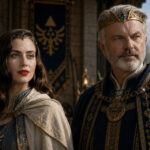
The production itself reinforces that sense of continuity. Werwulf reunites Eggers with Aaron Taylor-Johnson, Lily-Rose Depp and Willem Dafoe, carrying several of the faces and tensions of Nosferatu into a harsher, more earthbound nightmare. Written by Eggers with Sjón, and produced by Eggers alongside Tim Bevan, Eric Fellner, Garrett Bird and Sjón, the film is scheduled for a theatrical release on December 25, 2026 through Focus Features. It is not being positioned as a casual return to the monster movie, but as another controlled descent into the historical, religious and bodily roots of fear.
For Eggers, setting this story in thirteenth-century England means not using the Middle Ages as a picturesque backdrop, but as a mental system. In his films, the past is never decoration; it is a trap. The eras he depicts are not there to make everything more evocative, but to show worlds in which language, faith, superstition and guilt still carry physical weight. That is where horror begins to work again: when the monster does not arrive to disrupt order, but to reveal that order was already founded on fear.
Something more interesting than yet another Gothic reinterpretation
A film about the unstable boundary between sin and instinct, punishment and desire, real bestiality and attributed bestiality. The werewolf is such a powerful figure precisely because it does not allow for a clean separation between victim and threat. It is not only what attacks from the outside, but what man fears becoming when no law, no ritual and no public image can contain him anymore.
Eggers has spent years working against domesticated horror, the kind that explains too much, reassures too much, and often turns the abyss into an exercise in style. His cinema, by contrast, seeks a less comfortable terror, rougher and closer to the dirty matter of myths. For this reason, Werwulf matters not only as the new film by a recognizable auteur, but as a possible act of restoration: an attempt to return the monster to its original function.