- Home
- Cinema
- Tv & Streaming
- Music
- Art & LiteratureVisual art, photography, books, poetry and literary imagination. Works, authors and images that open new ways of seeing, reading and remembering culture.
- GamingNews, essays, and analysis on gaming: video games, consoles, soundtracks, game adaptations, AI in video games, horror games, sci-fi games, PlayStation, Nintendo, Xbox, fandom, and game preservation.
- Home
- Cinema
- Tv & Streaming
- Music
- Art & LiteratureVisual art, photography, books, poetry and literary imagination. Works, authors and images that open new ways of seeing, reading and remembering culture.
- GamingNews, essays, and analysis on gaming: video games, consoles, soundtracks, game adaptations, AI in video games, horror games, sci-fi games, PlayStation, Nintendo, Xbox, fandom, and game preservation.
Now Reading: Maurizio Manzieri: The Art of Imagining the Future
-
01
Maurizio Manzieri: The Art of Imagining the Future
- Home
- Interviews
- Maurizio Manzieri: The Art of Imagining the Future
Maurizio Manzieri: The Art of Imagining the Future

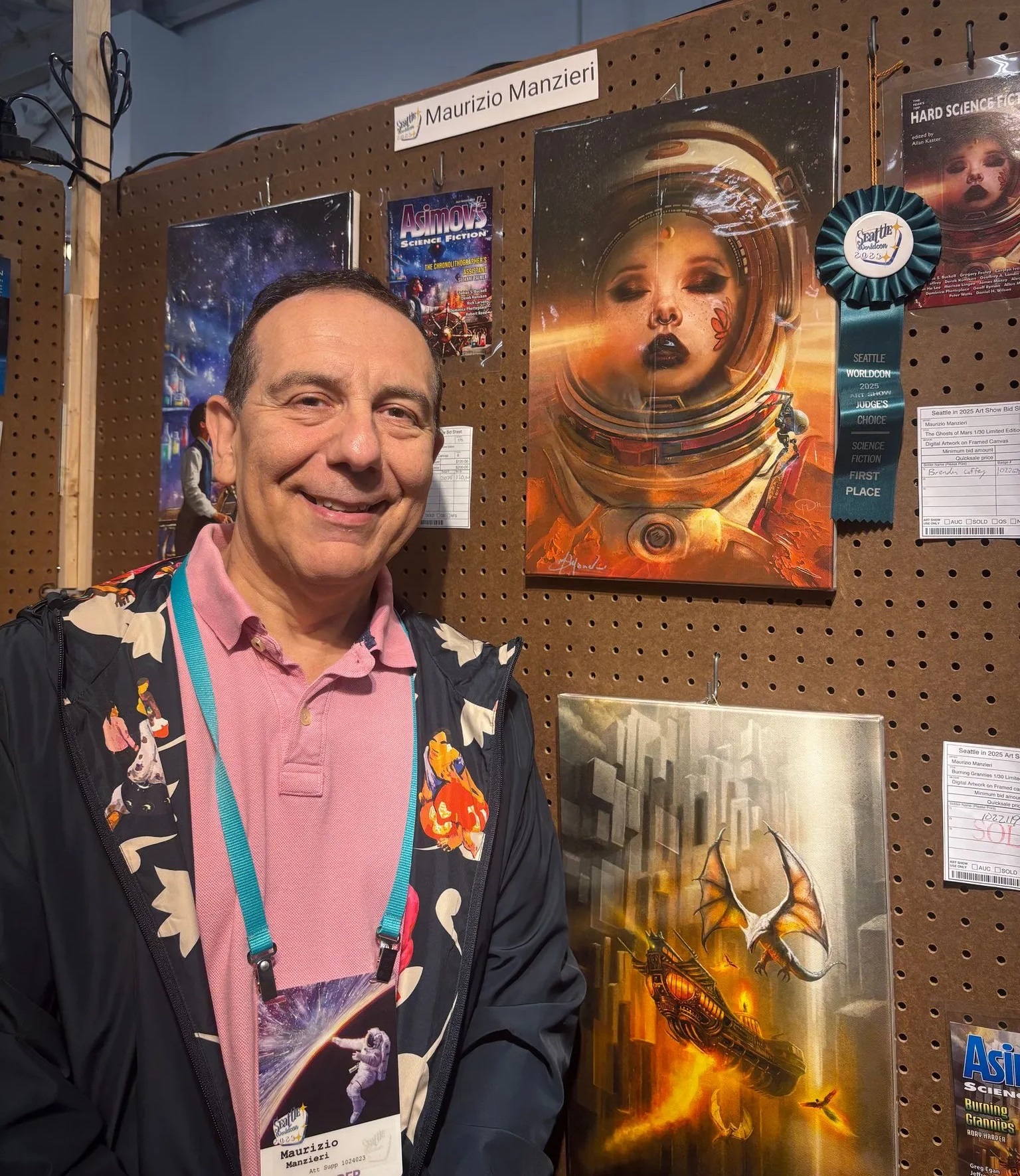
The interview with Maurizio Manzieri explores the art of fantastic illustration, from science fiction covers to cinema, all the way to the arrival of AI within the creative process.
Before science fiction became a cinematic language, before CGI made the impossible ordinary, and before artificial intelligence promised anyone an image in exchange for a sentence, there was a time when the future arrived on book covers. All it took was an illustration for Urania, a distant planet, an alien architecture, a figure suspended between science and vision, for the reader to understand that they were about to enter an elsewhere more serious than simple escapism.
Maurizio Manzieri belongs to that genealogy of artists who did not merely decorate science fiction, but gave it a body. In his images, the fantastic is never just spectacle: it is the construction of a world, a discipline of the gaze, an attempt to condense onto a single surface what a novel unfolds across hundreds of pages.
Manzieri responds without moralism and without surrender: a generated image may strike the eye, but a coherent universe still requires intention, culture, and vision. And perhaps this is precisely where fantastic illustration preserves its oldest function: not to show the future, but to remind us that someone must still know how to imagine it.
The Interview with Maurizio Manzieri
Do you remember the moment when you realized that certain worlds were not something you only wanted to read or look at, but to draw? Was there an image, a cover, or an artist that made you think: “This is my path”?
“From a very young age, my passion for fantastic fiction led me to discover and love artists who fueled my dreams and nourished an imagination that was not content simply to consume everyday reality. I have always wanted to explore unknown dimensions of the Universe into which we happened to be born, and I have always enjoyed drawing things that do not exist.
As I gradually discovered new authors — Jules Verne, Isaac Asimov, Arthur C. Clarke, Ray Bradbury — I also began to admire cover images. There was a wonderful period when Urania, Mondadori’s science fiction series, was published weekly, and I couldn’t wait to read the next volume and discover the new cover by Karel Thole. In those illustrations there was something more than a simple cover meant to represent the novel: the style led you to imagine vast immensities and distant planets.
Toward the end of the 1990s, I managed to meet Thole in person during the ItalCons in Courmayeur, and I remember a couple of afternoons spent with him talking about art and science fiction. Over time I improved my knowledge of English and began importing novels and art books from abroad, coming into contact with Michael Whelan, the artist who truly made me say: ‘This is my path!’ In any case, there are many artists in the editorial field to whom I owe a debt of gratitude. To name a few: Moebius, Drew Struzan, Patrick Woodroffe, Roger Dean, Jim Burns, Hajime Sorayama.”
Your images often seem suspended between technical precision and dream: space opera, fantasy, surrealism, hard science fiction. What truly makes a fantastic image powerful: technical detail, atmosphere, or the idea it contains? How much does scientific documentation matter, and how much does visionary instinct matter instead?
“I would lean toward visionary instinct. I acquired technical knowledge spontaneously by avidly reading hundreds of fantasy and science fiction books, and by studying countless covers by many artists. When I go through that preliminary phase in which I think about the cover I am going to create, I look for a vision that, in a single image, tries to synthesize the emotions and concepts expressed in the book; I search for that indefinable ‘something,’ difficult to explain, that can speak to the reader both before and after the purchase of the book. At first, the image must naturally attract and encourage the purchase, but later it can reveal itself, explaining hidden details visible only after reading the text.
My illustrations try to speak and release the energy of my thoughts. Since they are the result of many freelance commissions, they often follow the brief of an art director. The ones that work best are those in which I am granted broad creative freedom. I like trying to create works that are able to live a life of their own, independently of the novel they refer to. It is a process I am not fully aware of, and it is gratifying to witness the reception many of my creations have received abroad, from fans I have never met in person.”
For many years, science fiction illustration came before cinema: it gave shape to planets, cities, spaceships, and creatures when cinema did not yet have the tools to do so. Today, in the age of CGI and digital worlds, how central does the illustrator’s work remain when a film begins to imagine its own visual universe?
“I believe the vision of the human being will always remain the core of many productions. A great number of films continue to be adapted from novels; often their visualization is supported by directors and art departments capable of imagining them. It was like this in the past, and it will continue to be so in the future.
I think of Syd Mead for Blade Runner, Giger for Alien, John Howe for The Lord of the Rings trilogy. Of course, today technology makes it increasingly easy to translate ideas into images or video, so it becomes possible to represent universes that would have been impossible to realize until a few years ago. TV series as well, which generally suffered from more limited budgets, have made enormous leaps forward, as in the case of Apple TV’s Foundation, inspired by Asimov’s novels. As is already happening, the illustrator’s work remains a valuable guide in the construction of the imaginary.”
When you think about science fiction cinema, which figures feel closest to your imagination: directors, screenwriters, concept artists, creature designers, masters of visual effects? Are there names or films that have directly influenced the way you think about images?
“Last year I visited the exhibition dedicated to director James Cameron at the National Cinema Museum in Turin, set up in the spectacular spaces of the Mole Antonelliana. Many of his sketches and paintings in various media were on display, later becoming the inspirational basis for his films, from Aliens to Avatar: a heritage of the director’s concept art entrusted to his production teams. In Orlando, Florida, I experienced the immersive attraction that simulated the dive of a winged dragon among the floating mountains of the planet Pandora, including wind and water sprays. Very fascinating.
I am usually attracted to those who allow you to reach places ‘where no one has gone before,’ both in written and visual form. I have watched most of the Star Trek sagas, as well as the Star Wars films and series, where I admire the coherence of the atmospheres and architectures, the way they manage to become cult milestones of the collective imagination. I have been a guest many times at the Fantasy Basel festival in Switzerland, where every year an immense hall, as large as a hangar, is devoted to recreating environments from George Lucas’s saga, with settings and spaceships rebuilt at 1:1 scale. Walking among those creations, made by clubs and enthusiasts, always remains a beautiful experience of sharing for those who love those worlds.”
You have worked on very different imaginaries, from Ursula K. Le Guin to Robert Silverberg, from magazines such as Asimov’s, Analog, and F&SF to more refined and hybrid works such as The Tea Master and the Detective and Quindici Desideri. What concretely changes in your method when you have to illustrate a major author, a short story, or an already highly recognizable narrative universe?
“At the foundation of everything there is always careful documentation. If I am working on the work of a major author, perhaps for a limited edition, attention to detail and to the integrity of the narrative universe is fundamental. Unlike conventional commissions, where I may receive summary indications or a small brief, here I am sent the story or the entire manuscript, if it is a novel, so that I can read it calmly, get to know the characters deeply, and enter the mood of the work.
Often I get in touch with the author to explore certain passages more deeply, and, with the support of the art director, we all discuss things together in brainstorming sessions. The more famous the work, the greater the need to proceed with caution so as not to disappoint the fans, who are often in anxious anticipation of the book’s release date, most often announced precisely through the reveal of the cover.”
Looking at Sinkha today, the project created with Marco Patrito, it almost seems like an “Out of Place Artifact”: CD-ROM, multimedia graphic novel, 3D computer graphics, interactivity. At the time, were you aware that you were working on something that anticipated much of later visual culture?
“At the time we were aware that we were part of something magical, and there is no shortage of anecdotes that characterized the adventure of those years. Although the graphic novel version appeared almost in full in the pages of the iconic American magazine Heavy Metal, the multimedia version, as an insert in various publishing initiatives including La Stampa of Turin, certainly deserved greater international resonance.
I remember Marco’s trip to Los Angeles to discuss the rights for a big-screen film, the visit to the office of a director with an actress who looked identical, in features and clothing, to Hyleyn, the protagonist of the Sinkha saga. I remember the work in progress on multimedia projects for games and virtual reality headsets, the contact with composer Jean-Michel Jarre for the creation of background soundtracks for Sinkha and the multimedia projects underway. For various reasons, the years went by without Sinkha expressing its considerable potential. It was a beautiful period that deeply enriched our professional lives.”
You went through the transition from traditional to digital illustration. Today, with generative artificial intelligence, are we facing a new tool or a deeper rupture in the relationship between artist and image?
“I think we are at the beginning of a new era, one that will inevitably see the rise of a new class of artists capable of manipulating artificial intelligence and adapting it to their individual vision, using it to create reasoned and coherent stories and universes.”
With generative artificial intelligence, the issue no longer seems to be only who creates an image, but whether the public still has the time and tools to recognize its origin. Do we still distinguish between generated images, drawn images, and images that are truly thought through? Or does everything risk becoming merely visual content?
“Today an artist could already create an entire universe, not just a single image. Creating images that appear pleasing to the eye with a prompt is now within everyone’s reach; creating a coordinated universe, one in which there is a story and which is signed with one’s own name and style, is not within everyone’s reach.
For me, the difference lies precisely there: in intention, coherence, and the ability to give identity to what is produced. An image may strike immediately, but when it is truly thought through, it remains in the memory, because it does not merely please: it suggests a world, an atmosphere, a vision. And that, for an illustrator, continues to make the difference.”
You have taken part in many conventions and received important recognitions, from Hugo Award nominations for Best Professional Artist to the title of European Grand Master awarded by the European Science Fiction Society. What do these moments represent for you: confirmation of the path you have taken, an opportunity to meet the science fiction community, or also a way to understand how the public’s gaze is changing?
“They represent a confirmation. When I signed up to actively participate as a speaker in conventions abroad, in Europe and in the United States, I was welcomed with great honors by the organizations and widely included in the official programs, receiving treatment almost like a guest of honor.
I have taken part in exhibitions, meetings with the public, Kaffeeklatsches, and I was able to experience firsthand the enthusiasm of fans and writers who wanted to spend a few hours in my company. I have always felt part of a great family, and this healthy networking wove a network of relationships and work opportunities that branched out over the years.”
You have spent a lifetime giving visual form to science fiction. When one illustrates the future, is one truly imagining what will come, or giving form to something already hidden in the present?
“The future always has roots in the present. Futuristic literature tries to imagine the results or consequences of today’s reality. Apart from novels we might call classics, which can be read generations later without losing their brilliance, most ideas become dated, replaced over the years by emerging writers aligned with the technological achievements of their own time. Progress is increasingly fast, and often reality surpasses fantasy.”
If you had to give serious advice to a young illustrator who wants to work in science fiction today, in an era of generated images, social networks, digital portfolios, and artificial intelligence, what would it be?
“All periods of transition are difficult to ride, but afterward there is always a settling phase. Manual techniques will certainly remain an elite path and will always give life to projects worth pursuing in every field of art, including comics. The fascination of an artist capable of improvising a sketch on the spot will continue to arouse interest and joy in the public and in collectors.
As time goes by, studying the creation or modification of an illustration with sophisticated artificial intelligence applications will become a necessity. At this moment there are studios hiring artists provided they are willing to use it, while at the same time various publishers are presenting contracts in which the artist signs a statement that the commissioned illustration will not be made with the aid, even partial, of AI.
In the digital field, requests of this kind are beginning to become anachronistic, when Adobe Photoshop itself — which I have personally used continuously since 1994 — is adding every kind of AI plug-in to its latest versions in order to facilitate even the smallest modification to an image in progress. The professional artist remains the primary engine of creation, but the brushes available are no longer only those that simulated traditional techniques: today they are broader, more complex, and offer new possibilities.”
We thank Maurizio Manzieri for his availability and for sharing a valuable perspective on the role of illustration in the construction of the science fiction imaginary.
Previous Post
Next Post
Previous Post
Next Post

Essays22 hours ago
Rebellion: Elon Musk Bought the Megaphone