Now Reading: Ridley Scott, AI and the Carbonized Scrolls of Herculaneum
-
01
Ridley Scott, AI and the Carbonized Scrolls of Herculaneum

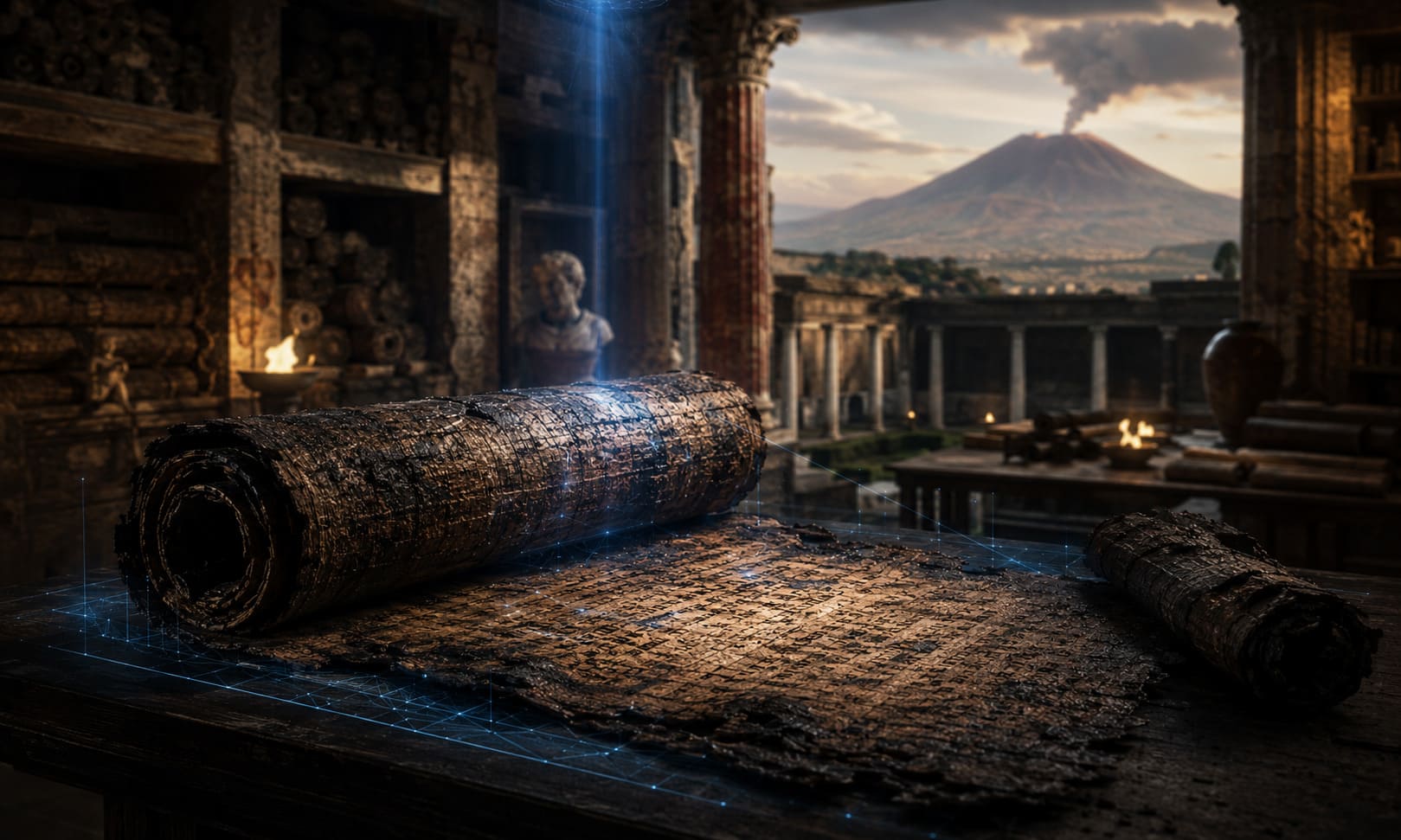
Ridley Scott is producing The Vesuvius Challenge, a documentary narrated by Guy Pearce about the project using X-rays and AI to read the Herculaneum scrolls.
Ridley Scott’s Scott Free Productions has developed and produced The Vesuvius Challenge, a documentary devoted to the work of computer scientist Brent Seales and the international community attempting to decipher the carbonized scrolls of Herculaneum without physically opening them.
The documentary is directed by Daniel DiMauro and Morgan Pehme, the filmmakers behind Get Me Roger Stone, and will be narrated by Guy Pearce, who previously worked with Ridley Scott on Prometheus. The film will chronicle a decades-long research effort that culminated in June 2026 with the complete reading of the surviving text inside a scroll sealed by the eruption of Mount Vesuvius in 79 AD.
“Armed with cutting-edge imaging, artificial intelligence, and relentless determination, Dr. Seales and his underdog team work to digitally unlock the secrets of ancient Rome’s only surviving library. As their quest captures global attention, The Vesuvius Challenge becomes a high-stakes story of perseverance, discovery, and humanity’s quest to recover the great lost books of antiquity”.
The Vesuvius Challenge: Directors, Producers and Key Figures
The documentary’s central scientific figure is Brent Seales, professor of computer science at the University of Kentucky and founder of EduceLab. In 2023, Seales made images and software developed by his laboratory publicly available and, together with Nat Friedman and Daniel Gross, launched the Vesuvius Challenge: an international, donation-funded competition based on machine learning, computer vision and geometric reconstruction. The project has already awarded $1,800,500 in prizes and has offered an additional $1 million prize for the complete reading of another scroll.
The documentary’s central breakthrough was presented on June 25, 2026, at the Vittorio Emanuele III National Library in Naples. The team announced the complete reading of PHerc. 1667, known within the project as Scroll 4: the first rolled Herculaneum papyrus to be digitally unwrapped and read from beginning to end without being physically opened.
Attempts to open it during the nineteenth century, in 1969 and again in the 1980s had destroyed its outer layers. The digital reconstruction recovered around 1.4 metres of papyrus and the lower sections of approximately 22 columns of Greek text, which were subsequently transcribed and verified by papyrologists. Tomographic data, reconstructed surfaces and transcriptions have been published under a Creative Commons licence.
How X-rays and AI Read the Herculaneum Scrolls
The scans were carried out on beamline BM18 at the European Synchrotron Radiation Facility in Grenoble using high-resolution, phase-contrast X-ray microtomography. The software reconstructed the three-dimensional arrangement of the layers, traced the surface of the papyrus, digitally flattened the sheet and used machine-learning models to detect ink that was almost indistinguishable from the carbonized material beneath it.
The text contained in PHerc. 1667 is probably a Stoic ethical treatise dating from the second century BC. It discusses human nature, impulse and moral progress. The final surviving column mentions Aristocreon, the nephew and pupil of Chrysippus.
The research also examined two other scrolls. In PHerc. Paris 4, a higher-resolution scan made the ink directly visible within the three-dimensional data. In PHerc. 139, researchers identified the title and attribution of the work, establishing it as the eighth book of On the Gods by the Epicurean philosopher Philodemus.
Scott Free’s involvement therefore comes at a stage when the project already has images, characters, verifiable results and a clear narrative progression: years of research, a global competition, million-dollar prizes and the first complete reading of an object that had remained sealed for almost two thousand years.
It is documentary material, but it also contains a structure Scott knows well: advanced technology, archaeology and access to buried knowledge, this time without the need to invent a distant planet.