Now Reading: The Philosophy Shared by The Odyssey and Oppenheimer
-
01
The Philosophy Shared by The Odyssey and Oppenheimer

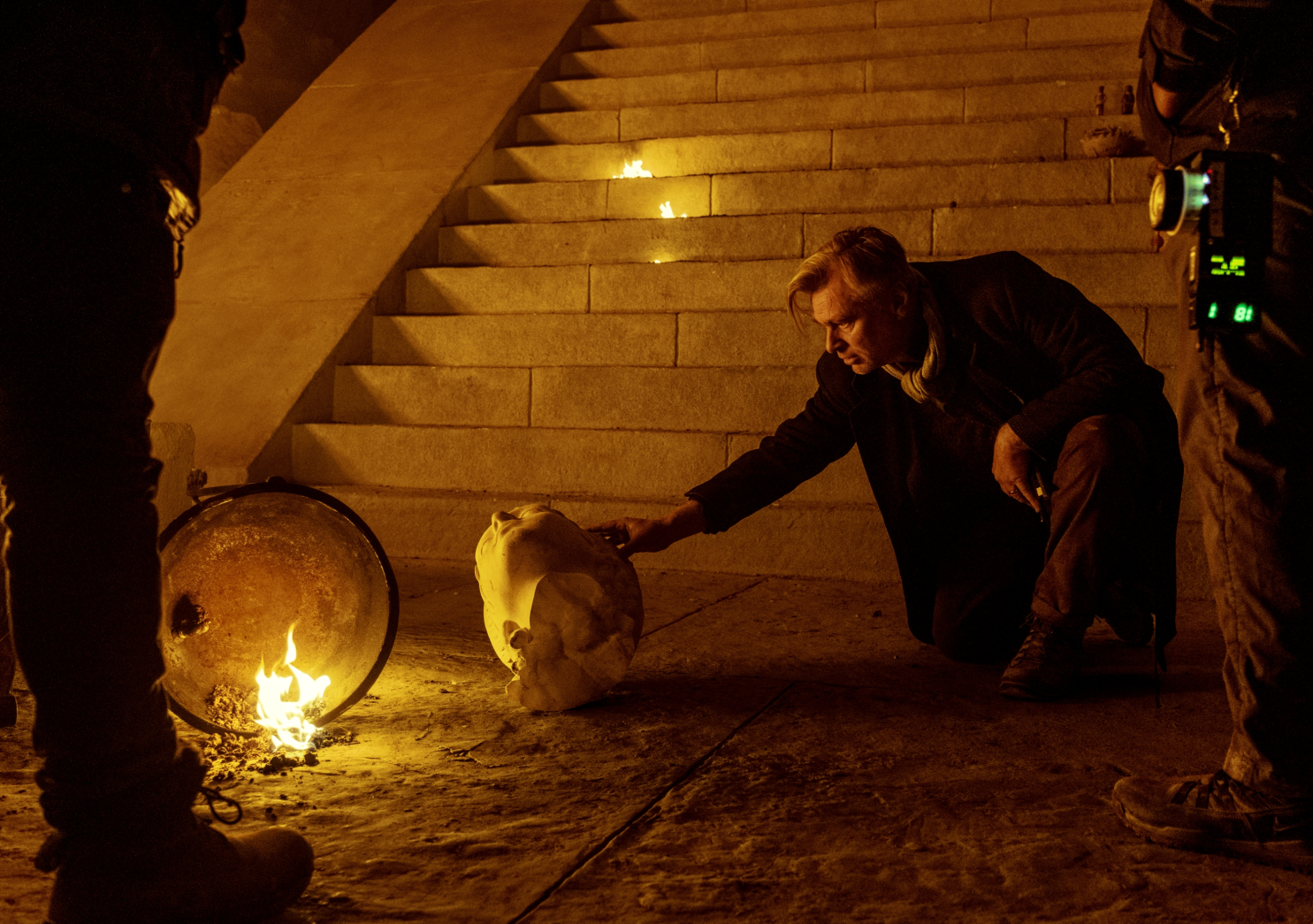
Christopher Nolan explains the connection between The Odyssey and Oppenheimer: broken xenia, irreversible guilt and the limits of repentance.
On July 30, during the Beijing promotional stop for The Odyssey, Zhong Shu, a political philosophy lecturer and PhD candidate, asked Christopher Nolan an unusual question for a press event: by introducing a form of atonement presented as foreign to the Greek world, had he not “Christianized” Homer?
In the original conversation, reported by The Film Stage, Nolan acknowledges that he did not consciously follow a philosophical category and redirects his answer toward what happens when xenia is violated: Odysseus can recognize his guilt, but he cannot repair the damage or stop the approaching catastrophe.
Zeus’s Law Shifts Guilt from the Palace to History
In the film, xenia is simplified as “Zeus’s law”: the reciprocal obligation between host and stranger, founded partly on the possibility that the guest might be a god in disguise. The Suitors violate it by occupying the palace of Ithaca. Nolan, however, does not automatically regard the final encounter between Odysseus and Penelope as an act of atonement. That catharsis, he observes, may depend on the modern viewer’s sensibility, drawn to the confession, honesty and intimacy of the scene.
The director then widens the frame by roughly four centuries—the interval that, according to the reconstruction referenced in the interview, separates the events being narrated from the moment the story reached Homer’s audience. Those listeners belonged to a rising society, yet looked upon the ruins of a past perceived as greater. The walls of the ancient palaces seemed so imposing that they were called Cyclopean, as though only giants could have built them.
This is the source of Nolan’s interest in the Bronze Age collapse and the mystery of the so-called Sea Peoples, identified by some reconstructions as one of the forces involved in the crisis. The director neither demonstrates nor proposes a historical connection between the conduct of the Suitors and that catastrophe. He uses xenia as a narrative principle through which to read a world whose social order is already coming apart. The return to Ithaca leads not only toward a usurped home, but toward a civilization that its original audience knew by then through its ruins.
Repentance Changes the Man, Not What He Has Destroyed
It is on this scale that The Odyssey meets Oppenheimer. Nolan describes the 2023 film as a story about the possible end of the world and the collapse of civilization; working on it, he explains, left him with a sensibility that he carried into his Homeric adaptation. The parallel therefore does not rest solely on two exceptional figures burdened by guilt. It rests on the gulf between their individual consciousness and consequences that have already become history.
When Zhong Shu asks what would change if Odysseus repented of his own hubris, Nolan replies that the effect would be inward, perhaps spiritual, but not practical: the damage has already been done, as the Sirens sing to Odysseus.
For Nolan, this is what makes hubris tragic: its irreversibility. The encounter with Penelope may give emotional shape to the hero’s recognition of his guilt; it neither restores xenia nor halts the collapse bearing down on his world. Just as Oppenheimer cannot uninvent the bomb, Odysseus cannot turn his confession into a retroactive correction of events.
The interview arrives as The Guardian reconstructs the debate among critics, classicists and audiences, fueled by Emily Wilson’s severe assessment. Although she welcomed the renewed interest in the poem, the translator told the Associated Press that the film accumulates episodes while neglecting essential themes and diminishing the roles of Penelope and the gods. Nolan neither mentions Wilson nor dismisses those objections. He addresses a different problem: does recognizing a narrative device amount to refuting it?
Seeing the Mechanism Does Not Mean Escaping Its Effect
For Nolan, some critics make precisely this mistake when they observe that a character has been made “sympathetic” and treat that discovery as evidence of failure. Every author, he argues, must measure their intention against what the audience brings to the story.
In a democratic and egalitarian culture, greatness cannot be presented as an absolute value: it must be put on trial, otherwise it will be rejected. Guilt therefore submits the hero to the viewer’s judgment without stripping him of his exceptional stature.
The example Nolan chooses is Memento.
The film arranges its chronology in reverse, yet preserves beneath that disruption a simple and recognizable three-act structure. Nolan formulates his rule accordingly: what lies underneath must remain familiar if what appears on the surface is to be altered. In The Odyssey, the final confession and the audience’s sympathy for the hero perform a similar function. Viewers may identify them, discuss them and even challenge them, but that alone is not enough to erase their effect.
The Gods, Then, Do Not Need to Enter the Frame
The same logic governs the divine presence. Nolan had considered casting actors as the gods and showing lightning bolts hurled from Olympus, but ultimately chose to locate them in the way the characters interpret nature. Thunder, sunlight and the state of the sea are not signs of an abstract faith: for people living before scientific explanations, they constitute the reality of the gods. In the director’s words, the divine is real to the characters because it is projected from within.
The philosophical decision also becomes a production choice. As Nolan told the British Film Institute, Matt Damon and the other performers worked aboard a real vessel, amid waves and storms; even the dolphins accompanying Odysseus during a storm were not digital. The sea has to be tangible enough for us to understand why a man might read Poseidon’s anger in it.
Repentance, too, remains inside Odysseus. Outside him remain the dead, Zeus’s law broken and a civilization moving toward its decline: after Oppenheimer, Nolan once again depicts a conscience capable of changing a man when it can no longer change history.