Now Reading: The Real Odyssey Runs Through Prague: The Journey to 70mm
-
01
The Real Odyssey Runs Through Prague: The Journey to 70mm

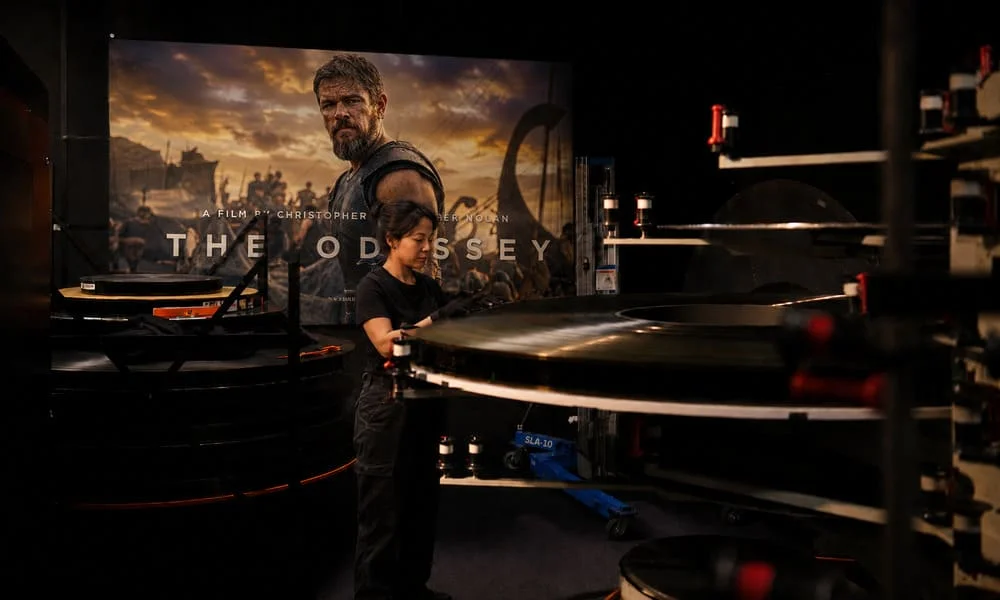
More than 22,000 moviegoers have traveled to Prague to see The Odyssey in IMAX 70mm, turning a film screening into a pilgrimage.
Cinema City Flora has become a cinematic destination for an entire continent because it houses one of only 41 venues worldwide capable of projecting the film in IMAX 70mm. The other two in the European Union are located in Brussels and Montpellier, while the United Kingdom has three more. By Monday, July 27, around 22,000 people had already traveled to the Czech capital to see The Odyssey by Christopher Nolan in the format intended by the director, prompting the theater to schedule four or five screenings a day, including one after midnight.
The pilgrimage to Cinema City Flora comes as the film racks up milestones almost as quickly as Odysseus suffered shipwrecks. After two weekends, The Odyssey had grossed $639.6 million worldwide, including $140 million from IMAX theaters—21.9 percent of its entire global box office. Its second weekend in the premium format generated $48 million alone, setting a new IMAX record.
The figures, however, tell only part of the story. Alongside praise for the film’s visual scale, the physical immediacy of its filmmaking and Nolan’s ability to bring an ancient poem into contemporary blockbuster cinema, criticism has emerged over precisely what may remain once the cult of the format has run its course.
The Real Hero of The Odyssey Is an IMAX Technician
The Odyssey is the first narrative feature shot entirely with IMAX film cameras. Each frame spans fifteen perforations, while the film runs horizontally rather than vertically, providing a much larger image area than traditional motion-picture formats. In theaters equipped for 15/70 projection, the 1.43:1 aspect ratio delivers above all more image height: not merely an enlarged picture, then, but a composition capable of occupying more of the viewer’s field of vision.
The print delivered to Cinema City Flora weighs around 300 kilograms and measures 18 kilometers. It is so large that it had to be transported in several sections as industrial freight and then assembled inside the theater. Both the film and projector must remain in a climate-controlled environment, while the machine may only be operated by projectionists authorized by IMAX.
The projector itself resembles a piece of industrial machinery more than a modern electronic device. The film must move with extreme precision without being scratched or torn; the powerful xenon lamp requires a water-cooling system; and the digital soundtrack must remain synchronized with the passing frames. Some components are no longer manufactured; even the old audio-control systems continued running for years on Windows XP. The survival of the format therefore depends on specialized technicians, increasingly rare spare parts and machines built decades ago.
Prague still possesses this small, functioning fossil because of a decision made during the digital conversion of movie theaters. Around 2008, when many venues were removing their old analog equipment, Flora’s projector was not dismantled. It was placed in a corner and remained unused for approximately three years, until it returned to service in 2012 for The Dark Knight Rises. It later screened Interstellar and Oppenheimer as well.
Nolan has spent years defending the movie theater as cinema’s privileged home. With The Odyssey, however, this position takes the form of a luxury theater model: a handful of venues, central seats booked months in advance, international travel, formats that are difficult to replicate and a constantly reinforced distinction between those who can see the entire frame and those who must settle for a reduced version.
Cultural Tourism Makes Its Feature Debut: Emily Wilson’s Critique
Most critics have greeted The Odyssey with enthusiasm. Variety praised its vastness and spectacular power, while also describing it as slightly detached: an epic in which Homer’s heart risks remaining outside the frame. The harshest criticism came from Emily Wilson, professor of classical studies at the University of Pennsylvania and author of one of the most influential contemporary translations of the Odyssey.
Nolan had cited her work among the film’s reference texts and drawn on some of her linguistic choices. Wilson, however, accused the screenplay of losing much of the poem’s psychological, political, ethical and emotional complexity: Odysseus’s accountability, the position of women, the weight of slavery, the violence of the homecoming and the perpetually uncertain boundary between heroism, cunning and domination.
The rush to Prague involves moviegoers from Scandinavia, Spain, Italy, Germany, Poland and many other countries. The result is an unusual form of cultural tourism: audiences are not traveling for a festival, a premiere or a meeting with the actors, but to watch a projector operate and gain a few extra centimeters of image. The most interesting discussion, however, concerns what may have disappeared inside that image: the sea, the Cyclopes, the Sirens, the storms and the vastness of the landscape do not automatically guarantee the moral depth of the journey.
70mm remains a technical achievement, and Nolan’s defense of theatrical exhibition has genuine value in a streaming industry accustomed to treating films as interchangeable content. But when the format becomes the primary guarantee of authenticity, cinema risks resembling a magnificently built ship that has forgotten its destination.