Now Reading: Star Wars: George Lucas and the Trilogy That Never Was
-
01
Star Wars: George Lucas and the Trilogy That Never Was

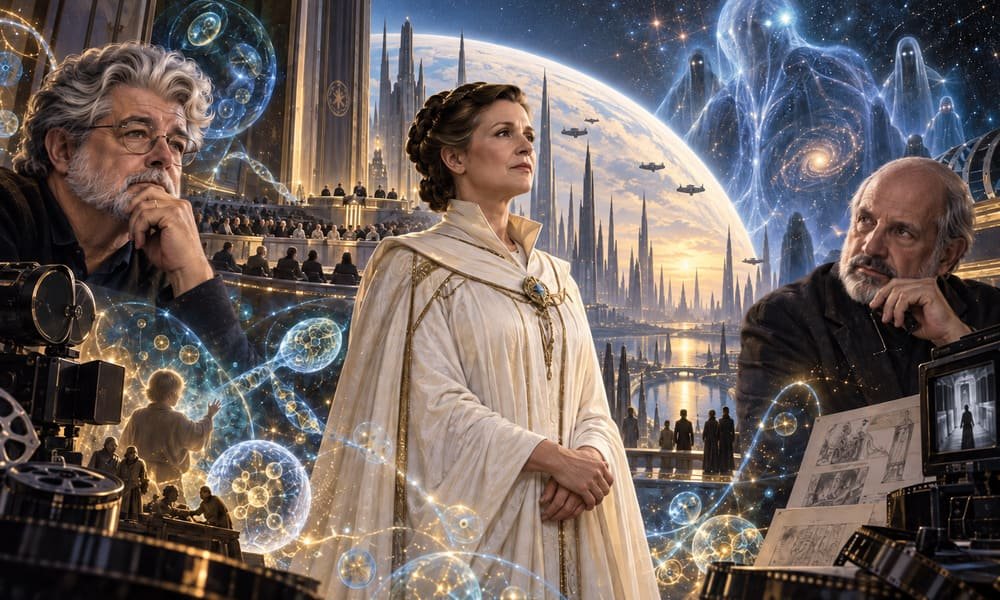
George Lucas had developed Episodes VII, VIII and IX before selling Lucasfilm. Darth Maul, Leia's political rise and the Whills reveal a trilogy Disney never made.
George Lucas had prepared a new Star Wars trilogy, then chose to stop. From Darth Maul to the Whills, here is what we know about the three films he never made.
In 2012, George Lucas still had three Star Wars films ahead of him. Not three ideas scribbled in a notebook, but Episodes VII, VIII and IX already in development.
Then he sold Lucasfilm to Disney and stopped.
Today, at 82, on the occasion of the opening of the Lucas Museum of Narrative Art, he finally explains why he decided that another ten years of his life was too high a price.
George Lucas, guardian of the Force and the IP
That those films were something more than a hypothesis was stated by Disney itself on the day it acquired Lucasfilm.
On October 30, 2012, Bob Iger told investors that, together with the company bought for about $4.05 billion, Disney was acquiring a “fairly extensive and detailed” treatment for the next three films. Episode VII was already in an early stage of development, and Lucas had reopened discussions with the old cast: Mark Hamill has said that he and Carrie Fisher were invited to lunch by the director to discuss the new trilogy in development.
Lucas had spent decades defending control of Star Wars from the studios, building around his personal creative sanctuary, Skywalker Ranch, an increasingly autonomous production system and even personally financing The Empire Strikes Back.
In 2012 came the capitulation: he handed over full control, along with the stories. He chose instead to devote himself to his family and to a project he had pursued for almost twenty years: the Lucas Museum of Narrative Art, built in Los Angeles with more than a billion dollars of his personal fortune and dedicated not only to cinema but to comics, illustration and visual storytelling.
Disney would later make The Force Awakens, The Last Jedi and The Rise of Skywalker by following a profoundly different path, while Lucas would become the unreachable guardian of his own universe: The Big Bang Theory turned that almost sacred aura of inaccessibility into a gag, with Sheldon and Leonard trying to break into Skywalker Ranch and ending up detained alongside a fan caught making out with a statue of Chewbacca.
“When you give something up, you also give up the right to decide what it will become.” — George Lucas
Darth Maul, Leia and the new galactic order
There is no public definitive screenplay for the trilogy George Lucas imagined after Return of the Jedi, partly because the project changed several times over the years. Some lines, however, have emerged with considerable precision from conversations published in The Star Wars Archives: 1999-2005. Lucas envisioned a third trilogy devoted to the daughter and grandchildren, a story capable of expanding to the next generation and examining the consequences of the Empire’s fall across a much longer time span than the original trilogy.
The Rebels’ victory, in fact, would not have automatically restored order to the galaxy. Lucas explicitly compared the situation to postwar Iraq: once the regime was defeated, the question remained what to do with its men, its structures and the power vacuum left behind. Surviving Stormtroopers would have continued fighting on the edges of the galaxy, while gangsters and criminal organizations would have exploited the weakness of the emerging Republic. Uniting that underworld would have been Darth Maul, survivor of the events of The Phantom Menace and transformed by Lucas into a kind of godfather of galactic crime, alongside Darth Talon, a character from the Star Wars: Legacy comics who would have filled the role of the new major Sith threat.
At the center of the trilogy would have been, above all, the difficult reconstruction of the Republic. Leia would not simply have inherited victory over the Empire, but would have had to transform it into a political order capable of surviving the war.
Leia Organa would have risen all the way to the office of Supreme Chancellor and, in Lucas’s vision, would even have taken on the role of the saga’s true “Chosen One.” In parallel, Luke Skywalker would have searched for survivors of Order 66 and trained new students, gradually rebuilding the Jedi Order almost from scratch.
“Rebuilding afterward is always harder than starting a rebellion or fighting a war.” — George Lucas
The Whills and the documentary about the Force dedicated to Brian De Palma
But the project would also have had a far more radical and hard-science-fiction dimension, because Lucas wanted to go inside the very nature of the Force.
Almost half a century earlier, during the famous private screening of the still-unfinished first Star Wars, Brian De Palma, a director far less inclined toward mysticism and much more tied to physical, earthly cinema, had teased him precisely about the vagueness of the concept, essentially asking “what the hell all that Force stuff was.”
Years later, in a conversation with James Cameron, Lucas explained that the three films would enter an actual microbiotic world, returning to the midi-chlorians introduced in the prequels and finally bringing the Whills, creatures or entities present in Star Wars mythology since its earliest drafts, to the foreground. According to Lucas, the Whills control the universe and feed on the Force, while midi-chlorians act as an intermediary between them and living beings. In this conception, therefore, humans would not simply control the Force: they would also be part of a vast cosmic biological system.
Lucas knew perfectly well that such a direction would reopen the debate born with The Phantom Menace: many fans would probably have hated that choice, just as they had objected to midi-chlorians and Jar Jar Binks. This is probably where the greatest distance lies from the trilogy later produced by Disney.
Lucas imagined a story about the political reconstruction of the galaxy, the rebuilding of the Jedi and the transition to the next generation, but at the same time he wanted to dismantle the engine of his own mythology in order to show its internal mechanisms, explaining precisely what many viewers would have preferred to leave mysterious.
“You can’t experiment. You always have to do it in a certain way. I don’t like that, and I never have.” — George Lucas