Now Reading: Paramount-Warner: The Skydance Empire Is Born
-
01
Paramount-Warner: The Skydance Empire Is Born

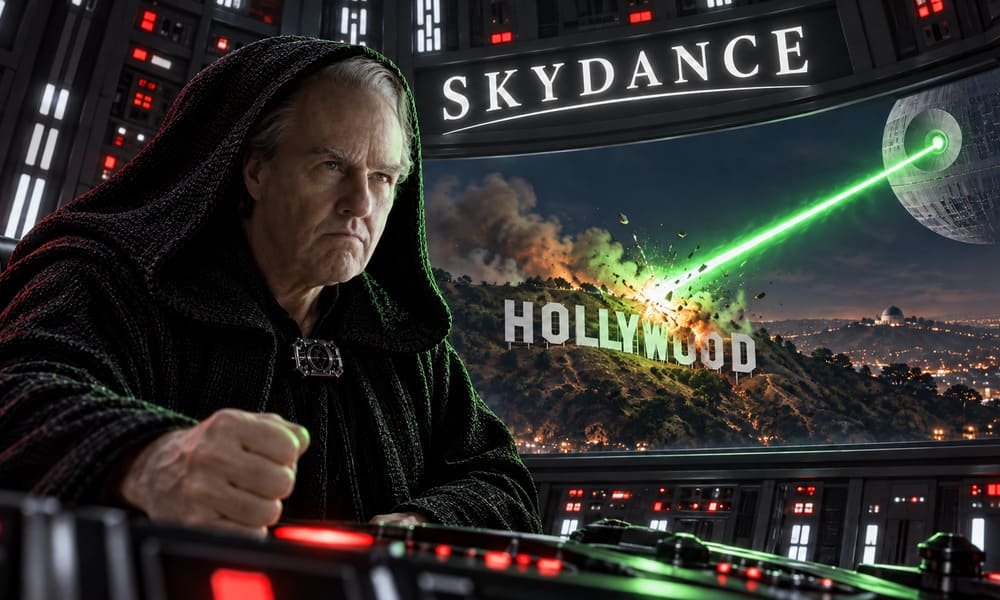
The Paramount-Warner merger promises more movies. The failure of one expensive bet leaves a less comfortable question behind: who will still have permission to try something different?
The acquisition of Warner Bros. Discovery by Paramount is set to create a company worth an extraordinary concentration of studios, libraries, franchises and distribution power. The new parent will operate under the Skydance name, while Paramount and Warner remain visible as historic brands attached to the same corporate center.
Artists are promised more opportunities. Investors are promised billions in synergies. Workers facing redundancy are promised training and reskilling funds. The vocabulary is familiar because consolidation almost always arrives speaking the language of expansion.
Thirty movies a year, provided the wrong one does not fail
Tom Cruise publicly supported the merger and endorsed the promise of roughly thirty films a year, even imagining that the number could rise further. It was a persuasive endorsement from a star whose career is entangled with both sides of the new structure: Top Gun and Mission: Impossible at Paramount, alongside his producing relationship with Warner.
Then came Digger, Alejandro González Iñárritu’s satire starring Cruise. Its weak opening against a production budget of at least $125 million, plus a massive marketing campaign, supplied the sort of result conglomerates remember very efficiently. Warner had invited audiences to make up their own minds after disappointing reviews. They did.
The irony is that Warner had ended 2025 with $4.3 billion in worldwide box office, its best result since 2019. Yet the leadership that oversaw that run still exits, while Dana Goldberg and Josh Greenstein take control across both studio operations.
The public promise remains abundance. The private pressure will be to make sure the next twenty-nine movies do not resemble the one investors have just watched underperform.
Andor, Gilroy and the architecture of control
Warner Bros. Discovery itself was born from a merger in 2022. That combination was also presented as a way to create more resources, more choice and billions in annual synergies. Within a few years the company had taken a multibillion-dollar impairment on its television networks and was again being reorganized in the name of competitiveness.
The pattern resembles a broader feature of concentrated platform power: scale is justified as a way to compete with even larger rivals, and then the resulting structure becomes the argument for another round of scale.
Tony Gilroy has called the Paramount-Warner merger tragic, describing it as a destruction of Hollywood’s architecture in the name of venture-capital logic. His own work on Andor offered a useful metaphor. Empire appears monolithic from a distance, but inside it sits a network of frightened people, career ambitions, incentives and offices. Centralized authority looks orderly until its mistakes have nowhere else to go.
That is the structural risk here. A failed experiment inside a diversified industry is one company’s bad decision. A failed experiment inside a concentrated industry can become a directive applied everywhere.
The fewer desks there are to reject the same idea, the fewer desks remain where a different idea can be proposed. Consolidation may eliminate duplication. It can also eliminate the spaces that allow an industry to correct itself.