Now Reading: Sunshine: Danny Boyle’s Psychoactive Light
-
01
Sunshine: Danny Boyle’s Psychoactive Light

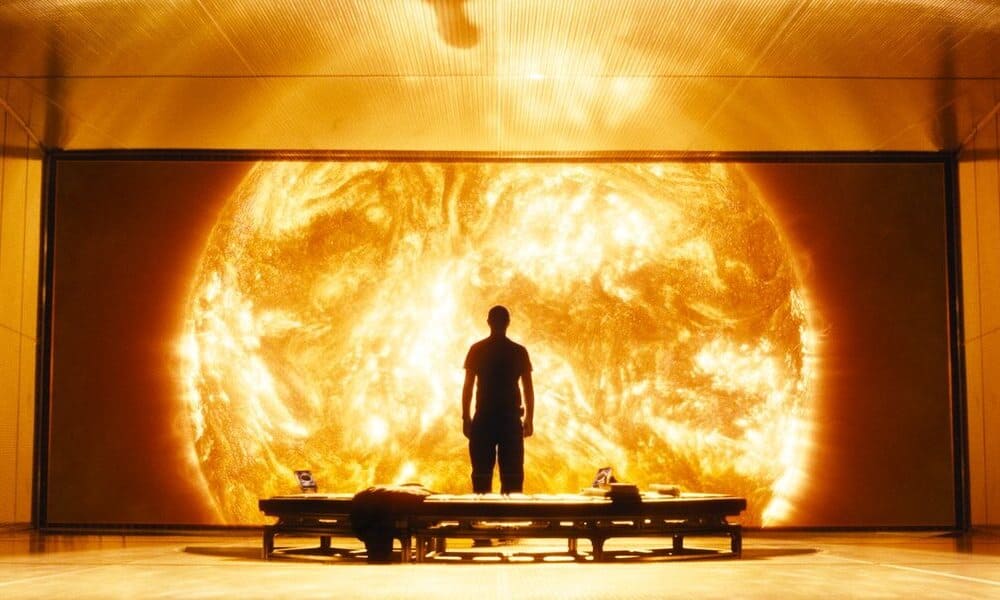
Directed by Danny Boyle, written by Alex Garland and scored by John Murphy, Sunshine (2007) is a hypnotic work of science fiction, scorched by fatalism.
The long-running collaboration between Danny Boyle and Alex Garland—which has recently begun to show signs of strain following the lukewarm reception of 28 Years Later: The Bone Temple—reaches an unsurpassed peak in Sunshine. Here, the philosophical ambition of Garland’s writing and Boyle’s visionary direction merge into a science-fiction synthesis of rare power.
The plot of Sunshine follows the crew of the Icarus II on a desperate mission: to reignite the Sun with a stellar bomb. As the spacecraft approaches the Sun, each crew member sees their own shadow expand, blinded by the reflection of their ego.
While heroin in Trainspotting promised fulfilment, the erasure of pain and access to a higher meaning, in Sunshine sunlight is not merely a physical or symbolic element. It behaves like a genuine metaphysical drug, gradually penetrating the souls of the crew, altering their perception, expanding the unconscious and magnifying latent desires, fears and impulses.
The light reveals, and revelation is lethal. In keeping with his artistic vision, Danny Boyle portrays addiction not as an escape from reality, but as a violent acceleration towards its most traumatic core.
Kaneda, Harvey, Searle, Trey, Corazón, Mace, Pinbacker, Cassie and Capa: eight crew members, together with a “ninth ghost”—the commander of the previous Icarus I mission—form a collective act of atonement on behalf of all humanity. Each death is not accidental, but profoundly karmic: a progressive form of poetic justice punishing virtues, faults and obsessions.
Kaneda’s Harakiri: The Possibility of Sacrifice Within the Pioneering Drive
When the spectre of failure appears in the form of a mayday signal from the Icarus I, the crew decides to alter course in an attempt to recover a second explosive device.
The first to die is Captain Kaneda, played by Hiroyuki Sanada. He goes out onto the heat shield with Capa to repair panels damaged by Trey’s navigational error. At the fatal moment, he remains behind to contemplate the Sun, driven by the visceral curiosity of the pioneer and unable to look away from the heart of creation.
His poetic punishment is clear: Kaneda is the most disciplined and reliable member of the crew, the leader who sacrifices himself for the mission. And it is the mission itself, embodied by the blinding light, that calls him towards it.
He is consumed by the very force from which he was meant to protect the others, like a captain consciously choosing to be the last to abandon his ship. Yet in this case, he willingly embraces annihilation for the sake of the group, while keeping the ultimate vision for himself, despite psychologist Searle repeatedly asking him, until the final moments:
“What do you see?”
Harvey: The Blind Survival Instinct of the Status Quo
The possibility of obtaining a second device, additional oxygen and a greater chance of survival through the cannibalisation of those who failed before them leads Harvey—the deputy commander and communications officer played by Troy Garity—to board the wreck of the Icarus I alongside Capa, Mace and Searle.
But from Alien to Event Horizon, the history of science fiction has taught us that docking with abandoned spacecraft is never a good idea.
Just as Harvey discovers a forest aboard the Icarus I capable of providing oxygen for everyone, the airlock connecting the two ships is destroyed by the monstrous Pinbacker, forcing the four men to decide whose survival should take priority.
Although Harvey insists on saving himself and attempts to impose his personal survival through orders and threats, the universe ultimately tears away the breath to which he has so violently clung, leaving him drifting through space alongside the fragments of his truth.
Searle: The Contemplation of a False Divinity, Between Worship and Perversion
Searle, the psychologist played by Cliff Curtis, is the crew member most fascinated by the Sun. His observation sessions become increasingly long and intense, bringing him closer to a form of mystical ecstasy.
“The thing about darkness is that you float in it. You and the darkness are separate from each other, because darkness is the absence of something. It is a vacuum. Light, on the other hand, envelops you. It becomes part of you.”
When he chooses to remain aboard the Icarus I and the viewing-room filter fails, Searle is consumed by the light he has deified. It is the perfect ending for a character who had ceased to distinguish between a scientific mission and personal worship.
Trey: Technical Pride and Human Fallibility
“People make mistakes. I made a huge one.”
Trey, the engineer played by Benedict Wong, is responsible for the calculation error that alters the ship’s course and jeopardises the mission. His already fragile mind, shaken by isolation, collapses beneath the moral pressure, turning him into a seemingly “useless” individual within an environment of limited resources.
Just as the surviving crew members consciously decide to kill him in order to conserve oxygen, the rational individual’s poetic punishment is completed through suicide. Trey does not die because of the Sun or a technical accident, but because of the devastating force of guilt.
His fate becomes an inward spiral, and his death emphasises one of the film’s central themes: technology does not give humanity control over its destiny. Material resources and ingenuity are not enough to keep us alive.
Corazón: The Guardian of Life and the Unnaturalness of Evil
Corazón, played by Michelle Yeoh, is the biologist responsible for tending the garden that sustains both the crew’s oxygen supply and morale. She is the character most deeply connected to life, the one who can still perceive hope in seeds and growth.
Devastated by fire, the garden may no longer be capable of producing enough oxygen for the crew to reach the bomb’s release point. Yet just as Corazón discovers a surviving plant among the ruins, she is senselessly murdered by Pinbacker, who sabotaged the Icarus I mission and has now infiltrated the Icarus II with the same deranged purpose.
Corazón dies inside the vegetal womb she had protected, at the very place where life had proved strongest. Pinbacker’s act becomes a symbolic blood sacrifice: the destruction of nature by fanaticism.
Mace: The Will to Power and Redemptive Poetic Justice
Mace, played by Chris Evans, is the pragmatic technician who makes difficult decisions with coldness and clarity. He is the crew member most committed to the survival of the mission, even at the cost of his companions’ lives. When something does not work, he fixes it with his fists.
His poetic punishment comes in the form of absolute cold. Pinbacker’s attempt to sabotage the mission compromises the Icarus II’s guidance and control system, forcing the remaining crew to reorganise the operation manually.
Mace freezes to death while attempting to restart the computer system: an heroic act that no amount of physical strength can accomplish. The man of action, the strongest and most resilient among them, is defeated by the physical limitations of his own body.
Still determined to complete the mission, he projects his will beyond his own survival. His final words are:
“Do it, Capa! Do it!”
Pinbacker: Religious Fanaticism and Desperate Narcissism
Pinbacker, the captain of the Icarus I played by Mark Strong, has been transformed by years of solitude into an entity deformed by excessive exposure to solar radiation and by a desperate, obsessive faith:
“At the end of time, there will be a moment when only one man remains. Then that moment will pass, and man will be gone. There will be nothing to show that we were ever here. Nothing but stardust. The last man, alone with God. Am I that man?”
As Capa and Cassie “ride the bomb,” separated from the mother ship and having abandoned all hope of returning to Earth, Pinbacker attacks them in a final desperate attempt to impose himself as the chosen one:
“For seven years I spoke with God. He told me to take us all to Heaven.”
His poetic punishment is fulfilled when he is left behind, no longer capable of interfering with events.
In these scenes, Mark Tildesley’s production design, Alwin H. Küchler’s cinematography and, above all, the visual effects created by the Moving Picture Company team reach their highest level, both in the horror sequences and in the depiction of space-time contracting during the journey into the Sun.
Cassie: The Empathetic Conscience of a World Falling Apart
“Bad dream? Let me guess—the surface of the Sun. That’s the only dream I ever have. Every time I close my eyes, that’s what I see. Always.”
Cassie, played by Rose Byrne, is the ship’s biologist and medical officer, as well as the most empathetic member of the crew: the emotional conscience of the group. She believes in the humanity of the mission and in the dignity of sacrifice.
She is the only one to support the diversion to assist the Icarus I without reservation, a decision that paradoxically endangers the mission. She is also the only one who opposes killing Trey, even when the alternative appears to be suffocation before they can complete their objective.
Her poetic punishment is to become the agent of the film’s most explicitly splatter-like act of violence. The conclusion of her character arc also marks the disappearance of the final trace of compassion from the story. From that moment onwards, only function remains.
The Death—and Rebirth—of Capa: Knowledge Transformed into Action
“At first, when the bomb is triggered, nothing much will happen. Then a spark will appear out of nowhere, and for an instant it will hang in space. Then it will split into two, and split again, and again, and again. An unimaginable detonation. A miniature Big Bang. A star will be born from a dying one. It will be beautiful. No, I’m not afraid.”
Capa, played by Cillian Murphy, is the physicist responsible for the stellar bomb, the person who truly understands the nature of the mission. As a theoretical physicist, he lives through abstractions, calculations and models. Unlike the other characters, he is motivated neither by military duty nor religious faith, but by an almost contemplative curiosity: how close can he move towards his vision without losing himself?
In this sense, he is a tragic hero, destined to perform the final act without reward or remembrance. His poetic punishment is the physical sublimation of his own being.
At the moment when he is dissolved by the light, Capa reignites the Sun and restores a future to Earth. His is a death that does not deny life, but pays its full price, redeeming all the deaths that came before it.
Sunshine therefore closes its argument in a ruthless and unmistakable way: meaning exists, but it is incompatible with the survival of the individual ego.
To illuminate others, one must be willing to burn.