Now Reading: Microdrama: When Stories Become Tokens
-
01
Microdrama: When Stories Become Tokens

Shortical raises $100 million, Instagram targets TV, Peacock tests ReelShort and India accelerates: all the data on the microdrama boom.
The microdrama is becoming one of the most closely watched formats in the American and international audiovisual industry. In recent weeks, the sector has seen a string of funding rounds, licensing deals, major-studio investments, agreements with movie theaters, new vertical platforms and Indian catalogs designed for global distribution.
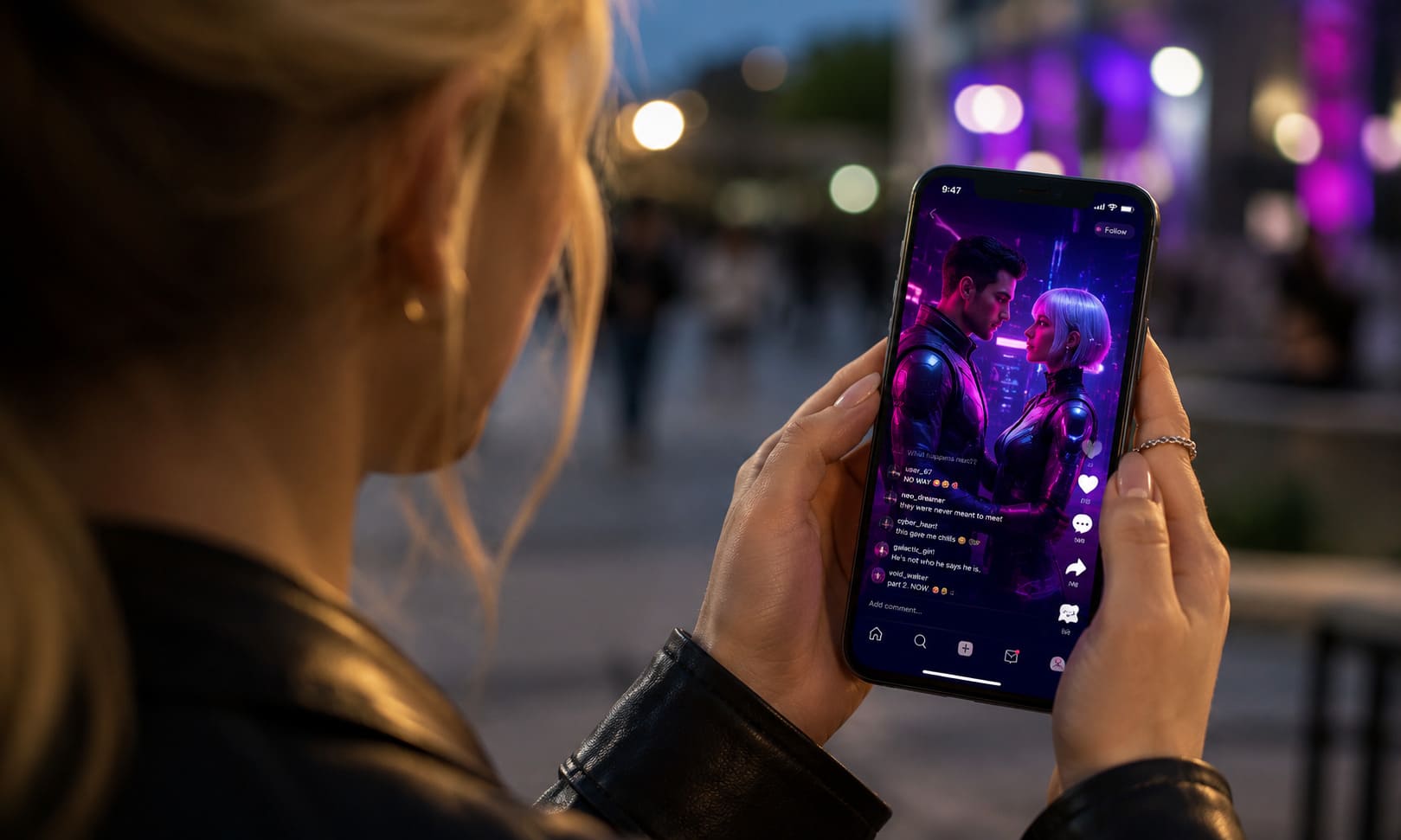
The format is simple and highly recognizable: vertical phone-first episodes, often one to three minutes long, built around romance, betrayal, fantasy, thrillers, cliffhangers and progressive payments after the first free episodes. But the numbers suggest that the sector is no longer operating only on the margins of the market.
In China, where they are known as duanju, these contents are already cannibalizing social media and evolving into a global industry, with an estimated value that could reach $25,7 billion by 2030.
Shortical raises $100 million and bets on AI actors
The most recent news comes from Business Insider: Shortical, an Israeli microdrama app, has raised $100 million in funding from PvX Partners, structured as user acquisition financing. The deal concerns an app that produces short series designed for phones and fits into a market that Deloitte expects to grow to $7.8 billion in revenue this year, with the United States accounting for around 40% of the total. According to Sensor Tower, Shortical rose to 24th place among microdrama apps by downloads in the first half of 2026, after ranking 39th in the second half of 2025.
Shortical says it employs 15 full-time screenwriters and has worked with talent such as Ofir Lobel, director of the Netflix series Black Space. On the production side, however, the company is pushing decisively into AI-generated actors: it has already released the fantasy series Bound by Fire, starring AI actors, and says the audience response was comparable to that of live-action productions. In the coming months, Shortical plans to produce 20 hours per month of AI shows and 5 hours per month of live-action shows.
This is PvX’s third investment in microdrama apps, after StoReel and Luni. Shortical had already raised $15 million earlier this year from Net Capital Ventures and Sticker Ventures. The app’s business model uses coins to unlock episodes and unlimited plans priced at $7.99 per month or $124.99 per year.
Hollywood enters microdrama with Issa Rae, Fox and ViX
Associated Press traced Hollywood’s entry into the sector starting with Screen Time, a vertical thriller produced by Hoorae Media, Issa Rae’s company, and backed by TikTok. The series was released in May and reached nearly 75 million views in its first week. Hoorae studied the format for more than two years before launch: microdrama episodes last between one and three minutes, are shot vertically and are designed for smartphone viewing.
The model originated in China during the pandemic and then spread to the United States. The most common commercial structure offers a few free episodes and then requires payment to unlock the following ones. Titles often cited as examples of the genre include The Double Life of My Billionaire Husband, which helps show how closely the format is still tied to soap-opera, romance and serialized melodrama formulas. According to an estimate by Omdia, global microdrama revenues could reach $14 billion by the end of 2026.
The clearest signal, however, comes from the players involved: Peacock has already launched a dedicated microdrama hub, Fox Entertainment has invested in producer Holywater and committed to making hundreds of vertical titles, while TelevisaUnivision is developing short-form serialized dramas for ViX. It is not only smaller platforms or phone-native apps that are moving into the format: broadcasters, streamers and producers tied to mainstream entertainment are also entering the field. Kevin Hart is working with HartBeat on vertical comedy, Kim Kardashian is among the investors in ReelShort, while Taye Diggs and director Deon Taylor are involved in the vertical sports series I Am Hoop.
A less visible but important data point concerns user acquisition costs. At MIP London, some executives said the largest microdrama platforms may spend up to 90% of their budget on marketing, a sign of highly aggressive competition to bring users into the apps. Kountry Wayne, who publishes 50 episodes a day, claimed to have generated around 1.4 billion views on Facebook and another 100 million on YouTube in a single month, while turning down eight-figure offers to license or sell his content.
Google Bets on Microdramas and Changes the Market (Again)
Google TV, too, seems to have understood that microdrama is no longer just a smartphone format, but a possible new gateway into streaming. The platform is integrating apps dedicated to vertical content into its central hub, along with discovery and navigation tools designed to make them easier to find and watch on television as well.
Google TV could become a kind of ready-made infrastructure for producers and creators who do not have the resources to build their own apps, backends and distribution systems. In this way, the threshold for entering the market changes: what is needed is no longer necessarily the capital of a major streamer, but a serial idea, fast production and the ability to capture an audience quickly.
This is where platforms such as VeYou come in. Founded by Tommy Harper, a producer of Hollywood blockbusters and franchises such as Star Wars and Top Gun: Maverick, VeYou sums up the ambition to bring microdrama into a more premium logic with an effective formula: “We want to be HBO mixed with TikTok.”
Instagram brings Reels, Stories and episodic content to TV
On June 25, 2026, Instagram launched new features for its smart TV app, available on Amazon Fire TV, Google TV and Samsung Smart TV. The app now allows users to watch vertical Reels, disappearing Stories and horizontal videos with an aspect ratio close to the one used on YouTube. Instagram also announced a future push into long-form, episodic content and live experiences designed for TV.
The most relevant point for microdrama is the direct competition with YouTube Shorts and with vertical platforms already built around phone-first serial storytelling. Instagram can rely on a massive base of around 3 billion monthly users, but it still has to adapt that audience to a different kind of use: not just quick scrolling on smartphones, but longer, episodic and possibly even home-based viewing. That is why the TV app includes dedicated channels and a section for widescreen videos, while vertical Stories remain a format that is harder to make feel natural on wide screens and with a remote control.
The current weakness is the catalog. YouTube is already extremely strong on television, while Instagram has to convince creators to produce more polished, longer or at least more big-screen-friendly content. Product vice president Tessa Lyons presented short-form content as an accessible route for creators who want to move into longer and more episodic stories: starting from short, accessible and familiar content in order to arrive at more structured products, without losing the habit of fast viewing that made the platform so dominant on phones.
Peacock uses ReelShort and Bravo to test microdrama inside streaming
NBCUniversal has brought 10 ReelShort microdramas into the mobile app of Peacock through a temporary agreement, using titles such as Fated To My Forbidden Alpha, The Call Boy I Met In Paris and Baby, Just Say Yes! to directly test how users behave when faced with short, serial and phone-first content.
The ReelShort deal comes ahead of the launch of two original microdramas tied to the Bravo world, Campus Confidential: Miami and Salon Confessionals with Madison LeCroy, expected this summer: a test to understand whether already recognizable television brands can be stretched or compressed into a mobile-first form that is faster, more episodic and better suited to vertical navigation.
John Jelley, senior vice president of product and user experience at Peacock, also explained this approach: NBCUniversal wants to measure how users interact with different kinds of vertical video, how much they click, how long they stay and how they move through the app. In other words, Peacock is using microdrama as a product experiment, not just as editorial content.
The move fits into a broader mobile strategy aimed at making vertical video an extension of existing television franchises. NBCUniversal had already added vertical clips to the Peacock app last year, while Disney+, Netflix and Paramount+ have also introduced similar features. The difference is that Peacock is connecting the format to a more precise ecosystem: Bravo content, sports highlights and even an AI avatar of Andy Cohen.
ThumFlix prepares a vertical platform for filmmakers and scripted content
On the new-platform front, the case of ThumFlix shows how microdrama is also attracting independent companies interested in building catalogs, rights and distribution. The service was announced by House of Reux, an Atlanta-based company led by Taylor Ri’chard, with the goal of launching a mobile-first platform dedicated to short scripted series designed for vertical viewing.
The project is already starting with four international acquisitions and an Indian co-production with Sita22 Films, but the most interesting point is not only quantitative: it is an offer built around rights, catalogs, co-productions and new exploitation windows. This is also confirmed by the titles acquired for North America, which range across film, documentary and digital series: the Indian film Dilli Dark, the documentary Zende: The Supercop, the Indo-American YouTube series How to Make It in Mumbai and the Belgian film Holy Rosita.
These are joined by The Good Son, a six-part docuseries made with Sita22 Films, and Tryin’, an adaptation of the bestseller Trying to Sleep in the Bed You’ve Made. House of Reux also plans to distribute nine feature films in North America by the end of the year, a detail that makes ThumFlix look less like a simple vertical app and more like one piece of a broader strategy built around international acquisitions, independent distribution and new windows for scripted content.
India: YRF invests in Rusk Media, One Life Studios acquires 500 microdramas
The Indian front is one of the most useful signals for understanding that microdrama is not only about the United States, China or apps created to monetize very short episodes. In India, both historic film companies and firms specializing in international distribution are moving into the space, and in both cases the vertical format is being treated as a field for building IP, catalogs and young audiences.
Yash Raj Films has announced a strategic investment in Rusk Media, a digital-first company specializing in vertical IP for Gen Z and Gen Alpha. The financial details of the deal were not disclosed, but the structure of the partnership is clear: YRF will oversee the creative direction of original animation and vertical microdrama IP, while Rusk Media will produce and distribute the content through its own platform, Alright! TV, and global digital channels.
One Life Studios has announced a global expansion in its tenth year of activity: more than 750 premium Indian titles in its portfolio and over 500 microdramas acquired for worldwide distribution. The vertical format thus enters an exportable library designed for global platforms and mobile-first audiences. The company is also preparing an animated IP for MIPJunior and cites international deals such as Dhruv Tara in Vietnam, through IMC-TV Today, and Porus and Chandragupta Maurya in Ghana.
With more than 65 awards across India and foreign markets, One Life Studios treats microdrama, animation and television libraries as parts of the same international strategy.
aTwist brings microdramas to cinema preshows
The most direct connection with traditional cinema comes from the United States: the preshow, that space before the trailers where advertising, promotional content and commercial messages try to reach an audience already seated in the theater. National CineMedia, the company that manages the Noovie cinema preshow, has struck a deal with aTwist, an AI-native microseries studio based in Los Angeles, founded by former Hollywood executives such as Jana Winograde, Susan Rovner and Lloyd Braun.
Starting this summer, audiences will see previews of aTwist vertical series before the trailers. The ads will include brand-sponsored series, previews of aTwist originals and QR codes to take audiences directly to the platform. NCM’s programming reaches more than 18,500 screens in over 1,650 theaters across the United States, including chains such as AMC, Cinemark and Regal, across 185 markets.
According to an estimate by Owl & Co., the vertical video market should generate around $150 billion this year, a scale that also explains the interest of brands such as Marc Jacobs and Crocs, which are already active in using this kind of storytelling for advertising and campaigns.
Creators, marketing and costs: microdrama seeks legitimacy
The growth of microdrama is accompanied by strong numbers, but also by an economic structure highly exposed to user acquisition costs. Still, the rise of microdrama is not only about platforms and investors, but also about the way creators and filmmakers are already trying to use the format.
The American Black Film Festival launched its first microdrama showcase this year, selecting eight finalists from hundreds of submissions: programmer Bobbi Broome explained that some participants treated microdrama as a possible proof of concept for a feature film.
It is not an isolated case: the Vertical Drama Love Fan Awards were created in Los Angeles, while the Vertical Shorts Festival will bring its ceremony inside the Vertical Microdrama Market 2026 in Las Vegas. In Europe, too, the topic reached the European Film Market at the Berlinale, with a workshop dedicated to vertical microdrama, and in China the New Media Short Film Festival in Shenzhen included an international micro-drama market with platforms such as TikTok and ReelShort.
Microdrama is growing because it gives the industry what the industry is always looking for: lower costs, faster production, measurable audiences and revenue split episode by episode. The fact that it is now also appearing in festivals, showcases, cinema preshows and major-studio strategies says a lot: the format born to fill the gaps in scrolling is becoming a testing ground for stories, audiences, talent and new revenue models.