Now Reading: Human Consent Registry: Cate Blanchett at the EU Parliament
-
01
Human Consent Registry: Cate Blanchett at the EU Parliament

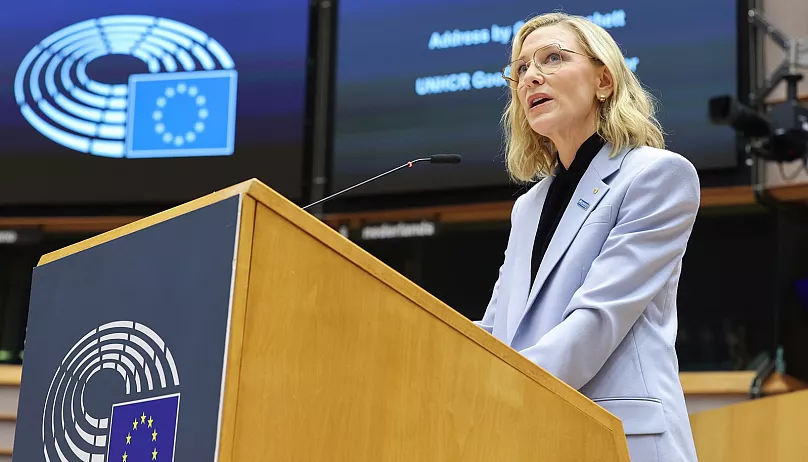
Cate Blanchett presents the Human Consent Registry: a free registry designed to protect faces, voices and identities from unauthorized use by AI.
Artificial intelligence has not only learned to write, sing, draw and imitate. Above all, it has learned to extract value: it takes images, voices, gestures, faces, archives and fragments of identity, then turns them into material that can be trained on, replicated and commercialized.
Cate Blanchett, together with Steven Soderbergh and Nikki Hexum, presented the Human Consent Registry at the European Parliament, a free registry created by RSL Media, the nonprofit organization co-founded by the actress. The idea is that every person should be able to clearly state whether their name, face, voice and identity may be used by artificial intelligence systems.
The Human Consent Registry seems to gather and operationalize the same exposed nerve touched by the “Stealing Isn’t Innovation” campaign: the idea that AI cannot keep calling innovation what, without consent, increasingly resembles a systematic extraction of works, faces and identities.
Consent as infrastructure, not as privilege
The registry works as a kind of consent traffic light: red if use is prohibited, yellow if it is allowed only under certain conditions, green if it is authorized. In the project’s intentions, this declaration should also be readable by models that collect data online. It is an attempt to insert into the web what has so far been glaringly absent: a layer of consent, a minimal grammar for saying, “this is me, and you are not free to turn me into raw material.”
Today, many forms of protection against the misuse of one’s image cost enormous sums, creating a system in which rights truly exist only for those who can pay for them. Soderbergh argues: “If there is going to be a solution, it has to be built on this kind of structure, otherwise we will create a multi-tiered system in which some people will have access to these rights and protections, while those who cannot pay will be excluded.”
Blanchett challenges the idea, increasingly useful to the interests of platforms and parts of the creative industry, that human consent is an obstacle to be overcome in the name of efficiency: when production claims the right to emancipate itself from the permission of the people it uses, innovation changes face and begins to resemble an organized form of appropriation.
Laws are beginning to arrive, but concrete protection still lags behind
The European AI Act has opened an initial regulatory front, while in the United States the NO FAKES Act attempts to intervene against unauthorized digital replicas of voices, faces and images. The problem is that between a general law and a person’s ability to clearly state what AI can do with their identity, there is still an enormous gap.
In that gap move lawyers, registered trademarks and defensive strategies that are mostly accessible to those who can afford them. It is no coincidence that figures such as Taylor Swift and Matthew McConaughey have sought to legally protect their voices and images, turning their identities into assets to be locked down before someone else turns them into synthetic material.
The Human Consent Registry will not solve the relationship between AI and rights on its own, but it introduces something that technological enthusiasm tends to remove: the necessary act of reflection. “This standard will not revolutionize our relationship with AI overnight,” Blanchett said. “The more people adopt it, the greater its chances of having a real impact. But we have to start somewhere, because a lack of reflection is the enemy of creativity.”