Now Reading: OMNI Awards Gaudette: AI Cinema Enters the Age of Judgment
-
01
OMNI Awards Gaudette: AI Cinema Enters the Age of Judgment

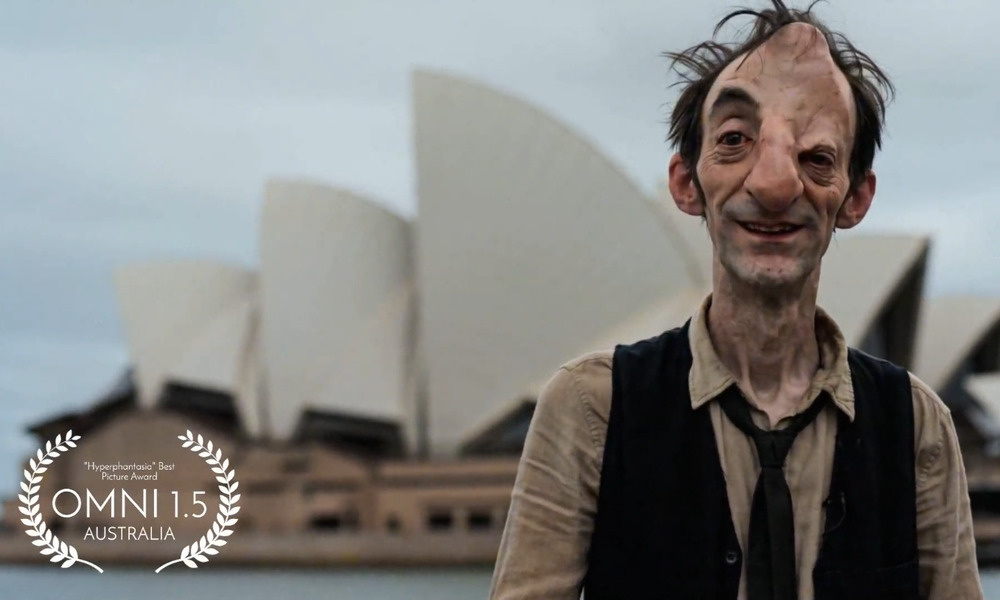
OMNI Hyperphantasia awards Robert Gaudette among 3,800 AI films: with Alex Proyas on the jury, generative cinema is now a crowded ecosystem in search of selection.
The OMNI International AI Film Festival has announced the winners of its 1.5 edition, titled Hyperphantasia, selecting 23 films from more than 3,800 submissions from around the world. Generative cinema has become a crowded, disorderly, inevitably uneven territory, but one broad enough to force someone to select, judge and award. And therefore to establish, even implicitly, an aesthetic hierarchy.
The top prize, the “Hyperphantasia” Best Picture Award, went to A Face Only a Mother Could Love by Canadian filmmaker Robert Gaudette. The jury was led by Alex Proyas, director of The Crow and I, Robot, two films that, in very different ways, had already reflected on the relationship between image, artifice, identity and technological power. That an AI festival is also being evaluated through the gaze of an author who emerged from visionary industrial cinema means that the issue is no longer determining whether these images “count” as cinema, but understanding what forms of cinema they are actually capable of producing.
The news also contains an interesting editorial coincidence: after meeting Alex Proyas and Robert Gaudette in two separate conversations about cinema and the imagination in the age of AI, we now find ourselves facing a festival in which Gaudette’s film is awarded by an edition whose jury is led by Proyas. It is not a causal link, of course, but it is a useful trace through which to read the moment: sometimes editorial work serves precisely to intercept trajectories before they become obvious, and when those trajectories cross within a prize, a jury and a festival, it means one was not observing a technological curiosity, but an already recognizable cultural junction.
OMNI Hyperphantasia and the Qualitative Leap of AI Cinema
The title Hyperphantasia recalls the neurological phenomenon of mental imagery so vivid that it approaches real perception. It is an effective choice because it describes both the ambition and the danger of generative cinema: making almost everything visible, while still having to prove that the infinite availability of images does not kill the necessity of vision.
Compared with OMNI 1.0, held in November 2025, this edition received five times as many submissions. The festival speaks of works coming from Canada, the United States, the United Kingdom, Brazil, Ukraine, Australia and other countries, with a range extending from dystopian science fiction to romantic comedy, from short documentary to feature-length film. It is the clearest sign that AI cinema is passing through a phase in which technical accessibility produces an enormous mass of content, but only part of it manages to become language.
OMNI insists on a point that is far from secondary: the films are screened in person, inside theaters and cultural contexts, rather than simply scattered online as viral clips. It is an almost political choice, one that removes AI cinema from feed-based consumption and places it back in front of an audience, in the very space where the image must hold not as a trick, but as an experience. According to founders Travis Rice and Aryeh Sternberg, the works submitted to the festival show creators who are now interested not only in the power of the tools, but also in themes such as identity, authenticity, memory, climate crisis, human agency and emotion.
The New Grammar of Imagination: From Producing Images to Building Cinema
Gaudette’s victory with A Face Only a Mother Could Love should not be read as the definitive consecration of an author or of a technology, but as a sign of an ongoing cultural selection.
AI cinema is trying to distinguish what is a produced image from what is a thought image; what amazes for thirty seconds from what remains after the screening; what simulates cinema from what, perhaps still imperfectly, attempts to modify its very conditions.
Proyas’s presence on the jury makes the transition even more interesting: if generative cinema is not to remain a fairground of effects, it needs to be measured also by those who understand the weight of staging, duration, storytelling and limits. AI promises to erase many barriers between imagination and image; cinema, however, is born precisely at the point where that freedom is organized, cut, contradicted and made necessary.
OMNI Hyperphantasia shows that AI cinema is not necessarily mature, but it has stopped being invisible as a cultural phenomenon.