Now Reading: Gattaca: Andrew Niccol’s Minimalist Streben
-
01
Gattaca: Andrew Niccol’s Minimalist Streben

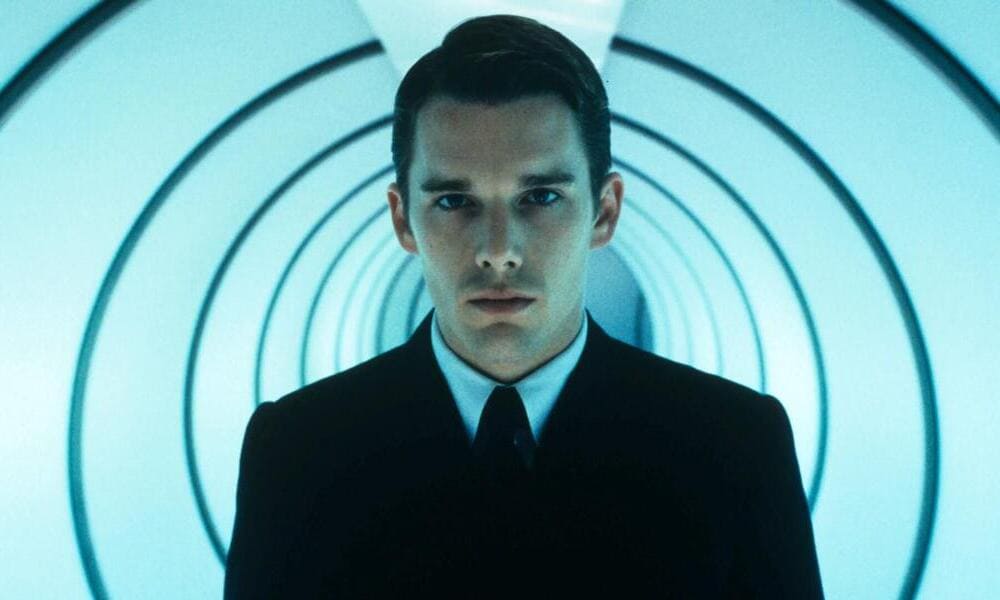
In the genetically classist society of Gattaca, anyone born “imperfect” is forced to break free and win through the only force that escapes measurement: willpower.
Directed in 1997 by a debuting Andrew Niccol, with music by Michael Nyman and starring Ethan Hawke as Vincent Anton Freeman, Jude Law as Jerome Eugene Morrow and Uma Thurman as Irene Cassini, Gattaca is a work of science fiction capable of speaking about the present without empty technological display, but through the integrity of the human being.
Ethan Hawke has returned to the spotlight with his recent Oscar nomination for Best Actor for his role as Lorenz Hart in Blue Moon by Richard Linklater. In Gattaca, Hawke built a fragile yet unbreakable protagonist with extraordinary restraint, entrusting the film’s emotional tension to expressive subtraction and the intensity of his gaze, silently sustaining the entire narrative architecture.
The protagonist, Vincent Anton Freeman, was conceived without the aid of genetic engineering. His DNA predicts a short life and heart disease, and that prediction becomes the social stigma that classifies him as “invalid.”
“It was said that a child conceived in love had a greater chance of happiness. They don’t say that anymore.”
But Vincent refuses to accept the role assigned to him. His dream is to become an astronaut and reach the stars. To do so, he assumes the genetic identity of Jerome Morrow, a man biologically perfect but left paraplegic after an accident. Thus begins his life as a “genetic pirate,” built on precision, discipline and deception.
The visual minimalism of Gattaca: the DNA of a retro-futurist society
At a time when cinematic science fiction tended to emphasize special effects and technological innovation, in the world of Gattaca — whose name derives from the DNA bases Guanine, Adenine, Thymine and Cytosine — everything is reduced to the essential. No screens or gadgets, but monumental spaces in which spiral staircases float, recalling the double helix of DNA.
To represent this universe, Niccol chose buildings of modernist architecture: the headquarters of the space agency is the Marin County Civic Center designed by Frank Lloyd Wright, while the exterior of Vincent’s home is the CLA Building complex by architect Antoine Predock, already used in THX 1138.
The cars have vintage lines but are powered by electric engines, while the costumes are inspired by 1960s fashion, often considered the most “futuristic” decade of the twentieth century. The lunar cinematography of Sławomir Idziak further heightens this rarefied atmosphere, enveloping the film in cold, measured tones.
The result is a sober, elegant and almost timeless future. The environments are geometric, clean, almost ascetic. Polished corridors, flawless surfaces, spaces dominated by sharp lines and rigorous symmetries: a controlled aesthetic that creates an underlying tension in which even the smallest imperfection, such as a misplaced eyelash, becomes crucial.
Vincent: “Director, will this affect the mission?”
Director: “Oh no, everything will proceed as planned. The launch window expires at the end of the week and… as tragic as this event has been, it certainly hasn’t stopped the planet from turning, has it?”
Resilience and Streben: Vincent’s longing against the determinism of Gattaca
At the center of the film lies the story of Vincent’s radical resilience. Society considers him biologically fragile, yet that very fragility becomes the starting point of his determination.
Vincent embodies the philosophical concept of streben, the human being’s relentless drive to overcome his own limits and reach toward something higher than himself. His dream of going into space is not simply a career: it is the manifestation of an existential tension toward the infinite.
The film translates this idea into one of its most memorable scenes: the swimming race in the “primordial” sea with his brother Anton — and, in a sense, with himself, since Vincent’s middle name is Anton.
Anton: “How are you doing this, Vincent? We have to go back.”
Vincent: “You want to know how I did it? This is how I did it, Anton. I never saved anything for the swim back.”
This line is the film’s manifesto. Streben is neither cautious nor calculated. It is a total movement forward, an absolute dedication to one’s desire. Vincent is living proof that human will cannot be measured, and that it can overcome even the limits apparently inscribed in DNA.
The shadow of Eugene and Anton: middle names as returning partial objects
The character of Jerome Eugene Morrow, played by Jude Law, is one of the film’s most tragic and revealing figures. Genetically perfect, programmed to excel, Eugene is the “well-born” man, as suggested by the etymology of his name: eu-genés.
And yet his existence is that of an individual broken by the weight of expectations: Eugene becomes a marginal presence, an almost-man, reduced to providing his real name and genetic heritage as horrific partial objects. No longer a person, but a set of biological fragments — blood, urine, epithelial cells, hair — that allow Jerome, reduced to Hieronymos, “sacred name,” to exist socially.
Anton, played by Loren Dean, the genetically superior second son, designed to grow strong and come first — Antheos — is unable to fully understand Vincent’s will, to the point of sabotaging him. And by also being Vincent’s middle name and the name of their shared biological father, he represents the self-sabotaging shadow of the blind expectations of Gattaca’s society.
And yet, in Jerome’s final sublimation into Vincent, the true catharsis is symbolized by the medal and the lock of hair: wherever we go, we carry nothing with us but memory.
Eugene: “I got the better end of the deal. I only lent you my body. You lent me your dream.”
Genetic classism in Gattaca: a critique of the Übermensch
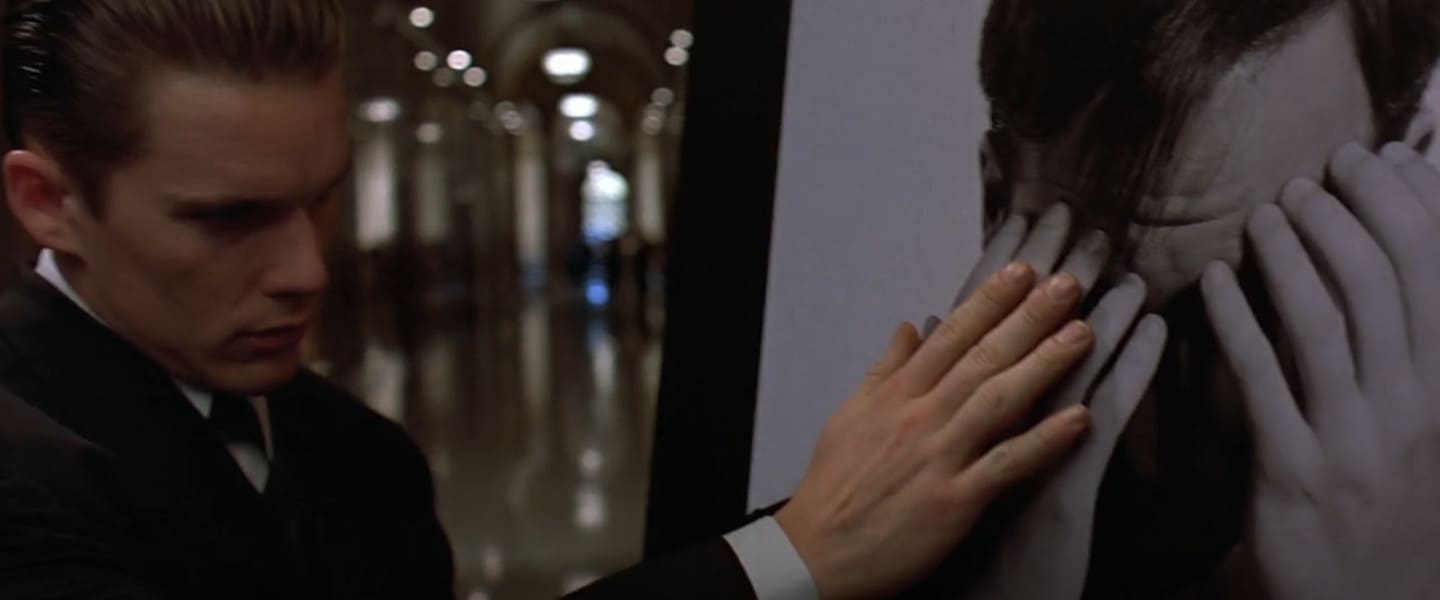
The paradoxical dimension of Vincent’s journey is that, despite undoubtedly overcoming his limits, he has also internalized the genetic classism of his time. This makes him “short-sighted” — as in the scene where he crosses the street for Irene without contact lenses — toward the weakness and unexpected strength of other people’s humanity. The real limit is not knowing one’s own limits.
Vincent: “Twelve fingers or one, it’s how you play.”
Irene: “That piece can only be played with twelve.”
During his date with Irene, played by Uma Thurman, who precisely because of her congenital heart defect manages to see into Vincent’s heart, the impossible twelve-finger adaptation of Schubert’s Impromptu Op. 90 No. 3 represents an artificial perversion of desire, one that risks corrupting the sense of adequacy of those who do not truly know themselves and their limits, and even extinguishing love before it can begin.
In Gattaca, authentic love begins precisely where prediction fails: in risk, in shared imperfection, in the freedom to choose someone not for what one is programmed to be, but for what one can become together.
The final encounter with the substitute father figure represented by the genetic testing doctor is Vincent’s true passage into maturity, as well as his human legitimation. Dr. Lamar, played by Xander Berkeley, although he has always sensed that Vincent’s real genetic identity was different, decides not to expose him, because compassion is an even more immeasurable force than willpower: “You’re going to miss your flight, Vincent.”
Michael Nyman’s narrative lyricism: the music of the de-siderantes
Just as Vincent’s voice-over accompanies the viewer with intimate and melancholic reflections, transforming dystopia into a poetic meditation on existence, so Michael Nyman’s music in Gattaca builds its lyricism through minimalist and repetitive structures.
Piano and strings intertwine in progressions that seem to gather energy with every iteration, like a breath slowly expanding upward. Pieces such as The Departure accompany the film’s decisive moments with an almost spiritual power, in the sonic translation of desire.
In the suggestive etymology of de-sidera — the absence of stars — desire is born from the loss of a celestial reference, from a nostalgia for the infinite. It is no coincidence that the “desiderantes” were Roman soldiers who kept watch under the night sky, awaiting the return of their missing comrades.
From this perspective, Nyman’s music becomes the soundtrack of those who look at the stars not only as a destination, but as an inner calling: the longing of a humanity that continues to search for its place in the infinite.
“For someone who was never meant for this world, I must confess I’m suddenly having a hard time leaving it. Of course, they say every atom in our bodies was once part of a star. Maybe I’m not leaving. Maybe I’m going home.”