Now Reading: Gaza Cinema Academy and the Question of Who Owns the Images of War
-
01
Gaza Cinema Academy and the Question of Who Owns the Images of War

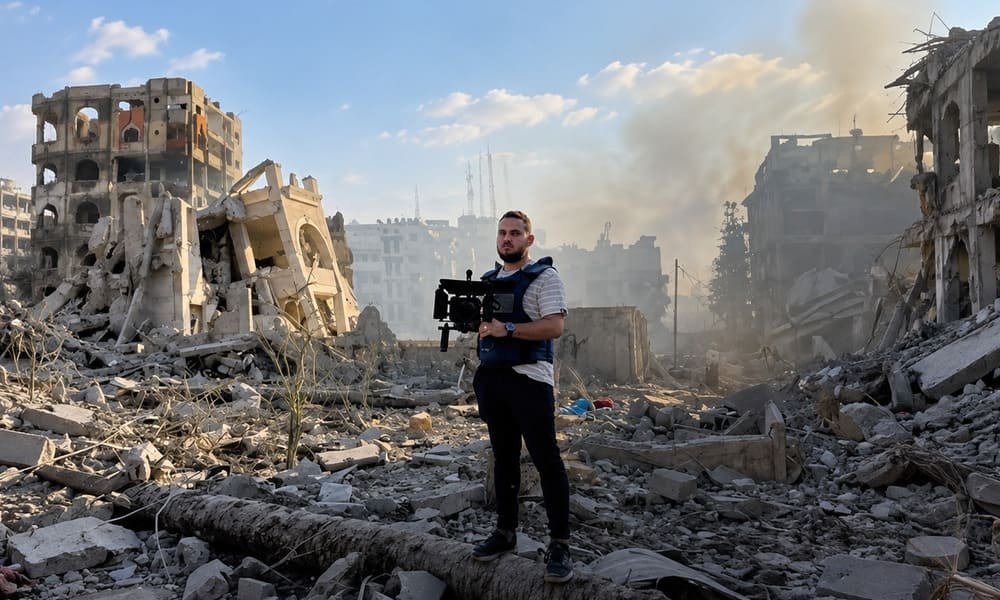
Gaza is extensively filmed but has little control over how its images are preserved, verified and distributed. The Gaza Cinema Academy targets that missing infrastructure.
From Citizen Osama to Naza, Venice 83 shows Gaza. The Gaza Cinema Academy raises a more uncomfortable question: who controls the images, the memory and the production chain of the story?
Gaza is probably one of the most filmed places in the world and, at the same time, one of the places with the least control over the destination of its own images. Not because cameras, phones or people capable of documenting what happens are missing, but because between the moment an image is recorded and the moment it becomes public memory there is a whole chain that determines its fate: production, editing, archiving, distribution, festivals, platforms and media, but also governments, military apparatuses and influence operations.
The creation of the Gaza Cinema Academy, presented during the Venice Film Festival, begins precisely from this point. Founded by Palestinian filmmakers Ezzaldeen Shalh and Mai Masri, the initiative is not limited to teaching people how to make a film, but aims to build a permanent structure for audiovisual training and production inside the Strip, beginning with a first class of 25 young Palestinian women.
To tell your own story, having a camera is no longer the problem
Palestinians already tell their own stories, often under the worst conditions imaginable, and they have been doing so for years. But who today can turn that testimony into a work capable of surviving, circulating and reaching an international audience?
A smartphone can record a scene, but it does not decide whether that scene can be verified by independent observers, whether the journalist who produced it can accompany it out of Gaza, whether it will be preserved when infrastructure is destroyed, whether it will be amplified or challenged on social media, whether it will find a producer willing to turn it into a film and, in the end, whether a festival or a platform will rescue it from the speed with which social networks consume every image.
Power therefore does not lie only in the frame, but in everything that comes after it, and this is why perhaps the most significant part of the project concerns precisely the construction of relationships with universities, festivals, funds, production companies and international platforms.
Citizen Osama and filming from inside the same catastrophe
The contradiction emerges with particular force in Citizen Osama by Ahmed Hassouna, in which Osama Al-Ashi, a photographer turned war documentarian, films besieged northern Gaza while at the same time having to find water, food and milk for his newborn son. The film dismantles one of the most persistent fictions of Western information: the reporter as a neutral eye recording tragedy while somehow remaining outside what is happening.
Here, the person documenting hunger must also find something to eat, the person filming fear must protect his own family, and the person producing the image belongs fully to the same reality he is trying to show.
Venice welcomed the film enthusiastically, while Hassouna could not reach the festival because he was unable to leave Gaza: the work crossed the border more easily than its author, and it would be difficult to imagine a more precise summary of the distance between the circulation of images and the freedom of the people who produce them.
Naza shifts the gaze from the victim to the mechanism
With Naza, presented in competition on September 10, Yuval Abraham and Rachel Szor make an almost opposite move.
After No Other Land, the two filmmakers turn the camera toward the systems through which the civilian cost of Israeli attacks on Gaza is assessed, reconstructing from Tel Aviv the functioning of procedures in which death can become a percentage, a forecast, an acceptable threshold.
The production itself also tells us something.
Naza is backed by The Guardian and JW Films, with Jonathan Glazer among the executive producers, and this shows how naïve it is to think that simply possessing a voice is enough for that voice to be heard. To become an international cinematic event, structures are still needed that can finance, protect, translate and distribute.
Not one film about Gaza, but the tools to make a hundred
Gaza also returns in the Venice program through Conversation With the Sea by Muayad Alayan and The Road to Jericho by Amos Gitai, while in the background the precedent of The Voice of Hind Rajab inevitably remains.
So is this simply the usual Western festival turning tragedy into cultural prestige, between standing ovations and red carpets? Today Venice is at once a showcase, a filter and a possible infrastructure.
It is one of the places where decisions are made about which films can obtain global attention, but it is also the place where a project such as the Gaza Cinema Academy can look for producers, universities, funds and the professional relationships needed to grow, gradually reducing its dependence on institutions, capital and circuits built elsewhere.
The Gaza Cinema Academy is therefore trying to transform a fragmented production of testimony into a structure capable of training directors, preserving archives, creating technical skills, developing works and guaranteeing the professional continuity needed to give form and meaning to what is being filmed today.