Now Reading: September 11, 25 Years Later: The Spectacle Did Not End, It Fragmented
-
01
September 11, 25 Years Later: The Spectacle Did Not End, It Fragmented

Twenty-five years after 9/11, cinema is looking beyond the towers toward war, surveillance, memory and the fragmented media system that followed.
Twenty-five years after September 11, cinema is no longer looking only at the Towers: it is processing wars, surveillance, propaganda and the world built after the attack.
Twenty-five years are enough for an event to stop belonging only to those who lived through it and to begin belonging also to those who know it only through images. That is what is happening to September 11, and cinema seems to have understood it.
For my generation, September 11, 2001 is still a precise memory: where we were, who called first, which television was on, the moment when it became clear that the second plane had ruled out any possibility of an accident. For another generation, increasingly numerous, those images are already history, archive, documentary, family story.
The twenty-fifth anniversary falls exactly on that dividing line. And it is no surprise that some of the works released or presented in 2026 have begun to shift their gaze: no longer only toward what happened that morning, but toward what continued to happen afterward.
The attack happened in New York, the spectacle all over the world
Before cinema, however, there was television. And it was enormous.
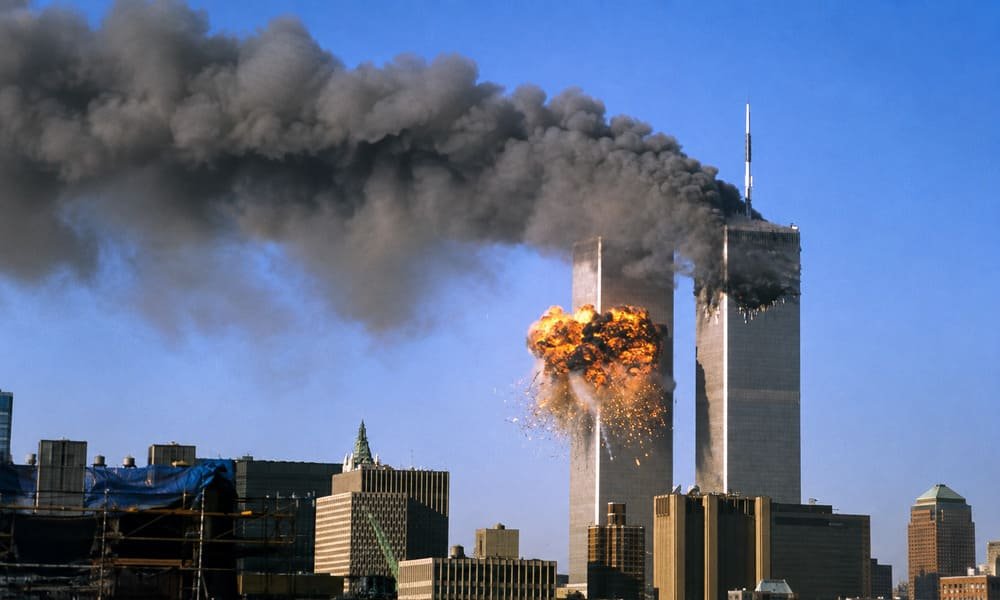
The first plane hit the North Tower before the cameras of the major networks could turn Manhattan into a worldwide live broadcast. The second arrived when those cameras were already pointed at the World Trade Center. Millions of viewers watched an attack take place while they were still trying to understand the one before it.
From that moment, September 11 became something unusual in the history of media as well: not merely a tragedy reported by television, but a tragedy television could reproduce practically without end.
The second impact, the fire, the collapse of the South Tower, then the North Tower. Replays, slow motion, changes of angle, commentators, breaking news, correspondents, maps. That gigantic flow nevertheless produced a result: before anyone could interpret September 11, the world already possessed an edit of it.
Cinema arrived when everyone had already seen the film
Hollywood therefore faced an unusual problem. How do you stage an event that the audience had actually watched, from multiple angles and hundreds of times?
When Paul Greengrass made United 93 in 2006, he avoided spectacle and worked on the claustrophobia of the flight. Oliver Stone, that same year, went under the rubble with World Trade Center, following two Port Authority officers trapped after the collapse.
Other films understood even earlier that perhaps it was not necessary to show again what television had already engraved into collective memory. Reign Over Me told the story of grief years after the attack. Remember Me, with a much more controversial choice, allowed September 11 to enter only in the ending.
Cinema was therefore beginning to discover something that now seems more obvious: the least-told material of September 11 was not necessarily what could be seen in the images, but what remained outside the frame.
Generation 9/11: when the attack becomes biography
Turning Point: Generation 9/11 by Brian Knappenberger makes a significant move.
Netflix presents it as a documentary built through firsthand testimony about the attack and its consequences, in order to examine how September 11 shaped a generation twenty-five years later.
Not only the people who were inside the Towers or on the streets of Manhattan, but the children of victims, the soldiers who left in the following years, Afghans, Muslim Americans, people who became adults while the “war on terror” gradually stopped being an emergency and simply became the political landscape in which they lived.
Patriot Act, Afghanistan and the long life of the emergency
Three days after the attacks, Congress approved the Authorization for Use of Military Force, granting the president very broad powers against those responsible for the attack and organizations considered connected to them.
On October 7, the war in Afghanistan began. On October 26, George W. Bush signed the Patriot Act. Iraq followed in 2003. Meanwhile, surveillance tools, security structures and powers built inside the emergency expanded.
The attack created the climate in which decisions that had previously been difficult to imagine became politically marketable, and some of them had a surprisingly longer life than the emergency that was supposed to justify them.
On the eve of the twenty-fifth anniversary, Reuters connected the current U.S. campaign against Iran to the so-called forever wars of the post-9/11 period: in other words, the debate over where a military response ends and a permanent condition begins is not exactly museum material yet.
IX XI and Tribeca 25 put back in the frame those who were not in command
From another direction comes IX XI by Sean Wilsey, recently presented at the Tribeca Festival.
Twelve ordinary people recount New York before and during the attack. A professional skateboarder, a cartoonist, workers, citizens who were not making military decisions and would not write the official version of that day bring back into the frame what monumentalization inevitably tends to expel: the ordinary life that existed five minutes before everything became historic.
The September 11 of official documentaries begins at 8:46 a.m.; the September 11 of ordinary people had begun hours earlier, with an alarm clock, a train, an appointment, someone arriving late at work and someone else who, by coincidence, never got there that morning.
Tribeca 25 by Matt Tyrnauer, available in the United States on Netflix on September 11 itself, tells another consequence. Robert De Niro and Jane Rosenthal created the Tribeca Festival in part to help revitalize Downtown Manhattan after the attacks: empty stores, struggling businesses, people who no longer returned to that part of the city.
The great show has not disappeared: it has fragmented
There is one final legacy of September 11, perhaps the least obvious precisely because it concerns the way we now watch anything at all.
In 2001, the world watched September 11 mainly through major television networks, in an extraordinary moment of global simultaneity. Today, an equivalent event would no longer have that unintentionally shared direction.
It would arrive through television, TikTok, X, Telegram, YouTube, livestreams, smartphones, clips stripped of context, old footage repackaged as new, propaganda, deepfakes and images generated by artificial intelligence. Above all, however, it would arrive through algorithms tasked with deciding which version of the event to show each of us.
But while the narrative tends to disperse, many of the logics born then continue to consolidate.
The Towers fell in less than two hours. The world built around their fall — wars with no defined end, normalized surveillance, security turned into political language, images turned into a terrain of conflict — is still standing.