Now Reading: Žižek, Utopia and the System That Learns to Sell Rebellion Back to Us
-
01
Žižek, Utopia and the System That Learns to Sell Rebellion Back to Us

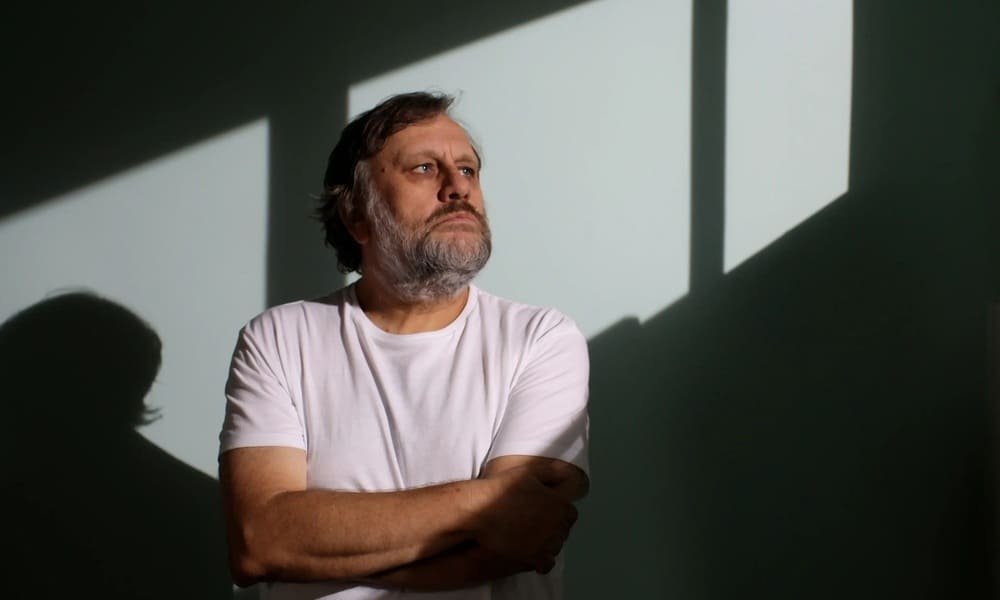
The Pervert’s Guide to Utopias returns Slavoj Žižek to Sophie Fiennes’s cinema to ask why revolution is so easily absorbed as style, product and content.
At Venice 83, Slavoj Žižek returns with Sophie Fiennes: cinema, apocalypse and ideology are used to explain why utopia today survives only when disguised as dystopia.
The Pervert’s Guide to Utopias, presented out of competition at Venice 83 in the Venice Open – Film on Films section, brings the Slovenian philosopher back in front of Sophie Fiennes’s camera, twenty years after The Pervert’s Guide to Cinema and fourteen after The Pervert’s Guide to Ideology.
Slavoj Žižek does not lead us toward paradise, but through the rubble produced by our attempts to build it. Apocalypse, revolutions, social control, sex, capitalism, authoritarianism, artificial intelligence and fantasies of liberation become parts of the same problem. The question is not so much which world we would like to inhabit, but why we keep desiring one that, the moment it takes shape, begins to look suspiciously like a prison.
The Pervert’s Guide to Utopias: after cinema and ideology
The mechanism is the one already familiar from the two previous documentaries.
Fiennes reconstructs environments and images from popular culture, while Žižek physically enters them, commenting on them as if cinema were a gigantic collective unconscious to be psychoanalyzed. He appeared inside our desires in The Pervert’s Guide to Cinema and inside the ideological structures that organize them in The Pervert’s Guide to Ideology. Now the question moves one step further: what happens when we try to imagine a different world?
The interesting point is that utopias, in the classical sense of the term, seem almost to have disappeared. Contemporary cinema prefers totalitarian societies, dying planets, revolutions, collapses and post-apocalyptic futures. It is much easier to imagine the end of the world than a society that finally works.
Žižek turns that absence into the heart of the film. Utopia does not necessarily coincide with a future paradise: it can also hide inside a repressive system, in a promise of absolute order, in the fantasy of finally being able to eliminate conflict. Every perfect society therefore risks becoming perfect above all for whoever gets to decide the rules.
Slavoj Žižek and the revolutions the system knows how to absorb
For Žižek, power does not survive only by repressing those who challenge it: it is often sophisticated enough to incorporate their language, their symbols and even their rebellion.
A revolt can therefore feel anti-system while using tools, rituals and forms of consumption that the system has already learned to turn into products. Protest becomes aesthetics, nonconformity becomes a market identity, the radical gesture becomes content to share.
Cinema is the ideal laboratory in which to observe this contradiction because it loves revolutions right up to the moment of victory. Bringing down the palace of power is spectacular; explaining what to build the next day is much less so. First one has to demolish the comforting idea that History necessarily has a direction and that every rebellion automatically leads toward something better.
The problem is not only managing to change the system, but preventing the system from turning even change into one of its own functions.