Now Reading: Artists Equity Accelerates: Writers’ Room and Netflix Alliance
-
01
Artists Equity Accelerates: Writers’ Room and Netflix Alliance

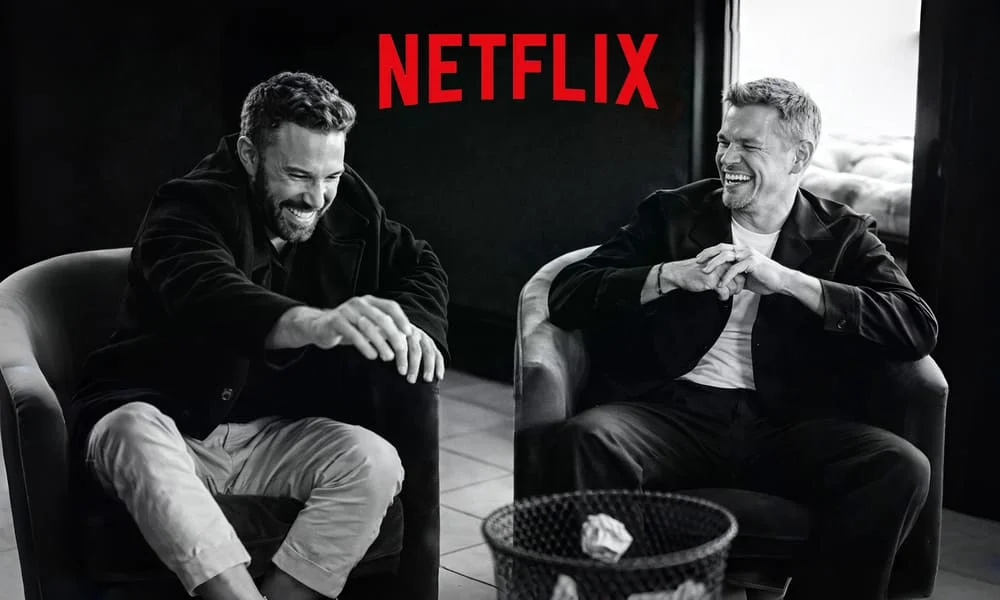
Affleck and Damon launch the Writers’ Room and strengthen their alliance with Netflix: in-house development, creative control and a new balance of power in global cinema
The production model is changing, and Ben Affleck and Matt Damon are attempting to rewrite its rules. With Artists Equity’s new Writers’ Room and its strategic agreement with Netflix, their studio aims to bring creative development back to the center of the process, but with much more direct industrial control.
The Writers’ Room: In-House Development and Creative Control
Artists Equity, the independent film production company founded in 2022 by Ben Affleck, Matt Damon and Gerry Cardinale, has officially launched a Writers’ Room program designed to develop original screenplays from writers’ own ideas. The mechanism is simple but ambitious: screenwriters submit projects, selected candidates work together in writers’ rooms and receive direct feedback from Affleck, Damon and Eric Roth.
This is not an ordinary creative workshop. Writers are paid according to WGA standards and, more importantly, enter a system that does not stop at developing scripts: successful projects are immediately packaged with talent and financing.
That is the key point: no more endless, unfocused development, but a closed pipeline controlled by the studio. The Writers’ Room will be held twice a year and represents, in the founders’ words, an attempt to “nurture original ideas without getting lost in endless notes and changes of direction.”
The current group includes Jason Stone (The Altruists, The Hardy Boys), Gabe Sherman (The Apprentice, The Loudest Voice), E.T. Feigenbaum (Blink Twice, High Fidelity), Flint Wainess (Linda and Monica, Super in Love), Jono Matt (the upcoming Foster the Snowman), Sam Mazany (Tires), Agatha Helena Nowicki (Kingdom Come, Gorilla and the Bird) and Steven Robillard (Summer Qamp, the upcoming The Up & Up).
The Netflix Alliance and the Parallel Track with Sony
This model fits perfectly with the multiyear agreement signed with Netflix. Artists Equity will become the lead studio on the films it produces for the platform, retaining a central role throughout the entire chain, from development to distribution.
The success of The Rip—112 million views and three weeks at number one globally—acted as the catalyst for the agreement. Netflix, for its part, gains access to fully developed content ready for a global audience. Artists Equity, meanwhile, obtains something even more important: direct access to distribution and therefore to the public.
At the same time, the studio is maintaining a three-year agreement with Sony Pictures for theatrically released films. Sony finances and distributes the titles globally, before they subsequently arrive on Netflix through the Pay-1 window. It is a hybrid model that avoids complete dependence on a single platform and maximizes the circulation of content, while building a filmography that seeks a balance between artistic ambition and the market (Air, The Accountant 2, Unstoppable, Animals).
The Real Game Changes: Creativity, Control and Technological Warfare
Behind the rhetoric of “putting artists at the center,” something far more concrete is taking place: an attempt to reclaim creative control before the Big Tech companies seize it. Netflix has acquired InterPositive, the AI company founded by Affleck, bringing not only its technology in-house but also its team and Affleck himself as an adviser.
The risk is that, were cinema to become dependent on tools developed by OpenAI, Google or Meta, creative control would shift outside the industry. InterPositive exists precisely to prevent this: to develop and train AI systems designed for the language of cinema, trained on proprietary datasets and created to assist directors and crews rather than replace them.
AI enters the production process, but under the control of the studios. These tools are intended to eliminate the heaviest technical work: analyzing dailies, correcting lighting, relighting scenes, reconstructing shots and automating visual continuity. The result is a dramatic increase in speed and a reduction in costs.
And this is where the circle closes. An in-house Writers’ Room, controlled production, global distribution through Netflix and Sony, and proprietary technology. Affleck and Damon are placing a complete production pipeline at the service of creativity.
The real question now is: who will be the next Good Will Hunting?