Now Reading: FUTURA 2026: Italian Cinema Puts AI to the Test in Rome
-
01
FUTURA 2026: Italian Cinema Puts AI to the Test in Rome

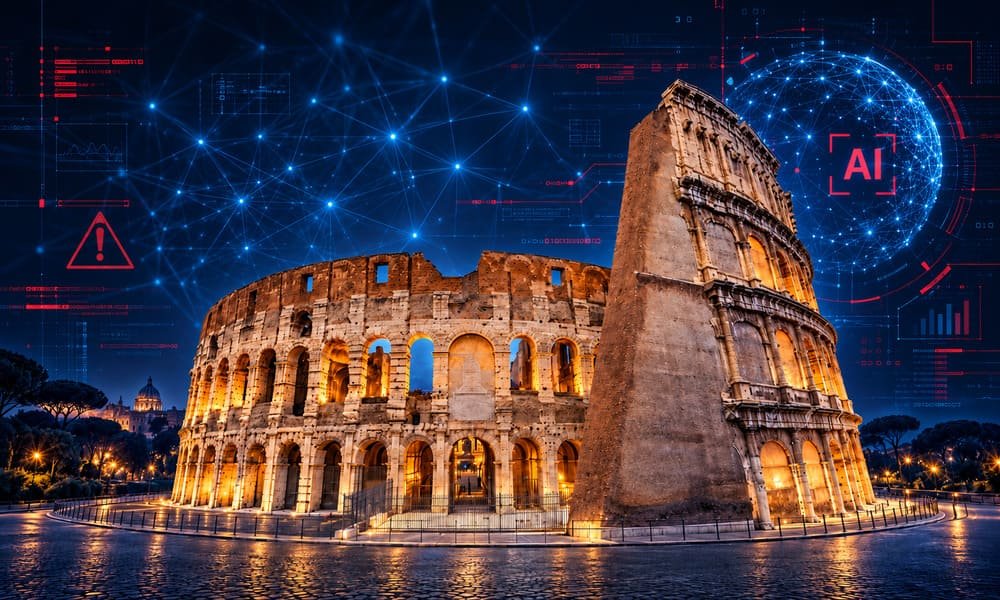
FUTURA 2026 brings cinema, AI and new rules to Rome. But between tax credits, contracts and EU obligations, the revolution has already ended up in the forms to be filled out.
FUTURA 2026 brings cinema, AI and new rules to Rome. But between tax credits, contracts and EU obligations, the revolution has already ended up in the forms to be filled out.
Eighteen events, two venues and virtually the entire audiovisual industry summoned to work out what to do with artificial intelligence now that simply talking about it is no longer an option.
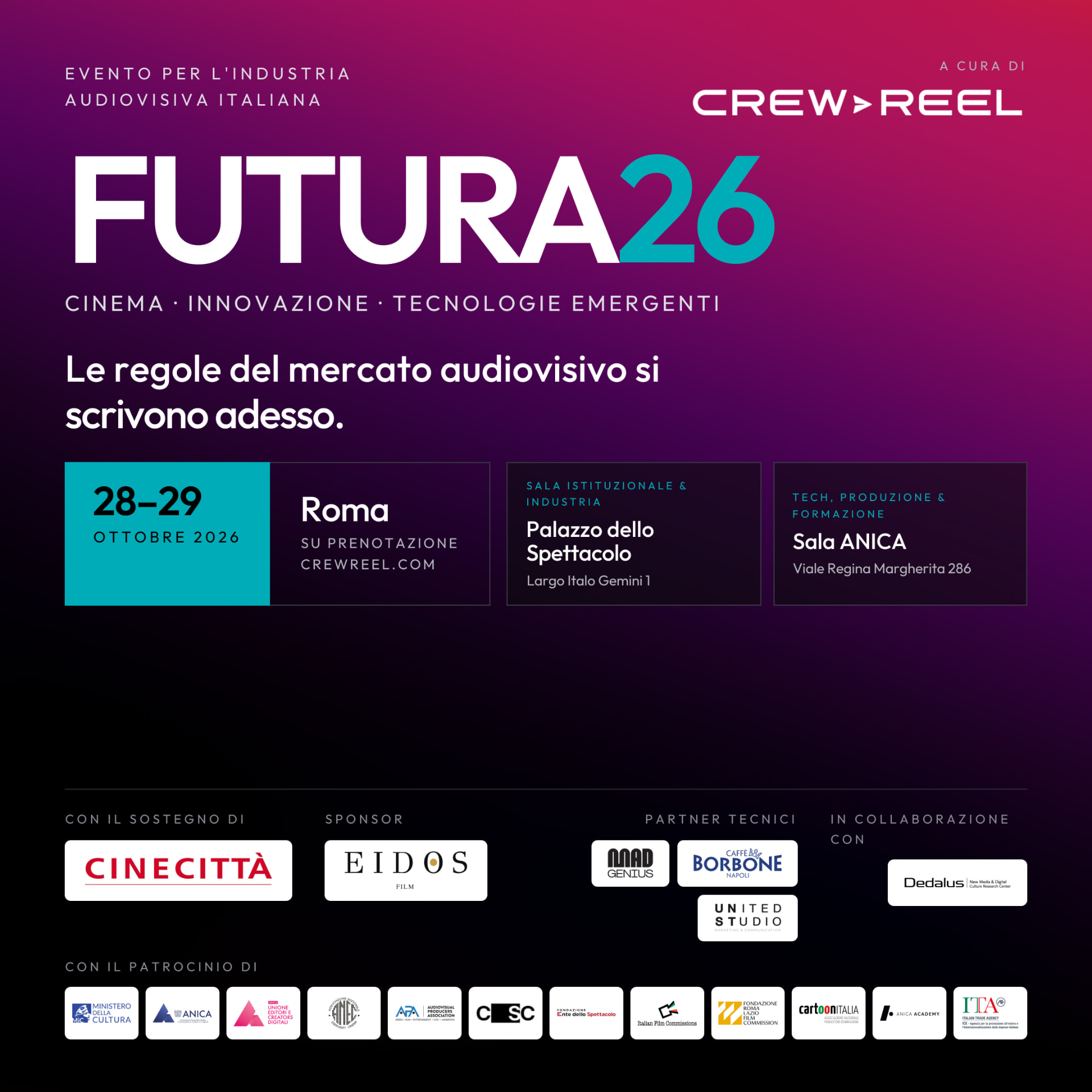
On October 28 and 29, FUTURA26 — Cinema, Innovation and Emerging Technologies comes to Rome, organized by CrewReel Services with scientific direction by Dedalus and the support of Cinecittà: at the Palazzo dello Spettacolo, discussion will focus primarily on the market, rights and positioning; at the Sala ANICA, on technology, training and the transformation of the industry.
The lineup gives a fairly good idea of the experiment. Representatives of Cinecittà, ANICA, ANEC, Cartoon Italia and APA will attend, alongside officials from the Ministry of Culture, writers and producers, but also Google, the Motion Picture Association, YouTube, RaiPlay, Sony Pictures, Cinetel, the Centro Sperimentale, Writers Guild Italia, actors and voice actors. The announced speakers also include Brando Benifei, the European Parliament’s rapporteur on the AI Act, and Federico Mollicone, chair of the Chamber of Deputies’ Culture Committee. Hardly a gathering of people who have come to gaze at Midjourney.
FUTURA 2026 in Rome: from tax credits to AI shorts
At 10:30 a.m. on the first day, at the Palazzo dello Spettacolo, the panel The Conditions for Innovation: Tax Credits, Investment and the National System brings together Elena Giacone, head of Tax Incentives at the Directorate General for Cinema and Audiovisual, producer Benedetto Habib of Indiana Production and Carlo Rodomonti to address what is now a very concrete problem: how to track the use of AI within a production.
Shortly afterward, Italian animation takes its turn, with professionals from companies such as Rainbow, MAD Entertainment and Lynx Multimedia Factory asking what happens when artificial intelligence enters not vaguely “cinema,” but individual departments within a pipeline. In the afternoon, creators will discuss the more slippery boundary between innovation and the loss of creative identity, with Flavio Pizzorno and Pietro Lafiandra, Massimo Toniato and Serena Corvaglia.
Then theory gives way directly to the screen: FUTURA26 will show a selection of Ai.Motion short films, including Anna Coccoli’s COSPLAI. Immediately afterward, at 5:30 p.m., producers and industry professionals can attend a workshop on the AI Act and tax credits: how to declare the use of artificial intelligence, how to document the tools and stages of the creative process, and how to build what CrewReel calls department-by-department traceability.
Meanwhile, at the ANICA venue, the discussion broadens. Sony Pictures, RaiPlay, Cinetel, distributors and exhibitors will discuss the changing relationship between theaters and streaming, and above all the asset that now determines a great deal even before the generative algorithm gets involved: data. Training and new industry professions will follow, then a workshop bringing Adobe Firefly and Express into a workflow stretching from the idea for a film to its promotional campaign.
Day two: who owns a voice, a face, a creator
On October 29, the program enters territory where innovation has changed category: from an experiment capable of producing curious images, it has become a cost item, a contractual clause, a potential legal dispute and a variable in access to public funding.
A panel on the AI Act and the regulatory framework will bring together Benifei, Mollicone, Google Italy, the Motion Picture Association and legal experts to compare European regulation, Italian legislation and US approaches to copyright.
One of the most sensitive sessions will follow: Protecting Professionals in the Age of the AI Act: Voices, Faces and New Rights. UNITA, the National Association of Voice Actors and Writers Guild Italia will discuss synthetic replicas, artistic performances and contracts. Parallel discussions will cover virtual production, postproduction and technical service companies; then the creator economy with YouTube, new forms of expression and the use of AI in industry workflows. The closing session will widen the frame again to Digital Made in Italy, with Cinecittà, ICE, the Ministry of Foreign Affairs and Italian and international film commissions.
It is almost an inventory of everything artificial intelligence can touch today: screenwriting, images, voices, production, distribution, marketing, training, public incentives and even Italian cinema’s ability to sell itself abroad.
The future has already become an administrative procedure
In the United States, artificial intelligence had already become a labor dispute in 2023: the Writers Guild of America secured provisions ensuring that AI-generated material is not considered literary material, that companies must tell screenwriters when they provide artificially generated material, and that a writer cannot be required to use generative tools.
That same year, SAG-AFTRA negotiated rules on consent and compensation for performers’ digital replicas. Hollywood came to the discussion after months of strikes; we, more soberly, arrive with panels, ministerial patronage and mandatory reservations.
The 2024 decree on production tax credits requires recipients to identify, in the opening or closing credits, the parts of the work or stages of production in which artificial intelligence was used. Contracts with authors and performers must also contain clauses allowing them to withhold authorization for AI systems to exploit their work, likeness or performance.
In 2025, the Directorate General for Cinema and Audiovisual even published specific interpretive guidelines. And since August 2, 2026, Article 50 of the AI Act has also applied, with transparency obligations for certain artificially generated or manipulated content.
This is where FUTURA26’s program becomes more interesting than the usual vocabulary of “innovation,” “opportunity” and “responsibility.”
On one side, protections are being built to prevent works, faces and voices from being absorbed without consent; on the other, workshops on the tools are being organized, generative shorts are being screened, and people are discussing how to integrate AI into preproduction, on set and in postproduction. The same ecosystem brings together those developing the platforms, those representing the industry and those who will have to sign the clauses limiting their use.
This is exactly where cinema stands today. It is no longer deciding whether to accept artificial intelligence. It is trying to establish the price, the signatures and the wording needed to make its arrival normal.