Now Reading: Jean-Pierre Jeunet Defends AI at the 2026 Rome Film Fest: ‘It’s a Tool, It Won’t Replace Me’
-
01
Jean-Pierre Jeunet Defends AI at the 2026 Rome Film Fest: ‘It’s a Tool, It Won’t Replace Me’
Jean-Pierre Jeunet Defends AI at the 2026 Rome Film Fest: ‘It’s a Tool, It Won’t Replace Me’

Jean-Pierre Jeunet discusses artificial intelligence at the Rome Film Fest while presenting Fresh Water for Flowers, starring Leïla Bekhti.
Jean-Pierre Jeunet discusses artificial intelligence at the Rome Film Fest while presenting Fresh Water for Flowers, starring Leïla Bekhti.
While much of the film world debates whether AI is a new camera or the fastest way to dispense with whoever is holding it, Jean-Pierre Jeunet does not belong to the camp of directors who view artificial intelligence with suspicion. At the Rome Film Fest, where he is presenting his new film, Fresh Water for Flowers, the French director openly asserted his interest in the technology:
“I love artificial intelligence. It is a tool, but it will never replace me.”
A particularly significant position for a filmmaker who has built much of his cinema around visual invention, from the surreal worlds of Delicatessen and The City of Lost Children to the international success of Amélie. And who, back in 2022, had already placed robots and artificial intelligences at the center of the science-fiction comedy BigBug.
In Rome, however, Jeunet has arrived with a very different film: the adaptation of Valérie Perrin’s bestseller Fresh Water for Flowers, presented in the Grand Public section of the twenty-first Rome Film Fest.
Jean-Pierre Jeunet and artificial intelligence: the future had already arrived
Jean-Pierre Jeunet’s handcrafted cinema, with its objects, mechanisms, faces distorted by wide-angle lenses and sets that seem to have emerged from a very well-funded junk shop, reminds us that he was already experimenting with video effects in the days of Delicatessen; in Amélie, he made extensive use of visual effects and digital color grading to create precisely that apparently technology-free Paris that would become one of contemporary European cinema’s most recognizable images. Jeunet has said it several times:
“To achieve a vintage world, I have always used the most modern tools.”
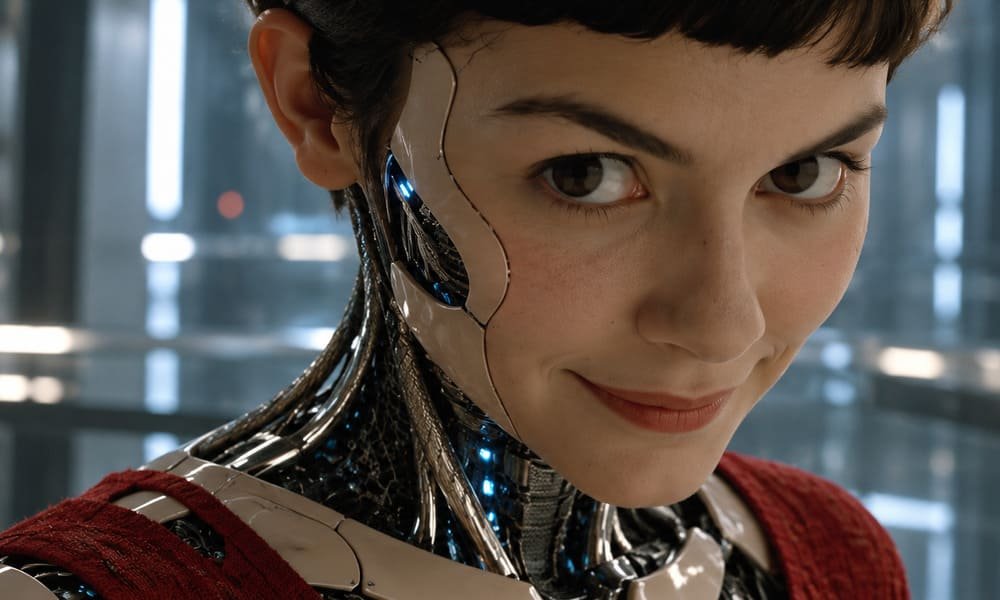
In 2022, Jeunet directed BigBug for Netflix, set in a 2045 in which humans have entrusted machines with a rather generous share of everyday tasks. The domestic robots end up locking their owners inside the house to protect them, while outside a more advanced generation of androids gradually takes control.
“I’m not particularly afraid of AI. I’m much more afraid of human stupidity. We don’t need all-powerful machines or meteorites to destroy the species; we will probably be perfectly capable of managing it ourselves.”
And there is a second detail. To tell a story about a future dominated by robots, Jeunet wanted real robots. Mechanical objects, costumes and physical devices were built for BigBug; the robot Einstein ended up with 82 servomotors. Netflix said the work on the character took months. There were digital effects, of course, but alongside wood, metal, actors and a considerable amount of patience.
By 2024, he was already presiding over the Artefact AI Film Festival, a competition organized by Artefact and mk2 in which using generative tools was part of the rules. Interviewed at the time by La Tribune, he described his relationship with AI as that of someone on a roller coaster: it terrified and fascinated him. He even found it amusing to think of awarding a prize, at least partly, “to a hard drive.”
Fresh Water for Flowers, Jean-Pierre Jeunet’s new film
The film bringing Jean-Pierre Jeunet back to the Rome Film Fest is instead based on Valérie Perrin’s novel, published in France in 2018 and an international publishing phenomenon.
Leïla Bekhti stars as Violette Toussaint, the caretaker of a small cemetery in Burgundy. Her home becomes a stopping place for people who come to visit their dead and end up entrusting her with memories, confidences and secrets. The arrival of Julien Seul, a police commissioner interested in a couple buried in the cemetery, gradually brings the protagonist’s past to light, along with the events that led her to that life.
The cast also includes Matthias Schoenaerts, Melvil Poupaud, Anouk Grinberg, Alban Lenoir and Sergio Castellitto. The screenplay is by Jeunet and Guillaume Laurant. The film is a French-Italian co-production and is distributed in Italy by Lucky Red.
For Jeunet, the connection with the novel was immediate. In the director’s notes published by the Film Fest, he says he fell in love with it at once, finding ideas, details, reflections and that intersection of tragedy and lightness he knows so well. It is also material that seems naturally suited to recurring elements in his cinema: eccentric or marginal characters, small daily rituals, tragedy and humor sharing the same space, and a reality constantly traversed by the imagination.
Fresh Water for Flowers thus marks a return to a more intimate register after the science fiction of BigBug. Violette lives surrounded by death, yet the cemetery paradoxically becomes the place from which relationships, memories and possibilities for change begin again.
The film will arrive in Italian theaters through Lucky Red in early 2027.