Now Reading: Danny Boyle on AI: When Efficiency Becomes Obedience
-
01
Danny Boyle on AI: When Efficiency Becomes Obedience

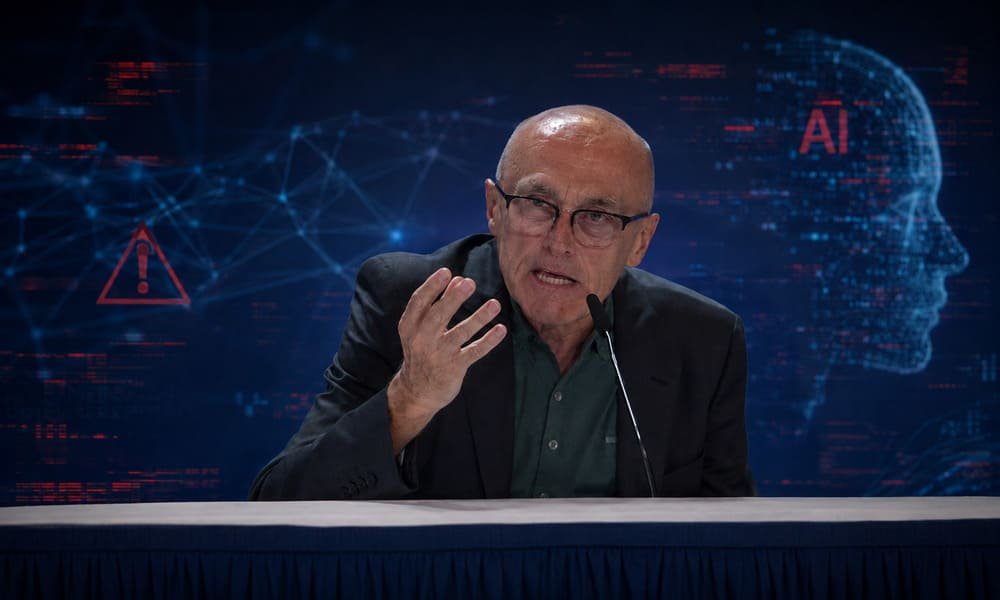
Danny Boyle’s warning about AI journalism is not mainly about job losses. It is about whether a machine can challenge the people who own its model, infrastructure and distribution.
Danny Boyle is not simply afraid that artificial intelligence will replace journalists, but that it may replace them perfectly — except at the moment when they are supposed to stand up to power.
At the Venice Film Festival, where he presented Ink, the British director spoke about the growing automation of information and the possibility that newsrooms and companies may replace part of journalistic work with systems that are faster, cheaper and more productive.
This is precisely where Danny Boyle shifts the problem: will an artificial journalist be able to speak truth to power if that power is the same one that built it?
The artificial journalist and the problem of obedience
It is therefore no longer just a question of jobs or the quality of writing.
A machine can already summarize documents, compare sources, produce texts, translate interviews and organize enormous amounts of information. Tomorrow it may be able to do all of that better, faster and at lower cost.
But journalism is not only the production of information: it is also conflict with the source of authority. A journalist can challenge the owner of the newspaper, the government, an advertiser, a technology platform. They can be fired, sued, isolated.
But there is at least the possibility that they may choose to do so.
With an artificial system, the nature of the question changes. There is no need to imagine explicit censorship; it is enough to ask who decides the training data, the safety rules, the model’s priorities, which sources are considered reliable and even which answers deserve to be produced.
We may then discover that we have automated its obedience as well.
From the Sun to the platforms, the same race for attention
It is no coincidence that Boyle is saying these things while presenting Ink.
The film tells the story of Rupert Murdoch’s purchase of the Sun in 1969 and the transformation of the newspaper into a machine capable of understanding and conquering its audience far better than its competitors.
Murdoch understood that information could be redesigned around attention. More aggressive headlines, scandals, sex, spectacle: the newspaper was not only supposed to report what had happened, but to understand what would make people buy the next copy.
Half a century later, that logic has not disappeared: it has become computational. Platforms know their audiences with a precision that a tabloid editor could only have dreamed of, while generative systems can now directly produce the content intended for that audience.
Boyle is therefore not romantically defending ink against silicon.
AI can certainly become a tool for journalism; the problem begins when it becomes the journalist, while the infrastructure, the model and the distribution belong to the same entities it should be free to investigate.