Now Reading: Local AI or Cloud? The Real Battle Is Over Where Intelligence Runs
-
01
Local AI or Cloud? The Real Battle Is Over Where Intelligence Runs


AI is moving back onto personal devices, but the cloud is not going away. The emerging architecture is hybrid — and it changes costs, privacy and platform power.
For years, generative AI seemed inseparable from the cloud. You type a request on your computer, the data travels to a data center, a remote model processes it and the result comes back. It is an effective architecture, but an expensive one: it requires infrastructure, bandwidth, energy and a continuous relationship with the provider hosting the model.
In October 2026, Microsoft and Nvidia pushed hard on an alternative: run a growing share of AI directly on the computer. The new Surface Laptop Ultra, presented on October 7, uses Nvidia RTX Spark chips and is designed to handle locally workloads that until recently would have been sent to the cloud. Microsoft also used the phrase “Hybrid Intelligence” for systems that decide when to use the device and when to rely on data centers. Reuters described the launch as an attempt to make Windows a platform where agents can perform complex tasks without constantly depending on remote infrastructure.
The interesting question is not which laptop wins. It is whether the future of AI will be local, cloud-based or hybrid.
What local AI actually means
A local model runs on the user’s device: PC, smartphone, workstation or dedicated appliance. The data required for processing can remain on the machine, and producing a result does not necessarily require a remote connection.
That is a substantial difference from the data-center model, in which the personal device is mainly a terminal sending requests toward much more powerful infrastructure.
Local AI does not mean that every model has to be tiny or primitive. More memory on consumer hardware, specialized accelerators and quantization techniques now make it possible to run increasingly capable models on personal machines. The main constraint remains how much compute and memory can be concentrated inside a device at an acceptable price and energy cost.
Why the cloud remains difficult to replace
The cloud remains superior when workloads need enormous models, elastic capacity or infrastructure that no single device can reproduce. Training, large-scale inference, heavy video generation and services used by millions of people at once still depend on GPU clusters and distributed systems.
Much of the performance comes from executing huge numbers of operations in parallel. Cloud systems can combine thousands of accelerators and make them behave like a single computational infrastructure.
The cloud also offers companies an economic advantage. They do not have to distribute extremely powerful hardware to every user. They pay for centralized capacity and can update a model without touching every device.
Privacy is the most intuitive local advantage
If a model can analyze documents, email or files without sending them to a remote server, the privacy advantage is obvious. That does not make the system automatically secure: the device can still be compromised and software can still record information. But it removes an important exposure surface.
This matters particularly for companies working with proprietary code, health data, legal documents or confidential information. In those cases, the ability to keep some processing local can become more valuable than the quality difference between a device model and the most powerful remote model available.
The strongest incentive may be economic
Privacy matters, but the industrial incentive may be cost. Every request processed in the cloud consumes compute paid for by the provider or customer. Move part of the workload onto personal devices, and much of the hardware cost shifts away from the data center and toward the user.
Microsoft and Nvidia are making this push while the cost of AI infrastructure continues to rise. For a developer spending hundreds each month on cloud services, an expensive local machine can become economically attractive if it absorbs a substantial share of the workload.
The personal device thus becomes an important site of computation again after years in which the industry moved in the opposite direction: software as a service, remote storage, web applications and centralized processing.
The winning architecture will probably be hybrid
The opposition between “local” and “cloud” is useful for understanding the trade-offs, but it is unlikely to describe the final architecture. An application can use a local model for private or fast tasks and call the cloud when more power is needed. It can perform a first analysis on-device and send out only a subset of the data. It can train or update models centrally and then distribute them back to PCs.
A hybrid architecture can optimize four variables: cost, privacy, latency and quality. There is no universally best combination. An assistant searching a file on a laptop has different needs from a video generator; health software faces different constraints from a public chatbot.
Local AI also changes platform power
There is a less visible consequence. If AI works only in the cloud, whoever controls the data center also controls access to the models. Prices, availability, policies and limits depend on the provider. Local execution can reduce some of that dependency and favour open-weight models or software that keeps working without a remote service.
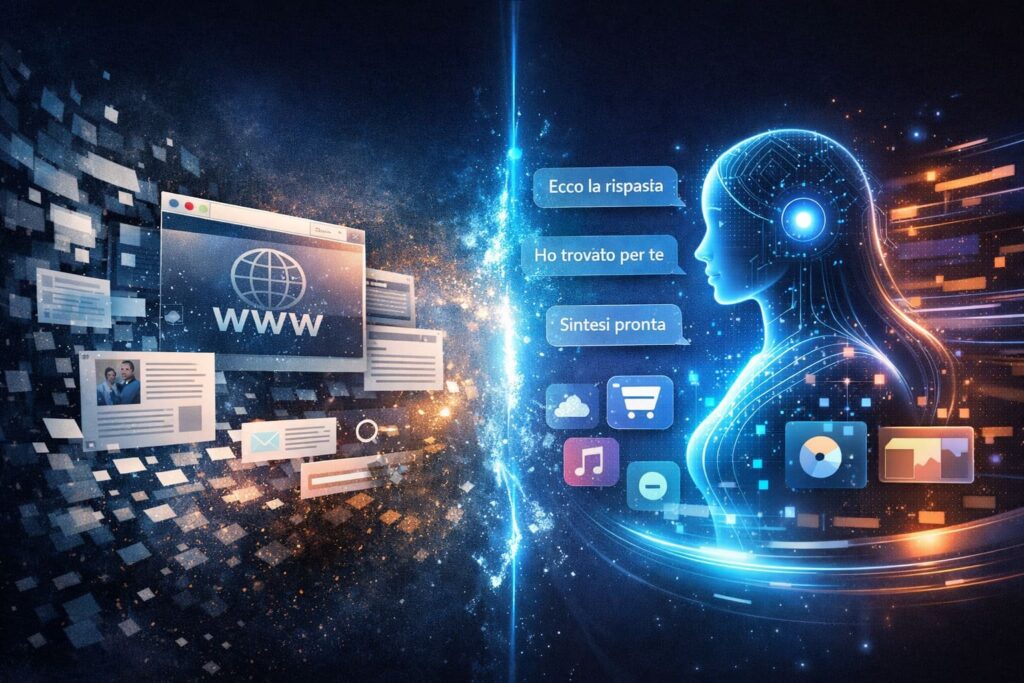
That does not mean the end of the cloud. It means some computational power can return to users’ devices. The future of AI may therefore look less like one remote brain and more like a distributed network of capabilities: some on the PC, some in the data center, with software deciding where each task makes the most sense.