Now Reading: Darren Aronofsky at the Cannes AI Summit, Seeking Absolution
-
01
Darren Aronofsky at the Cannes AI Summit, Seeking Absolution

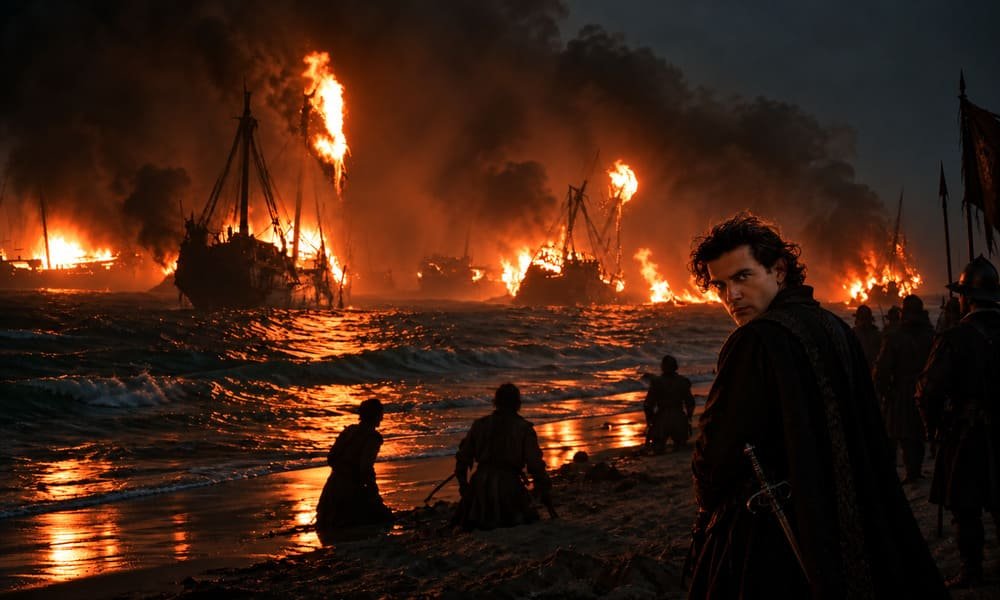
Darren Aronofsky defends the AI project On This Day… 1776 at Cannes, developed with Primordial Soup ahead of the 250th anniversary of the Declaration of Independence.
Darren Aronofsky chose the Cannes AI Summit to defend On This Day… 1776, the project on the American Revolution made with generative artificial intelligence through his studio Primordial Soup. Since its first January episodes, it had been received very badly by fans and critics, but Aronofsky pushed ahead anyway.
During a conversation with James Manyika, President of Research, Labs, Technology & Society at Google, on the second day of the Marché du Film’s AI for Talent Summit, Aronofsky explained that the initial idea was to make thirty or thirty-five films of about five minutes each, dedicated to what happened “on this day,” but 250 years earlier.
The director argues that the material released on April 29 already shows a significant leap compared with the early January episodes, due not only to the improvement of the models, but also to Primordial Soup’s pipeline and the growing experience of the artists involved.
Primordial Soup, Google DeepMind and the three shorts between live action and AI
Aronofsky said that his interest in AI as a cinematic tool began in 2023, after seeing images generated with Midjourney. From there came the decision to found Primordial Soup, not to replace his traditional filmmaking, but to be ready to work with a technology that, in his view, would inevitably change the way images are produced.
The studio makes its debut this year in Cannes’ Official Selection with Goodnight Lamby, a short by Dustin Yellin scheduled for Tuesday in Cannes Classics. The film was born from a creative initiative with Google DeepMind, built around three short films combining live action and AI: Goodnight Lamby, Ancestra by Eliza McNitt, already shown at the Tribeca Festival, and the documentary Love Rendered by Dan Cogan and Liz Garbus, currently in post-production.
According to Aronofsky, these films would not have taken shape without the technology used by Primordial Soup. The director insists that, at least in the projects originating from the studio, AI is treated as an additional tool. In the case of Goodnight Lamby, the work is meant to bring Yellin’s imagination into motion: the artist is known for sculptures made from layers of glass and collage. Aronofsky described the short as a story in which the artist’s daughter enters one of his sculptures and becomes a character inside that work; Yellin’s daughter plays herself, while Paul Rudd voices the father and Chris Rock is part of the voice cast.
The director linked Goodnight Lamby to the tradition of films such as Alice in Wonderland and The Red Balloon, then argued that the short’s presence in the festival program is a clear sign of Cannes’ openness and foresight.
From Ancestra to Love Rendered: the concrete examples brought by Aronofsky
Aronofsky explained that Ancestra, the film by Eliza McNitt, comes from a personal story: the director nearly died at birth because of a heart defect. McNitt wanted to recreate that difficult birth event as a tribute to her mother, and according to Aronofsky, without generative AI it would not have been possible.
Love Rendered, instead, follows the work between Primordial Soup and Google DeepMind on a technology designed to help elderly people who are losing their memory, attempting to recreate some of their memories. Aronofsky tries to distinguish between very different uses of AI, arguing that the word itself has become too broad and confused: asking ChatGPT about the weather is not the same as knowing how to use generative models to build cinematic images.
The director also rejected the idea that an AI film is born simply from the right prompt typed into an application: to obtain something worthwhile, human work, artistic direction, intention and control are needed. Aronofsky acknowledged the existence of real fears about AI’s impact on creative professions, but compared this moment to other technical shifts in the history of cinema: sound, which caused resistance among those who worked with live music in theaters; the portable camera, which made films like Breathless possible and helped fuel the French New Wave; and visual effects, which undeniably encouraged the expansion of science-fiction cinema.
Big theatrical films will not disappear because of AI
Aronofsky cited Orson Welles to explain what he sees as the most promising side of the technology: an artist forced for years to seek financing, defend his own cut and fight the production system could have used more accessible tools to follow his imagination directly.
For now, the clearest fact is that Aronofsky is not backing down after the criticism. On This Day… 1776 will continue until the end of the year, with the director already pointing to December 24 — the day when the project will reach George Washington’s crossing of the Delaware — as a possible demonstration of how much the quality can change month after month.
Meanwhile, Cannes is not merely discussing AI in theory: it is hosting it in panels, shorts, projects linked to Google DeepMind and in the path of an auteur who has decided to turn a contested beginning into a twelve-month public test.