Now Reading: Peter Jackson, Gollum and AI: Cannes Rewards Human Cinema
-
01
Peter Jackson, Gollum and AI: Cannes Rewards Human Cinema

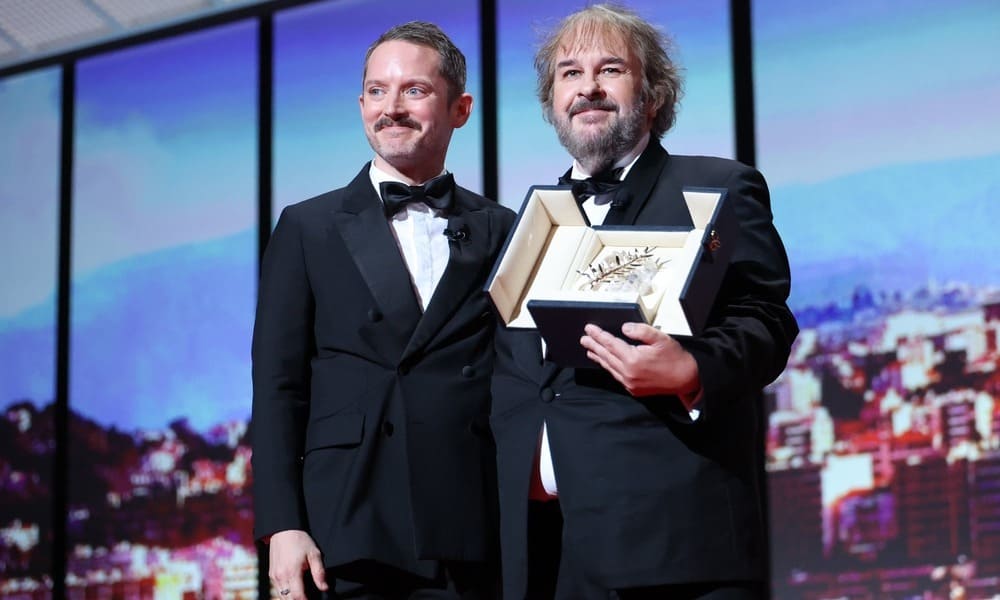
At Cannes, Peter Jackson receives the honorary Palme d’Or from Elijah Wood and defends AI as a tool: but Gollum reopens the problem of the digital actor.
The scene seems written specifically to short-circuit the present moment: Elijah Wood handing Peter Jackson the honorary Palme d’Or. Frodo honoring the director who turned The Lord of the Rings from a production risk into industrial mythology. Cannes applauds, the audience is moved, nostalgia does its work.
But beneath the ceremony there is another, less reassuring story: cinema is celebrating one of its great craftsmen precisely while trying to understand whether human craftsmanship still has a defensible boundary.
Twenty-five years after that Cannes moment that changed the industrial perception of The Lord of the Rings, Jackson recalled that at the time the project seemed like an insanely expensive gamble, before those twenty minutes shown in 2001 completely changed the mood around the film.
Cannes Is Not Just Rewarding the Past
It is staging the doubt around the future: will cinema still be made of bodies, faces, actors and directors, or of authorized replicas, avatars, motion capture and artificial intelligences trained to look like talent?
That is why Peter Jackson’s words on artificial intelligence carry more weight than those of many others: Jackson argues that it should be treated exclusively as a working tool, a special effect, with permissions, contracts and protections for actors’ images.
An almost moderate position, were it not for the most interesting detail: according to Jackson, the very climate of suspicion around AI risks retroactively erasing the authority of one of contemporary cinema’s greatest performances: Andy Serkis as Gollum.
Not because Gollum was artificial, but because today any character generated or transformed digitally is viewed as though it contained a dirty trick.
The Gollum Paradox: 100% Human, Forever Suspect
But Gollum was not an algorithm acting. He was Serkis: body, voice, effort, obsession. A performance passed through technology, not replaced by technology.
And yet today a character like that would have no chance at the Oscars, because Hollywood’s debate around AI has shifted suspicion onto the final result: and Gollum, one of modern fantasy’s most painfully human characters, would now risk being dismissed as an “effect.”
The Hunt for Gollum is an internal, psychological story, tied to addiction and to the character’s fracture. That is why, according to Jackson, the most sensible directorial choice is Andy Serkis himself: the man who knows Gollum better than anyone else, and who can guarantee the character’s acting origin. Jackson will produce, but without invading the field.
The Marché du Film Tells the Less Romantic Side of the Story
Meanwhile, outside the theater, Cannes pretends to hold the line: films using generative AI are not admitted to competition, but AI still dominates the conversation. Demi Moore, a member of the jury, said it plainly: fighting it is a losing battle; the point is to understand how to work with it and how to protect oneself.
And the Marché du Film confirms the perfect double game: on one side, the festival defends the noble idea of cinema; on the other, the market records around 16,000 registered professionals, 140 countries represented, thousands of projects, buyers, conferences, and programs on innovation and virtual production.
The Palme d’Or handed by Elijah Wood to Peter Jackson, then, is not just a career award. It is a perfect snapshot of the industry in 2026: on stage, it celebrates the man who gave a soul to digital monsters; in the panels, it discusses how to defend itself from AI; at the market, it prepares the price list for the synthetic future.
Cinema, as always, will arrive later.