Now Reading: Hollywood trains AI while Seth Rogen preaches at Cannes
-
01
Hollywood trains AI while Seth Rogen preaches at Cannes

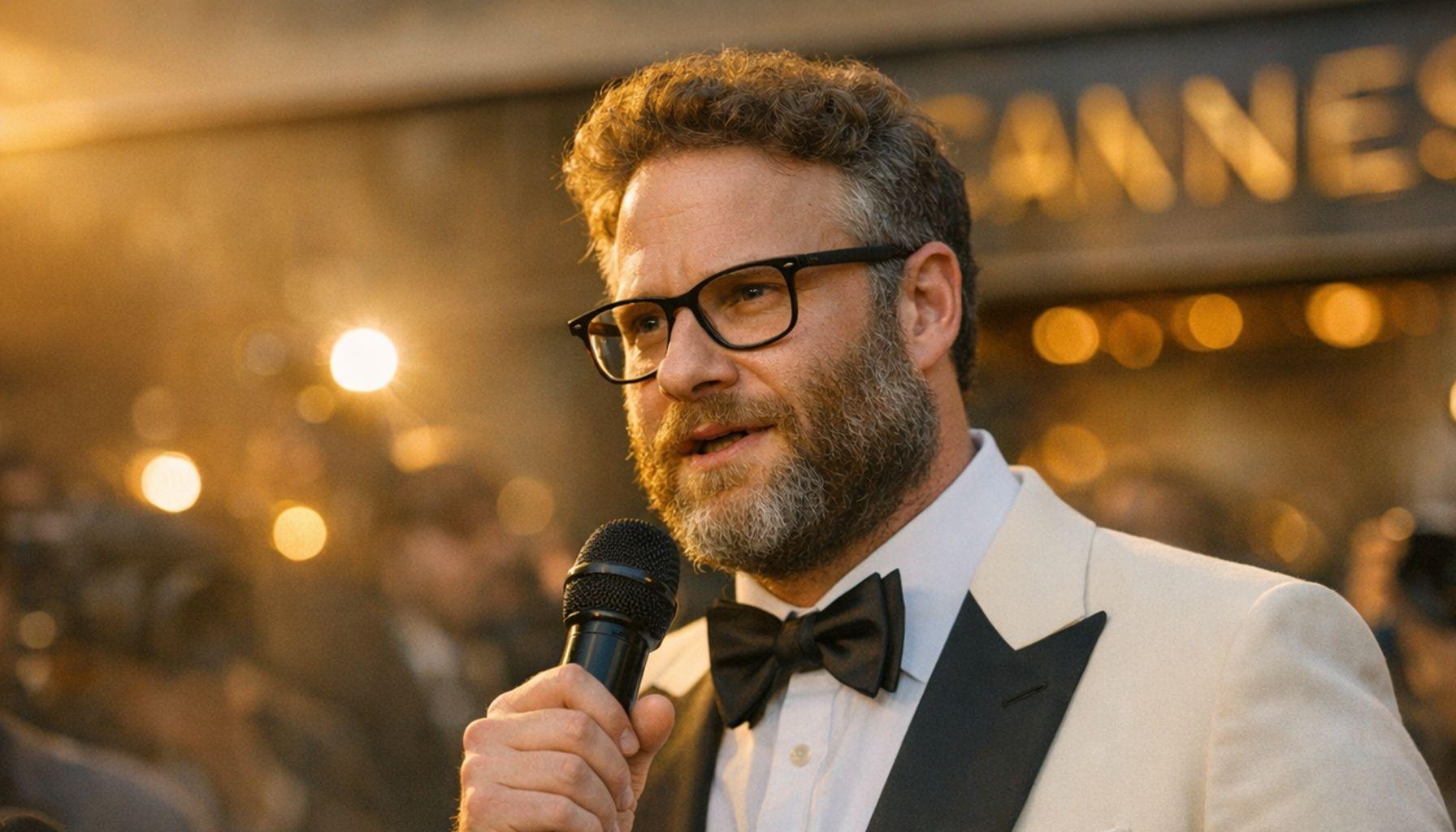
Seth Rogen attacks screenwriters who use AI, while many Hollywood workers are training algorithms just to survive.
While one part of Hollywood, left without work, finds itself training chatbots, video models and generative systems just to pay the rent, Seth Rogen declares at Cannes that “Anyone who uses artificial intelligence to write shouldn’t be a writer. They should do something else.”
Nice line if you have a film at Cannes, a solid career, a recognizable name and the luxury of defending the creative process as a calling. Less nice if you are a screenwriter, a technician, a second-tier author or an audiovisual worker who has ended up in the new underground of data annotation: correcting AI, evaluating it, feeding it, making it more credible, teaching the machine to do better the very job it is already taking away from you.
Seth Rogen against AI: purity as seen by those who can afford it
Rogen is not wrong when he says that writing means going through a process, making mistakes, rewriting, finding a voice. The weak point is turning an industrial issue into a moral one. The actor and writer called the idea of using AI to write absurd, while also defending the handmade nature of Tangles, the animated film presented at Cannes and made without AI, with hand-drawn animation.
True art.
But there are not only lazy screenwriters who want a machine to spit out a scene in three seconds. There are also independent filmmakers who, without these tools, would never be able to shoot, animators who use them to speed up technical phases, editors who integrate them into their workflow, concept artists who treat them as evolved sketches, authors without budgets and true sacred monsters like Alex Proyas and Roger Avary, who can finally visualize a world that was previously impossible.
And then there is the hypocrisy of a system that first reduces creative work by offering expelled creatives a precarious side job training the same tools that promise to replace them, and then, on the red carpet, looks down on them and tells them to change professions. The invisible worker, meanwhile, has often already seen that profession evaporate. And when they enter an AI training platform, they do not do it out of technophile enthusiasm, but because the industry has taken away the set, the writer’s room, the production, the continuity.
Hollywood preaches art while preparing its replacement
The story published by Wired is the dirty side of the same story: film and TV professionals who, after strikes, cuts and slowdowns, end up working for AI annotation platforms. They evaluate conversations, correct outputs, classify videos, test responses, act as human instructors for systems that one day will be sold as “creative.” But the worker training AI is not betraying writing. They are simply surviving its industrial demolition.
Even accepting the convenient fairy tale of pure artists, and leaving aside for a moment what is already happening in India and China, the point remains: Hollywood is already full of studios, platforms and tech companies absorbing expertise from the people who actually know how cinema works, only to repackage that extraction as progress, efficiency, innovation.
Seth Rogen can put on the robe of the sacred-fire keeper if he wants, but it is worth remembering that we are not talking about Darren Aronofsky, just to stay in the neighborhood of Cannes 2026. And it is also worth remembering another keeper: Ben Affleck, who first turned up his nose at AI and then became, with his InterPositive bought by Netflix and his algorithmic Writer’s Room, the perfect summary of the comedy: “The tool that does not replace the artist, but empowers them.”
And, as luck would have it, it empowers them much better when Hollywood is the one buying it.