Now Reading: The Social Reckoning: Facebook Faces the Consequences
-
01
The Social Reckoning: Facebook Faces the Consequences

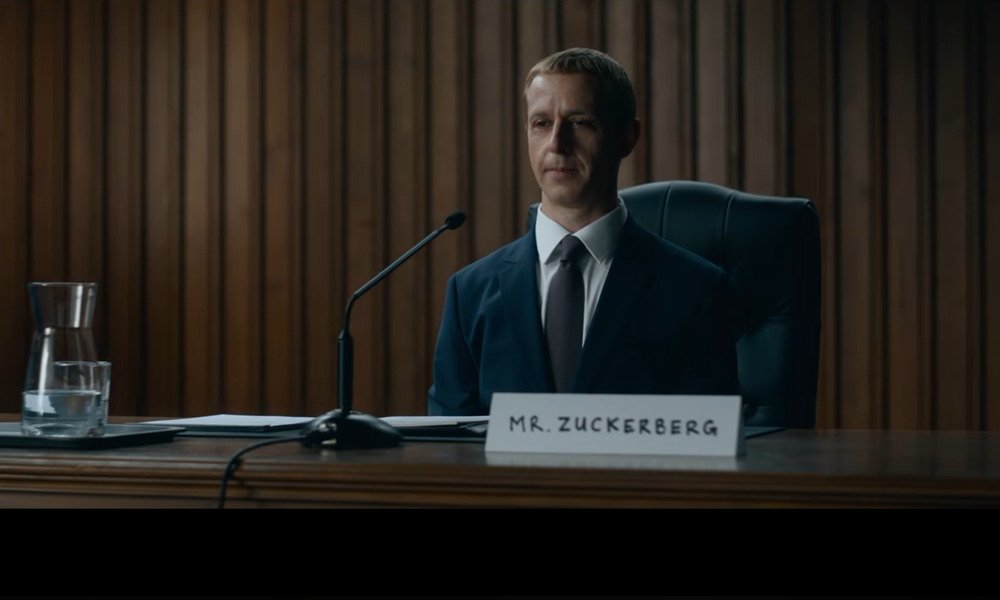
Aaron Sorkin returns to Facebook sixteen years after The Social Network, shifting the drama from the platform’s creation to what the company knew about its effects.
The new trailer for The Social Reckoning brings Aaron Sorkin back inside Facebook sixteen years after The Social Network, but this time the story is not about the birth of a platform: it is about what that platform learned to do to people.
The film will arrive in Italian cinemas on October 8, 2026, under the title The Social: Il prezzo della verità, one day before its U.S. release. At the center are Mikey Madison as whistleblower Frances Haugen, Jeremy Allen White as Wall Street Journal reporter Jeff Horwitz and Jeremy Strong as Mark Zuckerberg.
The new trailer finds its most eloquent image before the investigation even begins: Zuckerberg is instructed on how to nod in front of another person without looking unnatural. In 2010, Aaron Sorkin and David Fincher told the story of a young man incapable of managing a relationship while building the tool that would go on to connect billions of people.
The social network has grown up. Its founder’s emotional education, apparently, still requires technical assistance.
The social network is no longer an idea: it has become the environment
The most important change from The Social Network concerns the scale of the conflict. The first film observed the birth of Facebook through broken friendships, lawsuits and personal ambition; The Social Reckoning instead begins with the events that led to the Facebook Files, the series of Wall Street Journal investigations built on internal documents brought outside the company by Frances Haugen. In the trailer, Horwitz wants an increasingly bigger story, while his source must decide how much she is willing to risk to give it to him: the ferocious comedy about the technological elite thus gives way to something closer to a journalistic and political thriller.
Even the promotional description of the characters contains a small but significant simplification. Sony’s official synopsis presents Haugen as a young Facebook engineer; in her testimony before the U.S. Senate in 2021, however, Haugen explained that she had worked as lead product manager for Civic Misinformation and later in Counter-Espionage. She was therefore not simply an employee who had seen something compromising, but a figure positioned precisely where the functioning of the platform met disinformation, security and political behavior.
The documents she collected included internal research, presentations, discussions and corporate memoranda, and they fueled debate over Instagram’s impact on teenagers, the amplification of divisive content and Facebook’s ability to understand problems that appeared far less clearly defined from the outside. This is where the title Reckoning gains weight: the question is no longer who invented Facebook, but how much Facebook knew about the system it had built.
Fincher leaves the director’s chair, but his shadow remains in the frame
David Fincher is not directing: Sorkin is handling both screenplay and direction, after winning the Oscar precisely for the script of The Social Network. The 2010 film received eight nominations and won three Academy Awards — adapted screenplay, editing and score — while grossing almost $225 million worldwide on a budget of roughly $40 million. The comparison, then, will not be with a simple predecessor, but with one of the films that cinematically defined Silicon Valley before Silicon Valley began to define almost everything else.
One visual bridge, however, remains: Jeff Cronenweth, Fincher’s longtime collaborator and the cinematographer of The Social Network, returns behind the camera. The musical landscape changes radically instead: replacing the electronics of Trent Reznor and Atticus Ross, which won the Oscar in 2011, is Alexandre Desplat.
Jesse Eisenberg did not return, and Sorkin has said that he spent three days trying to persuade him: the actor no longer wanted to be associated with the figure of Facebook’s founder. His replacement by Jeremy Strong came about almost by chance during the 2025 Vanity Fair Oscar Party, where Sorkin first met Eisenberg and then, shortly afterward, Strong; the Succession actor offered himself for the role if it remained open. By the time he arrived on set, according to Sorkin, he had already absorbed Zuckerberg’s voice and cadence.
Meanwhile, Meta has learned to interpret billions of human beings
In 2010 Facebook asked users to tell the platform who they were; today Meta tries to infer what they want before they even say it. Since December 2025, even conversations with Meta AI have become signals used to personalize content and advertising; since June 2026, the company has announced that it will also use information received from outside activity — for example, games played or purchases made on other websites — not only for advertising, but also to decide what to show in the Feed and how the AI responds.
As long as the problem was a product decision, a commercial priority, an algorithm designed to reward certain interactions, or an executive called on to explain why a particular feature had been introduced, human error was already a simplification, but it still allowed a chain of intentions to remain visible. Today the umbrella of AI risks making that chain much harder to follow.
Inside the black box of an AI model, it will be far more difficult to distinguish an emergent consequence from a deliberately pursued choice, and that opacity itself may become the new gray area of responsibility. In the meantime, the system will have learned to “do better.” And to nod in Zuckerberg’s place.