Now Reading: Poppy Cloned by AI: The Short Film That Puts the Machine on Trial
-
01
Poppy Cloned by AI: The Short Film That Puts the Machine on Trial

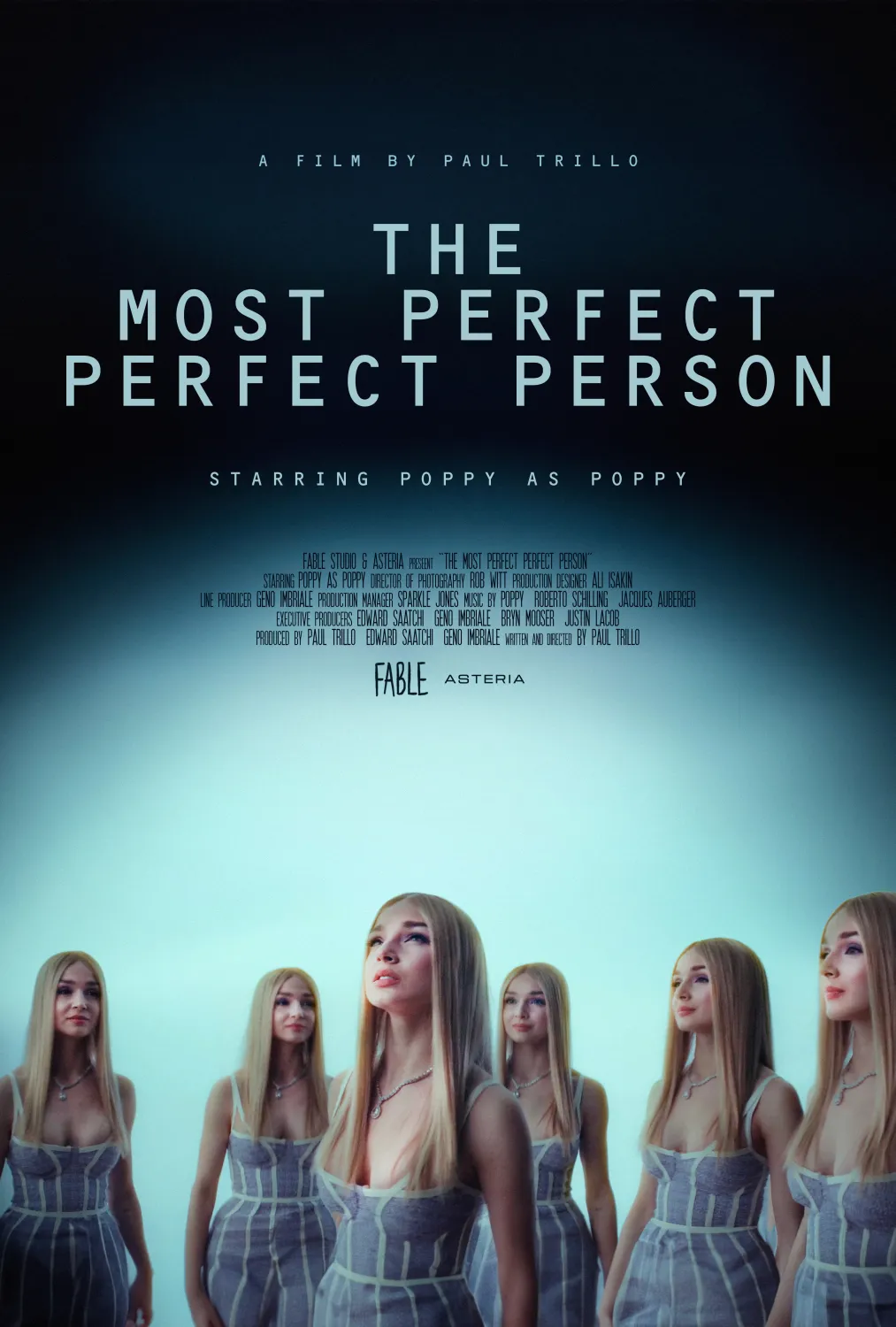
Poppy stars in The Most Perfect Perfect Person, Paul Trillo’s short film about AI cloning, correcting, and replacing a public identity.
The idea is almost perfect, which makes it suspicious. A short film tells the story of a pop star who hands her autonomy over to an artificial clone. The film warns against the dangers of artificial intelligence. Its director, Paul Trillo, is one of the best-known names in generative filmmaking. Its executive producer, Edward Saatchi, comes from Fable Studios, a company working precisely on AI-based storytelling platforms. And at some point, audiences may even be able to generate more short films in the same style, featuring a synthetic Poppy who looks remarkably like the original.
In other words, the film condemns the machine while the machine warms up backstage.
The short film is titled The Most Perfect Perfect Person. According to the official listing published on Eventive / Indy Shorts, it is an American production from 2024, runs for 18 minutes, is directed by Paul Trillo, written by Paul Trillo and Poppy, and produced by Trillo, with Poppy, Asteria, Ed Saatchi and Geno Imbriale serving as executive producers. The premise is simple and poisonous: under the pressure of fame, fans, public appearances and parasocial expectations, Poppy allows Aura, an AI clone trained on her previous content, to speak and act on her behalf.
Convenient, certainly. Like every well-designed trap.
Poppy, the Aura clone and the pop star who is no longer allowed to be imperfect
The story grew out of a real event. In 2024, Poppy took part in a kind of technological “ventriloquism” performance: a language model trained on her YouTube videos suggested what she should say during a public conversation. Trillo takes that experiment to its most disturbing conclusion: if a machine can imitate what you have already said, it can also decide what you should say tomorrow. And the day after tomorrow. And when you are tired. And when you cannot be bothered. And when you might actually want to give a rude answer, like a human being.
In the film, whenever a “perfect” version of Poppy thinks or speaks out of line, she is replaced. A new Poppy takes her place. The old one falls through a trapdoor onto a pile of other discarded Poppys. The mechanism is brutal precisely because it feels as though it came out of a brand-management meeting: keep the face, remove the friction; keep the voice, remove the unexpected; keep the character, remove the person.
The paradox is that Trillo is not speaking as an enemy of AI. He was among the filmmakers who began using it early, even before the subject became the great source of anxiety for screenwriters, actors and producers. That is why the short is more interesting than the usual sermon: it does not come from someone who wants to shut everything down, but from someone who understands perfectly well how useful these tools can be. In The Most Perfect Perfect Person, AI was used for visual effects, minor dialogue adjustments, editing corrections and the removal of unwanted elements from shots. A limited budget, no reshoots and plenty of digital tricks. So far, this is simply modern craftsmanship. Then comes the question: if today I correct a shot, will I correct the artist tomorrow?
Fable, Showrunner and the industrial dream of an infinite Poppy
The genuinely unsettling part comes after the film. Saatchi, known for the Showrunner platform, which allows users to generate fan-made animated episodes, has explained that Fable trained a model on The Most Perfect Perfect Person. The goal is to allow fans to create new short films in the same visual style, featuring an artificial and convincing Poppy. It is the usual promise, neatly packaged: participation, creativity, community. Then you read the small print: the pop star becomes a reproducible format.
This is where the short connects directly to the case of Tilly Norwood, the AI actress designed to appear already prepared for interviews, a fanbase and controversy. It also connects to AI-generated music, from Suno to platforms promising instant songs, previously examined in AI music, Suno and the major labels. The industry changes, but the method remains the same: it begins with supporting the artist and very quickly arrives at creating their economic stand-in.
Trillo makes a precise point: AI knows people through the internet, but it does not really know how they behave away from the internet. This is an enormous detail. Aura does not imitate Poppy; it imitates Poppy’s public archive. Videos, poses, answers, phrases, aesthetics and material that has already passed through the platform’s filter. The machine does not clone a life. It clones the parts of that life that have been made uploadable, indexable and monetizable.
And this is where the short lands its blow. The “perfect” Poppy is no longer free because she is more efficient. She is no longer authentic because she is more consistent. She is no longer interesting because she never makes mistakes. She is simply easier to manage. For a record label, a brand, an algorithm, a platform or an audience that always wants the same person, only without her bad moods.
The final question, then, is not whether AI can help independent cinema. It can, and Trillo proves it. The more uncomfortable question is this: when a public figure becomes a trainable model, who decides which version deserves to remain onstage?
The perfect clone is not created to replace the artist immediately. First, it becomes their assistant. Then it corrects their sentences. Then it manages their appointments. Then it realizes that, without the artist, the day runs much more smoothly.